Fewer people have stood on the floor of the Mariana Trench than have walked on the Moon. Meanwhile creatures go down there every day, because they live there.
Take Everest — all 8,849 metres from base to summit. Drop it into the Mariana Trench. There would still be two kilometres of water above the peak.
The deepest point on the planet is called the Challenger Deep, and it lies in the Pacific about 300 kilometres southwest of Guam. The latest measurements put it at roughly 10,935 metres — a figure that shifts slightly from expedition to expedition, because measuring it to within a couple of metres is still technically hard.
The trench itself is not a pit but a scar: a narrow arc 2,550 kilometres long and about 70 wide. You cannot see it from the air or find it on a globe. Yet it is the most striking feature of Earth’s relief after the mountains.
Where it came from
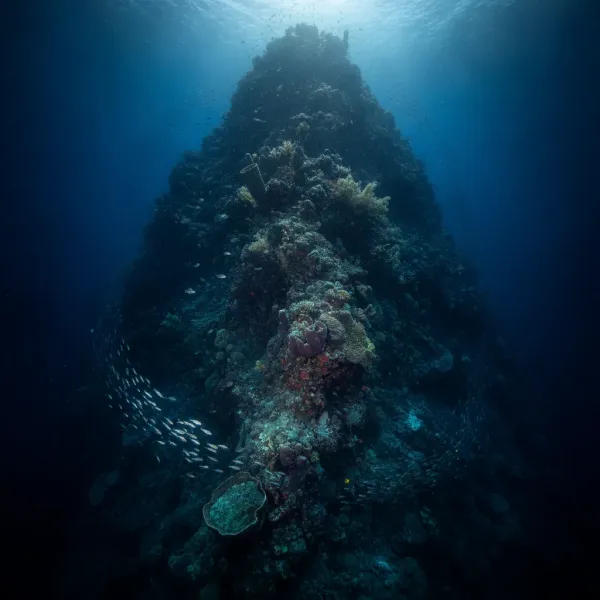
The Mariana Trench is a place where one plate of the Earth’s crust slides beneath another.
The Pacific Plate, the largest on the planet, moves west and dives under the Philippine Plate. Where it goes down, the crust bends — and a trench forms. The process runs at a few centimetres a year, about the speed fingernails grow, and it has been going on for 180 million years.
A side effect of the same process is the Mariana Islands: melt rising above the descending plate builds a volcanic arc. The deepest point on the planet and a chain of tropical islands are two faces of one geological mechanism.
A thousand atmospheres
At the bottom of the Challenger Deep the pressure is about 1,086 bar. That is 1,100 times atmospheric.
Turning that into a picture is difficult, but try. Every square centimetre carries more than a tonne. A palm-sized area carries roughly the weight of a car. A whole human body carries the equivalent of several dozen trucks, distributed evenly across the skin.
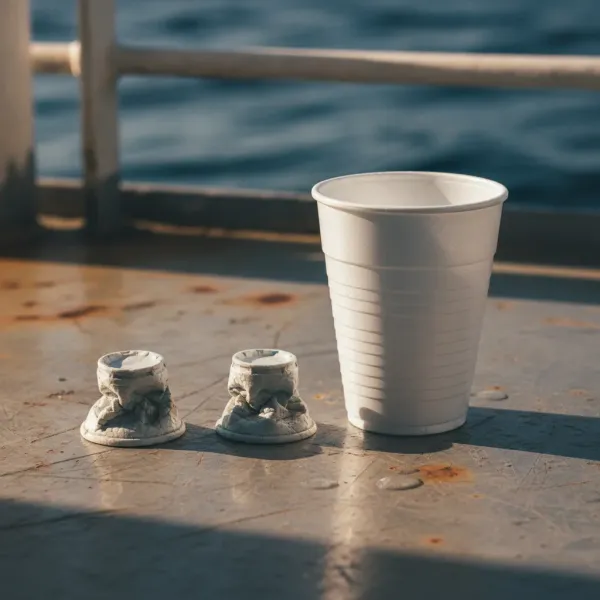
A polystyrene cup tied to the outside of a submersible comes back the size of a thimble: the air is squeezed entirely out of its pores. Those cups are a traditional souvenir of deep-sea expeditions.
Water itself barely compresses — at the bottom of the trench it is only about 4.5% denser than at the surface. Which is exactly why pressure rises linearly and predictably: one atmosphere per ten metres, with no exceptions and no surprises.
The temperature down there is 1 to 4 degrees above zero. Not freezing, not warming.
Who has been there
Fewer than three dozen people have reached the floor of the Mariana Trench. Twelve have walked on the Moon — but the Moon is closer to popular culture than to statistics: the trench floor remains a rarer address than most places on Earth.
1960. The bathyscaphe Trieste, with Jacques Piccard and Don Walsh. The descent took 4 hours 48 minutes; they spent 20 minutes on the bottom. Visibility was almost nil: the craft raised a cloud of silt, and a viewport had cracked at nine kilometres. But they came back with the main result: there is life down there. Piccard reported seeing a flatfish — a claim still disputed — though the fact of habitability was confirmed later.
2012. James Cameron, the film director, descended alone in the Deepsea Challenger. Three hours down, nearly three hours on the bottom, filming in 3D. He described what he saw as “lunar, desolate, completely isolated.”
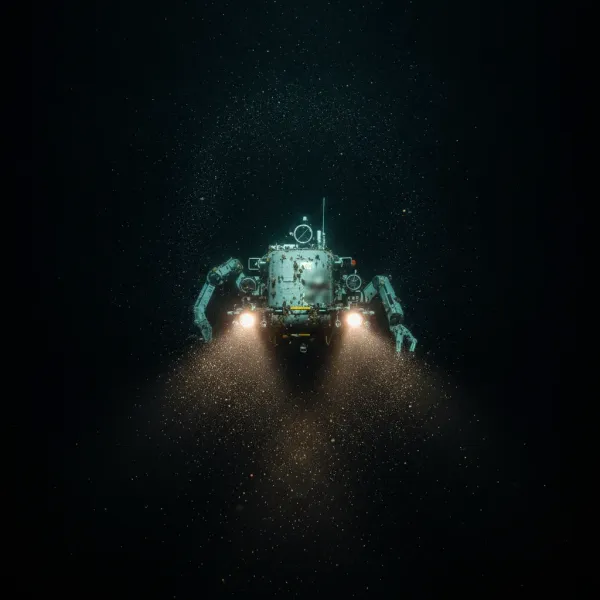
2019. Victor Vescovo made a series of dives in the Limiting Factor — for the first time in history the trench floor could be reached on a schedule rather than as a one-off expedition. The craft proved reusable, which at these depths was fundamentally new. On one of those dives Vescovo found a plastic bag on the bottom.
Who lives there
The great surprise of deep-sea expeditions is that the bottom is not empty.
Xenophyophores — single-celled organisms up to 10 centimetres across. One cell the size of a fist. They build shells around themselves out of sediment and house small crustaceans — miniature coral reefs, in effect, ten kilometres down.
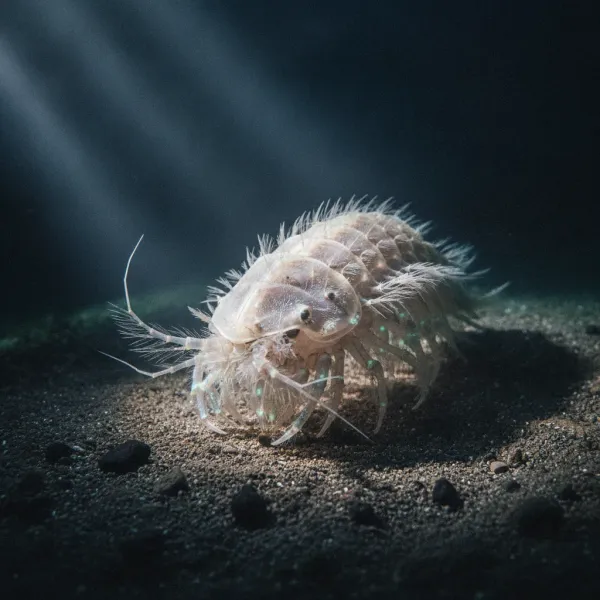
Amphipods — crustaceans that at these depths grow to 30 centimetres instead of the usual few millimetres. The phenomenon is called deep-sea gigantism, and there is still no convincing explanation for it. One species found in the trench can digest wood, and by the composition of its tissue, cellulose from sunken tree trunks that drift down from the islands.
Sea cucumbers, polychaetes and anemones turn up on every surveyed stretch of the trench.
The whole ecosystem lives on “marine snow” — the endless drift of organic particles falling from above. Plus the occasional windfall: a whale carcass or a tree trunk, around which a small civilisation grows for years.
The line below which there are no fish
The most beautiful fact about depth concerns where fish stop.
Below roughly 8,200 metres, none are found. Not because there is no food or because it is too cold — but because of chemistry.
To keep proteins from breaking down under pressure, deep-sea fish accumulate a compound called TMAO, trimethylamine N-oxide. The deeper a fish lives, the more TMAO its tissues hold. But the mechanism has a ceiling: at around 8,200 metres the concentration needed to protect proteins becomes so high that the cell can no longer maintain its salt balance. Beyond that the solution simply stops working.
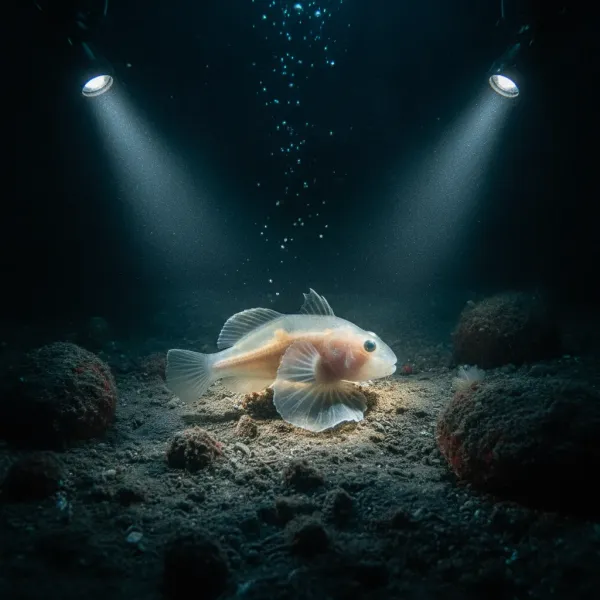
The record belongs to a snailfish of the genus Pseudoliparis, filmed at 8,336 metres. Semi-transparent, scaleless, palm-sized, with a body the consistency of jelly. It looks fragile — and it lives under 800 atmospheres.
Below that line the ocean belongs to invertebrates.
Oddities on the slopes
The Mariana Trench is also a collection of geological anomalies, each of which exists in a single copy.
The Champagne vent. The only known place in the ocean where liquid carbon dioxide seeps from the seafloor. Bubbles rise as they do in a glass — hence the name.
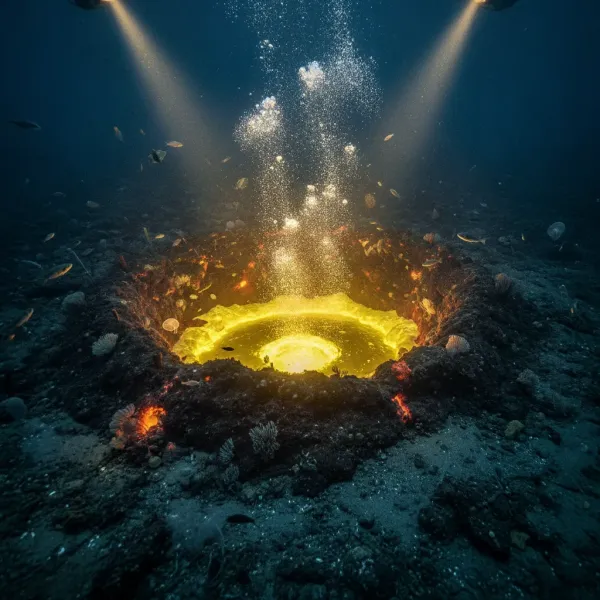
Daikoku volcano. At 414 metres, its crater holds a lake of molten sulphur. The only other one known is on Io, a moon of Jupiter.
Serpentinite mud volcanoes. They carry material from the Earth’s mantle up to the seafloor and produce water with a pH above 12 — alkaline enough to compare with drain cleaner. Even there, microbial life is found.
Why any of this matters
The Mariana Trench is not somewhere you can travel. Only a handful will ever see its floor, and almost certainly on a science programme.
But it sets the scale that makes ordinary diving comprehensible.
The scuba depth record is 332 metres, and it took four years of preparation. Saturation divers work at 300–400 metres for weeks, living under pressure in a chamber. Recreational diving is 12 to 30 metres — and that is where everything people actually go underwater for is concentrated: light, colour, coral, fish, turtles, mantas.
The ocean is eleven kilometres deep. Humans need the first thirty metres.
For how far down a person can actually go, see How Deep Can a Human Dive. For the people who live under pressure for weeks, Saturation Divers. And for how the physics works at ordinary, reachable depths, The Physics of Diving.