332 metres. 14 minutes down. 13 hours 50 minutes up. 92 tanks of gas. One man.
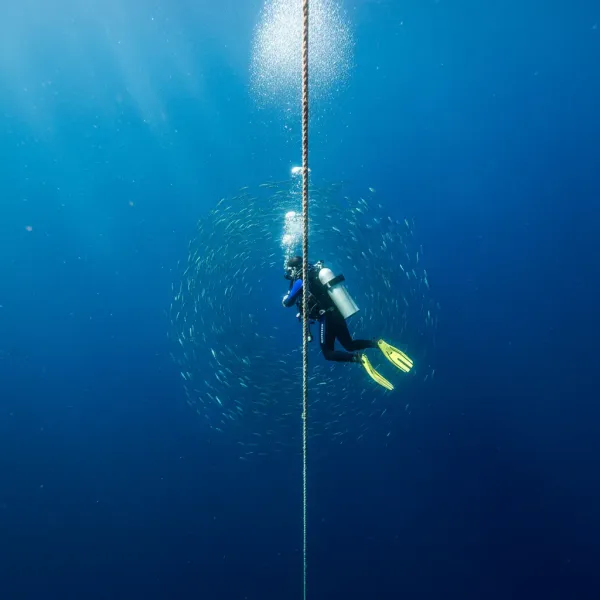
On 18 September 2014, Egyptian military diver Ahmed Gabr stepped off a boat into the Red Sea near the town of Dahab. At 10:30 in the morning he began his descent. He touched the surface again only at 20:20 — nearly 14 hours later.
In 12 minutes, Gabr reached a depth of 332.35 metres. At that depth the pressure is 34 atmospheres. Every breath consumes 34 times more gas than at the surface. A standard 12-litre tank — enough for an hour in shallow water — would have run out in two minutes.
The remaining almost 15 hours, Gabr was ascending. Not because he was swimming slowly — because he could not go faster. At such depths, gases dissolve into the blood and tissues under immense pressure. Ascend too quickly and the dissolved gas boils right inside the blood vessels, like fizzy water when you open the bottle.
This is the world record for scuba diving depth. It still stands today.
What Happens to the Body at Depth
Every 10 metres underwater, pressure increases by 1 atmosphere. At the surface — 1 atmosphere. At 10 metres — 2. At 40 metres — 5. At 332 metres — 34.2 atmospheres.
Pressure is behind the central paradox of diving: a tank of air does not get lighter with depth — you simply burn through it faster. At the surface, an average diver breathes 15–20 litres of air per minute. At 10 metres — already 30–40: the pressure doubles, and the regulator delivers twice as much gas per breath. At 30 metres — 60–80 litres. A standard tank holds 12 litres at 200 bar, totalling 2,400 litres of air. At the surface that lasts two hours. At 30 metres — 30 minutes. At 100 metres — just a few minutes.
But air consumption is not the worst of it. What gases do under pressure — that is the real danger.
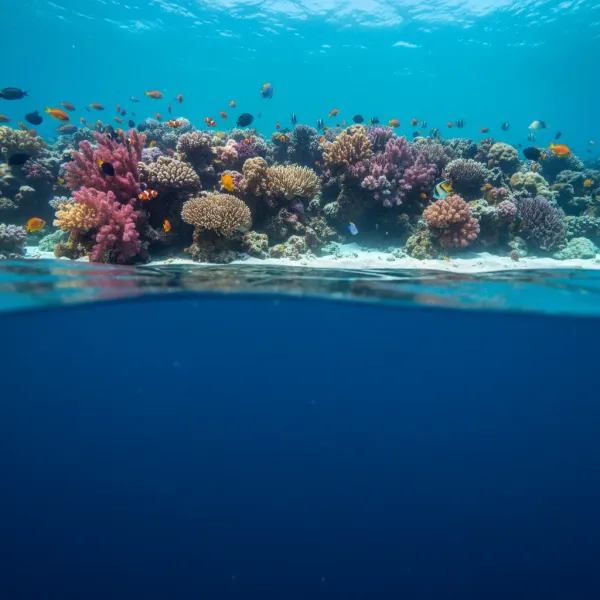
18 metres — the beginner’s limit. This is the maximum depth for the PADI Open Water certification. Everything is still safe here: ordinary air, ordinary sensations. Most divers spend their entire lives diving in this range — and it is more than enough.
30 metres — nitrogen narcosis. At this depth, the nitrogen in air begins to act like a narcotic. First comes euphoria, a sense of lightness, inexplicable joy. Divers call it the “martini effect”: every 10 metres below 20 is like a glass of martini on an empty stomach. At 30 metres you are already mildly intoxicated. At 40 — you make decisions you would never make at the surface. At 50 — you might remove your mask because it seems like you can breathe water.
This is the maximum depth for the PADI Advanced Open Water certification — 30 metres.
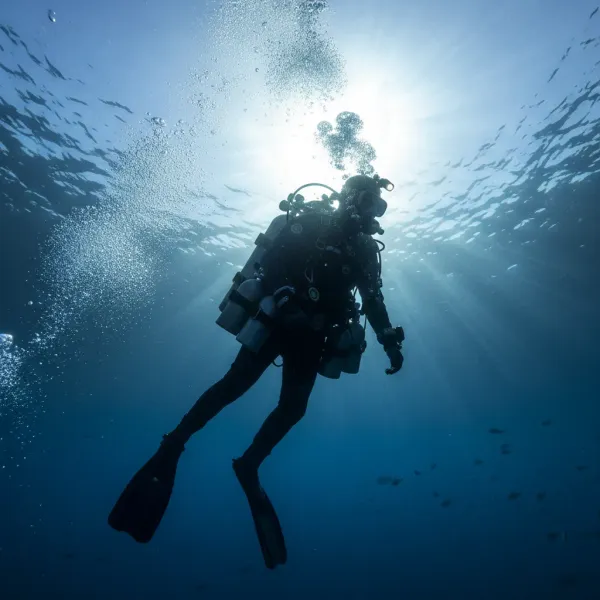
40 metres — the limit of recreational diving. Below this is the territory of technical divers. Breathing ordinary air is no longer an option. Instead, divers use trimix — a blend of oxygen, nitrogen, and helium. Helium does not cause narcosis, but it has a side effect: your voice becomes high-pitched and squeaky, like a cartoon character.
60 metres — oxygen toxicity. At this depth, the partial pressure of oxygen in ordinary air becomes toxic. Seizures, loss of consciousness. This is precisely why deep divers breathe mixes with a reduced oxygen content — a paradox that is hard to accept: the deeper you go, the less oxygen in the mix.
100 metres — the territory of very few. There is no margin for error here. Decompression takes hours. Every litre of gas counts. Losing consciousness means not coming back. The people who dive at this depth have dedicated decades to diving.
200+ metres — the zone of records. Ahmed Gabr had originally planned to reach 350 metres. Four years of preparation. A team of 30 — hyperbaric physicians, gas technicians, safety divers. French and Egyptian specialists developed custom decompression tables — the kind that do not appear in any textbook, because no one willingly dives to textbook depths.
More than 60 tanks containing gas mixes of varying composition were staged along the route — a different mix for each depth. On the descent — trimix with a high helium content. On the ascent — a gradual transition to nitrox and pure oxygen. Every stop had its own blend. Grabbing the wrong tank was simply not an option.
At 290 metres Gabr felt discomfort and stopped his descent at 332. That decision, made under the crushing narcosis of 34 atmospheres of pressure, saved his life.
Four years of preparation. 12 minutes down. 15 hours up.
What About Without a Tank?
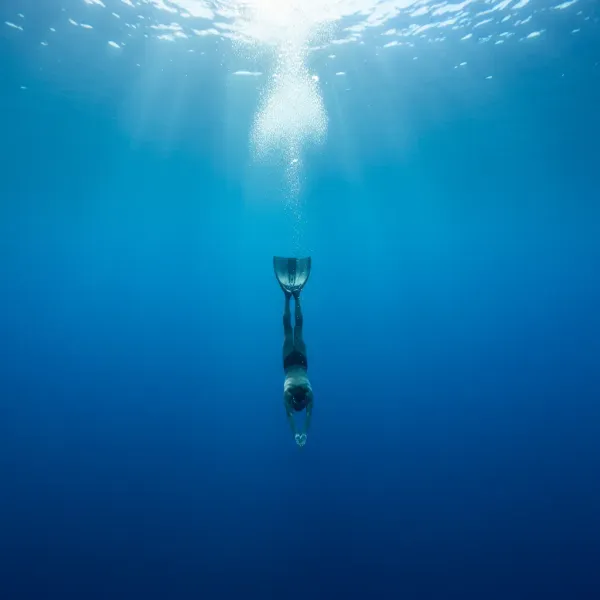
Freediving — descending on a single breath — is a world of its own. There are no tanks, no gas mixes. Just a person, one breath, and water.
It might seem impossible to go far without air. But the body is capable of things the conscious mind knows nothing about. When you hold your breath, the diving reflex kicks in: the heart rate drops, the spleen releases reserve red blood cells into the bloodstream, the lungs compress to the size of a fist. The body switches into a mode that is millions of years old.
Austrian Herbert Nitsch reached 214 metres on a single breath in 2007 (No Limits discipline — weighted descent, balloon ascent).
Alexey Molchanov of Russia holds 131 metres in the Constant Weight discipline (no assistance on ascent). He dives with a monofin, descending and ascending entirely under his own power. 131 metres is the height of a 40-storey building. Down and back — on one breath, in 3.5 minutes.
Alenka Artnik of Slovenia holds 122 metres — the outright women’s record. She began diving to overcome depression. Today she dives deeper than any male freediver except Molchanov.
The Depth Where Most People Dive
Everything described above represents extremes. Recreational diving is 12–30 metres. Coral, fish, turtles, rays. Warm water, good visibility, safe dives of 45–60 minutes.
At 20 metres in the Red Sea, visibility can reach 40 metres. At 15 metres off Sipadan, schools of barracuda swirl around you while hammerhead sharks cruise along the wall below the shelf. At 5 metres in the Maldives, a manta ray with a 4-metre wingspan glides past.
None of that requires Ahmed Gabr’s record. All it takes is a certification, a mask, and the desire to see the world you cannot reach from the surface.
Never dived before? Read about what it’s like to dive for the first time. And for the story of people who work at 300 metres for a month at a time, see the article «Saturation Divers».
Want to see 20 metres for yourself? Dive training in Moscow — a trial dive for 5,000 ₽, the PADI Open Water Diver course from 4,500 ₽. First open-water dives happen on the club’s journeys: Egypt, the Maldives, Mauritius.