At the surface, your tank holds 2,400 litres of air. At 30 metres, it will last 30 minutes. At 60 — 15 minutes. Physics doesn’t negotiate.
A diver’s tank contains ordinary air. Not oxygen, not a special mix (for recreational diving). The same air as outside: 21% oxygen, 78% nitrogen, 1% other gases. Just compressed to 200 atmospheres and passed through filters — cleaned of moisture, oils, and particles.
A standard tank holds 12 litres. At 200 bar, it stores 12 × 200 = 2,400 litres of air. That’s a lot. At the surface, an average person can breathe comfortably for about 2 hours.
But we don’t dive at the surface.
Boyle’s Law: Why Your Air Runs Out Faster
Robert Boyle stated this in 1662: at constant temperature, the volume of a gas is inversely proportional to pressure. Simply put: double the pressure — half the volume.
At the surface — 1 atmosphere. Your lungs hold roughly 6 litres of air.
At 10 metres — 2 atmospheres. Pressure has doubled. To fill the same 6 litres of lungs, the regulator delivers 12 litres from the tank (at surface pressure). Air consumption — ×2.
At 20 metres — 3 atmospheres. Consumption — ×3.
At 30 metres — 4 atmospheres. Consumption — ×4.
That’s why the same tank that lasts an hour near the surface runs out in 30 minutes at 30 metres, and in 20–25 minutes at 40 metres. Physics doesn’t negotiate.

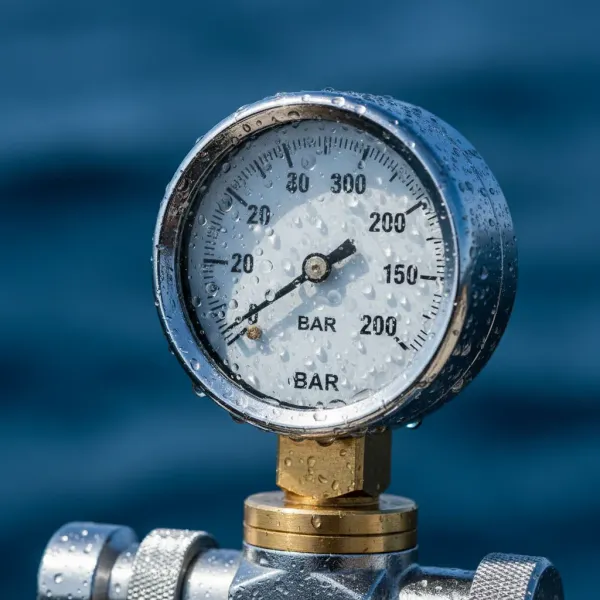
What this means in practice: if your gauge reads 150 bar at the surface and 150 bar at 30 metres — it’s the same number, but a very different amount of air in minutes. At 30 metres, 150 bar will run out four times faster. That’s why divers check the gauge every few minutes — and why an experienced instructor always knows when it’s time to head up.
Dalton’s Law: When Air Becomes Poison
John Dalton, 1801: the total pressure of a gas mixture equals the sum of the partial pressures of each individual gas.
Partial pressure is the pressure each gas would exert if it occupied the entire volume on its own. In air at the surface: oxygen — 0.21 bar, nitrogen — 0.78 bar.
As depth increases, pressure rises — and the partial pressure of each gas rises with it. The composition of air doesn’t change, but its effect on the body changes radically.
Nitrogen: The Martini Effect
At the surface, nitrogen is inert — we don’t notice it. But at elevated partial pressure it begins to act as an anaesthetic.
- 30 metres (ppN₂ = 3.12 bar): mild euphoria, slowed reactions. Like a glass of wine. Most divers feel it but remain in control.
- 40 metres (ppN₂ = 3.9 bar): noticeable intoxication. Decision-making becomes illogical. A diver can fixate on a single thought and lose awareness of everything else.
- 50–60 metres (ppN₂ = 4.7–5.5 bar): severe narcosis. Hallucinations. Some divers have tried to remove their mask, convinced they could breathe water.
- 70+ metres: loss of consciousness.
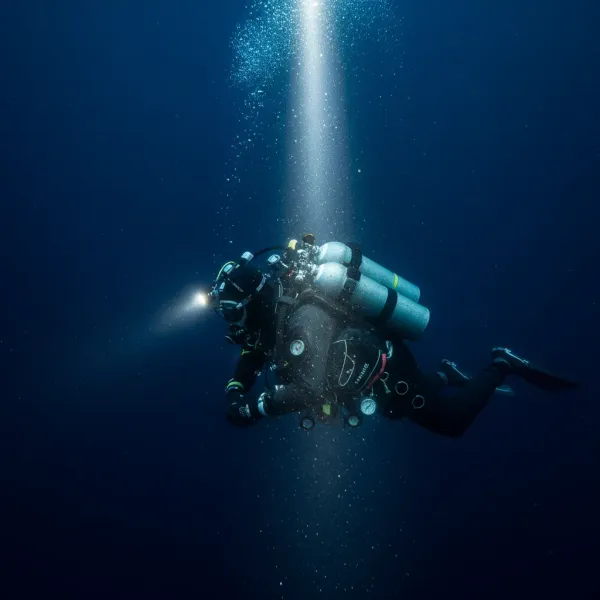
Divers call this the “martini effect”: every 10 metres below 20 is like a martini on an empty stomach. A rough formula, but it sticks. The key rule: narcosis clears instantly on ascending to shallower depth. Come up 10 metres — and your head is clear. If you managed to come up.
Oxygen: Too Much Is Dangerous
The oxygen we cannot live without becomes toxic at elevated pressure. This is known as the Paul Bert effect — named after the French physiologist who described it in 1878.
The critical threshold is a partial pressure of oxygen of 1.6 bar. In ordinary air (21% O₂), this occurs at a depth of around 66 metres.
Symptoms include facial muscle twitching, ringing in the ears, tunnel vision — and then convulsions. The situation is an emergency, but a preventable one: technical divers know the exact partial pressure limits for every gas mix they use.
This is precisely why technical divers below 40 metres breathe not air, but trimix — a blend in which some of the nitrogen is replaced with helium and the oxygen fraction is reduced. At 100 metres, a mix may contain as little as 10% oxygen. A paradox: the deeper you go, the less oxygen in your tank.
Henry’s Law: Why You Can’t Ascend Quickly
William Henry, 1803: the amount of gas dissolved in a liquid is proportional to the partial pressure of that gas above the liquid.
Your blood is a liquid. The nitrogen in your breathing gas is a gas. At depth, pressure is high — nitrogen dissolves into your blood and tissues. The deeper and the longer you stay, the more nitrogen accumulates in your body.
During a slow ascent, nitrogen escapes gradually — through the lungs, with each exhale. But if you ascend too quickly, pressure drops sharply — and the dissolved nitrogen boils right inside your blood. Gas bubbles block vessels, press on nerves, and damage tissue.
This is decompression sickness — “the bends”. Joint pain, numbness, and in severe cases paralysis. It is treated in a recompression chamber, but far better prevented.
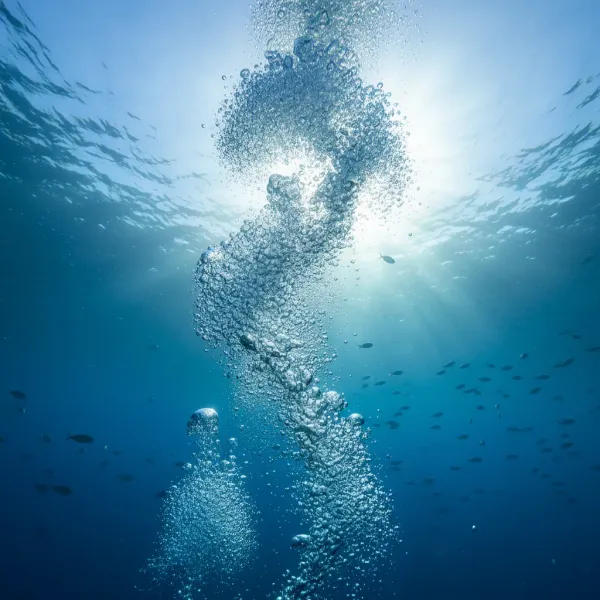
The recreational diving rule: ascent rate — no faster than 9–18 metres per minute (depending on the agency). Plus a safety stop at 5 metres for 3 minutes. This is enough to allow nitrogen to off-gas safely — provided you haven’t exceeded your no-decompression limit (the time you can spend at a given depth without mandatory decompression stops).
Summary: Quick Reference
| Depth | Pressure | Air consumption | What the diver feels |
|---|---|---|---|
| 0 m | 1 bar | ×1 | Normal |
| 10 m | 2 bar | ×2 | Need to equalise ears; otherwise fine |
| 18 m | 2.8 bar | ×2.8 | PADI Open Water limit. Comfortable |
| 30 m | 4 bar | ×4 | Mild narcosis. Advanced OW limit |
| 40 m | 5 bar | ×5 | Recreational diving limit |
| 60 m | 7 bar | ×7 | Oxygen in air is toxic. Trimix only |
| 100 m | 11 bar | ×11 | Territory of the very few |
Physics doesn’t forbid diving. It explains why some things work and others don’t. A diver who understands Boyle, Dalton, and Henry doesn’t just dive more safely. They understand what is happening to their body — and that removes the fear.
And fear is the main thing that stops you taking that first breath underwater.