28 days in a steel capsule. 9 atmospheres of pressure. A voice like a cartoon character. And a paycheck that almost makes it worth it.
At the bottom of the North Sea, at depths of 200–300 metres, sit oil pipelines, drilling structures, and underwater infrastructure worth billions. When something breaks — and things break constantly, because the sea corrodes, crushes, and destroys — someone has to go down there. A robot won’t cut it: the work is too delicate, the conditions too unpredictable.
These people are called saturation divers. Or just sat divers for short. There are around 300 of them in the entire world. And the way they live and work is like nothing else.
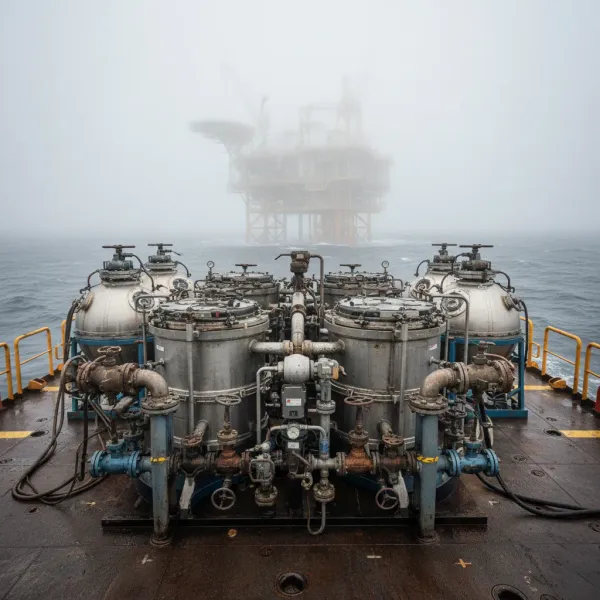
How it works
The problem with deep diving is decompression. At 100 metres, the pressure is 11 times higher than at the surface. The gases in the breathing mixture dissolve into the blood and tissues. Ascend too quickly and those gases bubble out. That’s decompression sickness: joint pain, paralysis, death.
A regular diver after an hour at 50 metres spends hours making decompression stops. The saturation diver found a workaround: he doesn’t come up at all.
The idea is brilliantly simple. After a certain amount of time at depth, the body’s tissues become fully saturated with gas — saturation is reached. After that, whether it’s a day, a week, or a month, the decompression time doesn’t increase. It depends only on depth, not on duration.
Which means you dive once — and work for 28 days straight.
28 days under pressure
Sat divers live aboard a dedicated support vessel — but not on deck. Their quarters are steel cylinders maintained at a pressure equal to that of their working depth. If the depth is 200 metres, the pressure inside is 21 atmospheres.
Inside: bunk beds, a shower, a microwave, a TV, sometimes a games console. Food and supplies are passed through an airlock — a small steel chamber you can push a food container through but not fit your head through. Communication with the outside world goes through an intercom only. Calling your wife — through the intercom. Asking for seconds — through the intercom. Saying you feel unwell — through the intercom. Four walls, three people, and an intercom.
And here is where it gets strange: they don’t breathe air — they breathe a helium-oxygen mixture called heliox. At ordinary air pressures that high, nitrogen would turn them into vegetables within minutes (nitrogen narcosis). Helium doesn’t do that — but it does something else. The voice goes thin and squeaky, like someone who’s just inhaled from a birthday balloon. Except this isn’t for five seconds. It’s for four weeks. For twenty-eight days you talk like a chipmunk. After a while you stop noticing — but listening back to recordings of conversations with the surface is impossible without laughing.
The temperature inside the chamber is around 30°C. Helium conducts heat six times faster than air, and the body loses warmth instantly — so the chamber has to feel like a sauna, otherwise the divers freeze even under blankets. Humidity is nearly 100%. Condensation on the walls. The smell is a mixture of rubber, sweat, and reheated food from the containers. Space: 2 square metres per person. Less than a prison cell. Except in prison the pressure is normal.
The working shift
A crew is usually 12 people — three teams of three on 8-hour rotations covering the full day. Days in saturation blur into an endless cycle: work, eat, sleep, work. No sunrise, no sunset. No “Friday.” There is only pressure, the schedule, and the intercom.
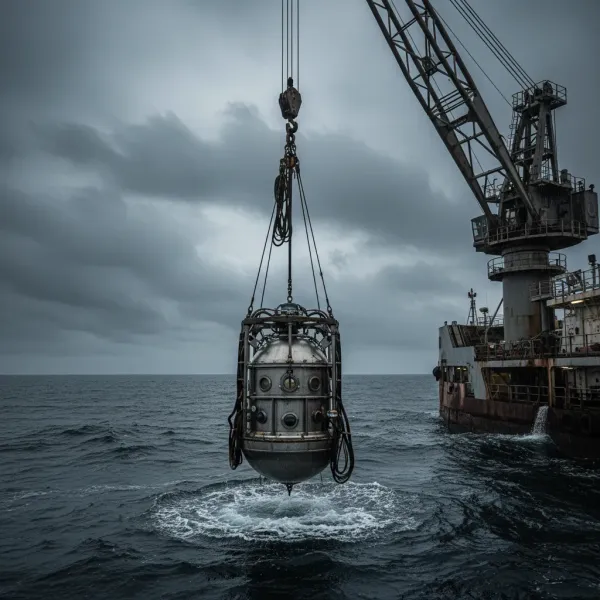
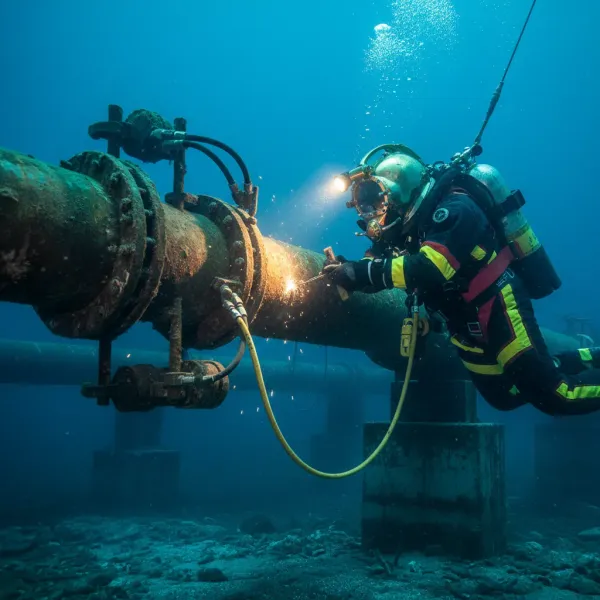
A working shift looks like this: from the living chamber, the divers move into the diving bell — a steel capsule about the size of a phone booth. The bell is crane-lowered to the bottom. The descent to 90 metres takes ninety seconds, a metre per second. Two divers exit into the water; one stays in the bell on communications and standby. Six hours of work on the seabed — welding, cutting, assembling underwater structures — in absolute darkness, current, and cold. Water temperature in the North Sea: between -2°C and +6°C.
At depth they wear hot-water suits: a hose from the bell pumps heated water inside the suit, flowing over the body from neck to feet. While the hose is working — warm. If the hose tears or the pump fails, body temperature starts dropping immediately. In water at +2°C, hypothermia shuts down muscles within minutes. First the hands stop responding. Then the legs. That’s exactly why a teammate is always standing by in the bell — and exactly why the hot-water supply is classified as a critical life-support system, not a comfort feature.
Safety
Saturation diving is one of the most regulated professions in the world. After the Byford Dolphin incident in 1983, when a human error caused a chamber system to decompress instantaneously, the industry overhauled every protocol.
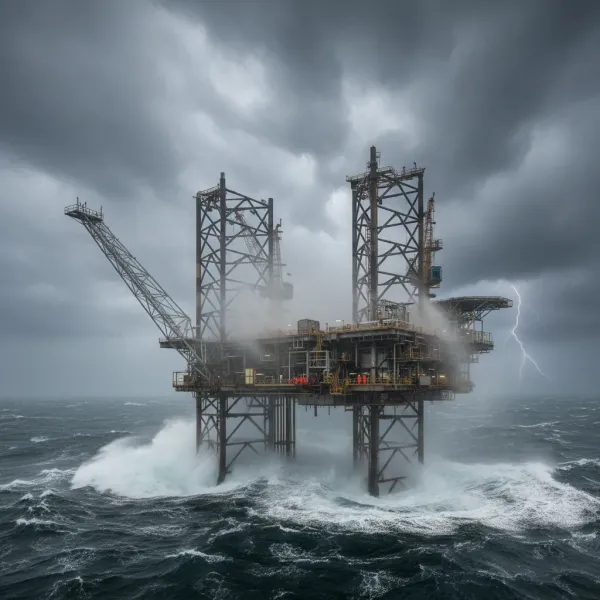
Every chamber system is now fitted with interlocks that physically prevent the outer hatch from being opened while there is pressure inside. Double and triple control systems. Annual inspections. The Norwegian sector of the North Sea is considered the benchmark — the strictest rules, the highest equipment standards. The 28-day saturation limit is also a Norwegian requirement.
Who these people are
You can’t become a saturation diver in a year or two. The typical path: commercial diving → deep-work certification → years of practice → clearance for saturation operations. Many come from the navy. The requirements are astronaut-level physical health, submariner-level psychological resilience, and the ability to weld pipes underwater while wearing gloves a centimetre thick.
Pay in the North Sea runs around £1,900 a day (with a saturation bonus of £37 per hour on top). For a 28-day rotation: £45,000–55,000. During peak periods more: when Hurricane Harvey’s aftermath was being cleared in 2017, rates in the Gulf of Mexico climbed to $3,500 a day. Between rotations — weeks and months ashore.
Good sat divers earn £80,000–100,000 a year. The best earn £200,000 and above. But on commercial diving forums, one phrase recurs more often than any salary figure: “The money is good. But that’s not why I’m here.”
28 days in a steel capsule. 6 hours a day working in absolute darkness at a depth where humans have no business existing. The rest of the time — a bunk, a TV, food passed through the airlock, and a chipmunk voice on the intercom. And somehow that’s exactly what feels real.
On the surface, it’s boring.
Decompression
When the 28 days of work are over, the divers don’t leave. They stay in the chamber. Decompression begins — a slow reduction of pressure back to normal. The rate: one metre of depth per hour. If the working depth was 100 metres, decompression takes 4–5 days. If 200 metres — a week.
All that time you sit in the same chamber. Except now you’re not working — you’re just waiting. The pressure drops so slowly you can’t feel the difference. But the gases are gradually leaving the tissues. Rushing is not an option: same bubbles, same decompression sickness.
Then the hatch opens. Normal air. Normal pressure. A normal voice — for the first time in a month.
The first thing everyone does is call home. In a normal voice.
Saturation diving is an extreme. But even a routine dive to 30 metres changes the physics of the body. And to understand why people go underwater in the first place — start with the first breath.
Start at 18 metres, not 300. Dive courses in Moscow: a trial dive for 5,000 ₽, PADI Open Water Diver from 4,500 ₽. And see what it is all for on the club’s upcoming journeys.