Eight hundred kilometres of water. Not one island, not one shoal. The only place on the planet where the ocean can circle the Earth without ever touching land.
Look at a globe from below — from the South Pole. Antarctica sits in the middle, ringed by ocean. And in only one place does land reach toward the white continent: the tail of South America, Cape Horn, and beyond it the chain of the South Shetland Islands.
Between them lies the Drake Passage. Eight hundred kilometres of open water, the narrowest gap anywhere around Antarctica. And, at the same time, the widest strait on Earth.
Everyone who travels to the seventh continent by sea passes through it. Two days out of Ushuaia, and you are in Antarctica.
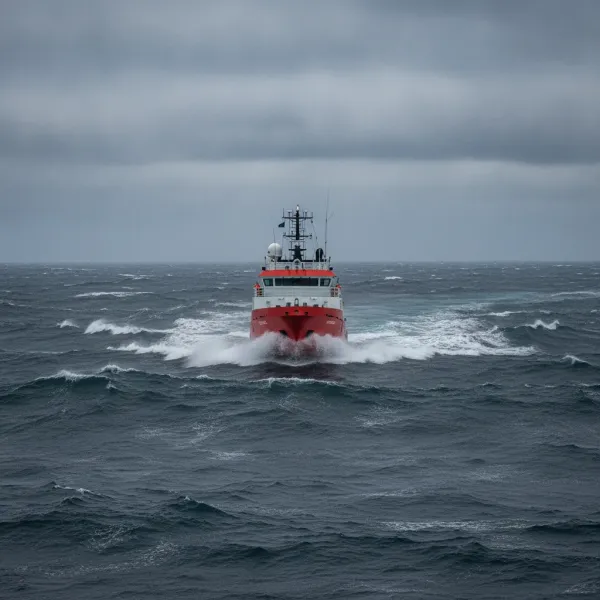
But the interesting part is not that ships cross the Drake Passage. The interesting part is what the water does.
A river with no banks
The Drake Passage carries the Antarctic Circumpolar Current — the most powerful current in the world ocean. It runs west to east, circles Antarctica completely and returns to where it started. It has no beginning and no end.
The numbers are hard to hold in your head. Roughly 137 sverdrups of water pass through the Drake Passage — that is 137 million cubic metres per second. Every river on Earth combined — the Amazon, the Nile, the Yangtze, the Congo and tens of thousands of others — adds up to about one sverdrup.
In other words, the Drake Passage carries more than a hundred times “all the rivers on the planet” at once.
The flow is hundreds of kilometres wide and reaches all the way to the bottom, which here is nearly five kilometres down in places. Nothing comparable exists anywhere else in the ocean.
How one strait froze a continent
Thirty-four million years ago the Drake Passage did not exist. South America and Antarctica were joined, and Antarctica itself was green: southern beech forests, ferns, rivers, temperatures much like modern Patagonia.
Then the continents drifted apart and a gap opened between them. For the first time in the planet’s history water could flow around Antarctica in a closed loop — and it did.
The circumpolar current cut the continent off from the warm water of the north. Warm currents had been delivering surplus heat to high latitudes; now a wall of water blocked their path. Antarctica was left to stew in its own cold — and began to freeze.
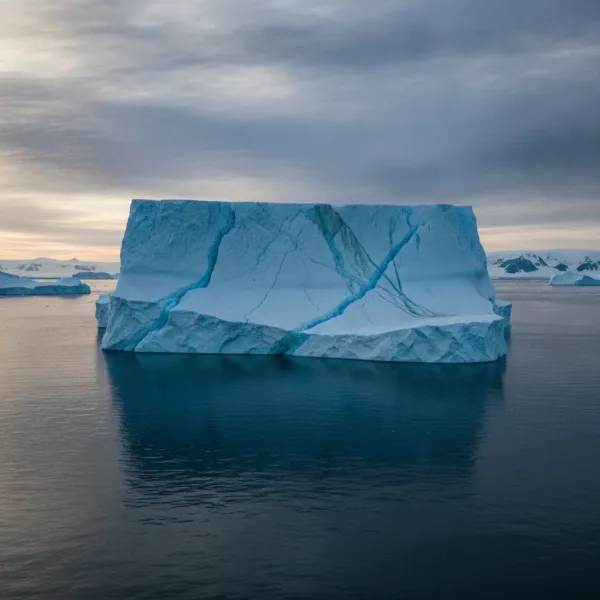
The ice sheet that today holds about 70% of all fresh water on Earth appeared then. One strait changed the climate of the entire planet.
Why the wind never stops here
At latitudes 40–60° south there is nothing for the wind to catch on. There is almost no land — open ocean the whole way around the planet. Sailors of the age of sail gave these latitudes names: the Roaring Forties, the Furious Fifties, the Screaming Sixties.
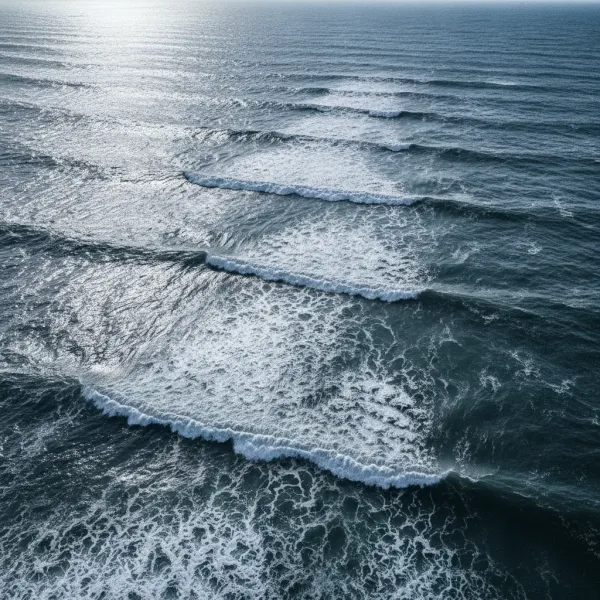
The Drake Passage sits squarely in the fifties and sixties. Wind builds swell across the entire circumference of the Earth, and the swell has nowhere to settle, because there are no shores in its way.
Hence the reputation. But that reputation predates modern shipbuilding by a century and a half.
“Drake Lake” and “Drake Shake”
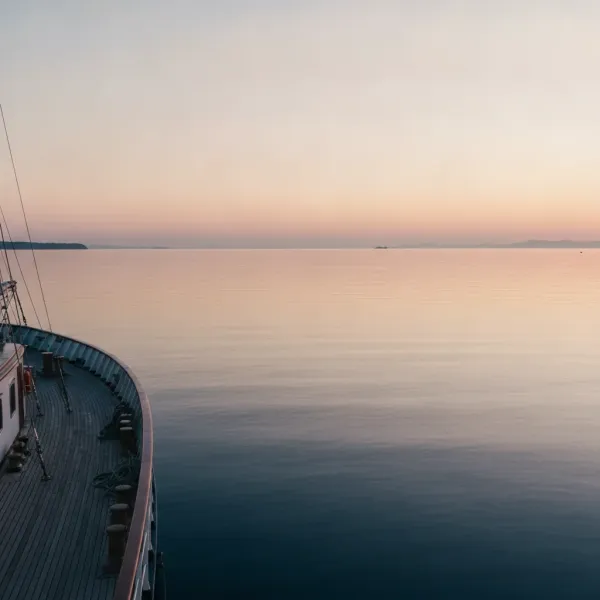
Expedition captains have two expressions: Drake Lake and Drake Shake.
Drake Lake is a crossing over water as smooth as glass, where passengers photograph the horizon and refuse to believe the old stories. It happens regularly: roughly one crossing in three or four meets calm or light seas.
Drake Shake is motion. Not a catastrophe — two days when lying down is easier than walking. Modern expedition ships are built precisely for these waters: reinforced ice-class hulls, active stabilisers that damp the roll, and captains who route around fronts using the forecast.
What actually helps a passenger:
Patches or tablets, taken early. Motion sickness remedies work ahead of time, before you go to sea, not after you start feeling off. There is a doctor aboard every expedition vessel.
A cabin midships and low. That is where the motion is smallest. A forward cabin on an upper deck moves the most.
Horizon and fresh air. An hour on the open deck watching the horizon beats any amount of lying in a cabin.
Food. An empty stomach handles motion worse than a full one — generations of polar travellers have confirmed it.
And most importantly: by the second day the body adapts. People who never left their cabin on day one are usually on deck with binoculars on day two.
What flies here
These two days are worth staying awake for.
The Drake Passage is one of the best places on the planet to watch seabirds. There is almost always something above the ship’s wake.
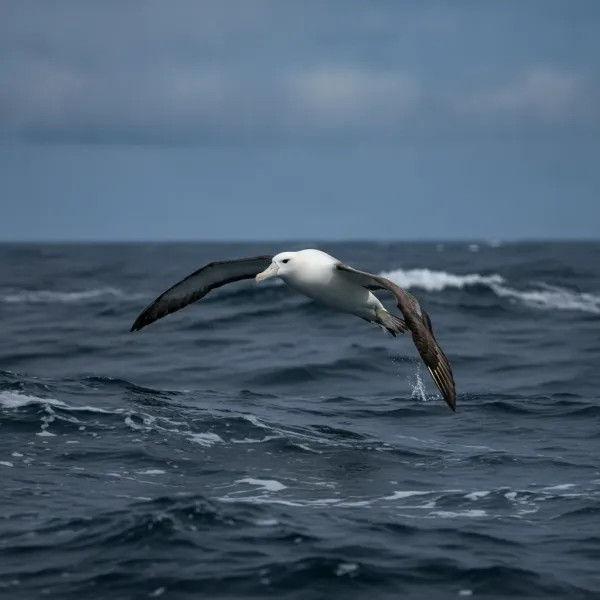
The wandering albatross — a wingspan of up to 3.5 metres, the largest of any living bird. It does not flap. It uses the wind gradient above the waves and glides for hours, spending little more energy than at rest. A young bird leaves for the ocean and does not return to land for five or six years — all of that time spent in the air and on the water.
Giant petrels, cape petrels, southern fulmars follow the ship in flocks and come within metres of the rail.
The birds are not there out of curiosity: the propeller lifts plankton toward the surface, and a free canteen trails behind the ship.
A border you can see on the instruments
About halfway across, the ship crosses the Antarctic Convergence — the Polar Front. This is not a notional line on a chart but a physical boundary between two oceans.
Cold Antarctic water moving north meets warmer sub-Antarctic water and, being denser, slides beneath it. Over a few kilometres the water temperature drops by 2–3 degrees. You can see it on the ship’s instruments, and you can feel it on deck — the air changes within an hour.
At a boundary like this, water mixes vertically and lifts nutrients from the depths. That starts the chain: phytoplankton, krill, everything else.
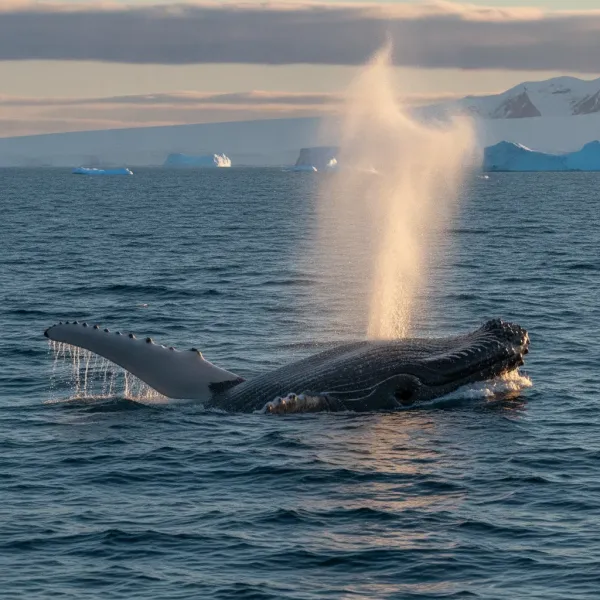
There are around 400 million tonnes of Antarctic krill in the Southern Ocean — one of the largest biomasses of any single species on Earth. Penguins, crabeater seals and whales live on it: humpbacks, fin whales and blue whales come here for the summer for exactly that reason.
So the Southern Ocean is not a desert but one of the most densely populated bodies of water on the planet. And it begins right in the Drake Passage: whales are sighted on the crossing regularly, well before the first iceberg appears.
What Francis Drake has to do with it
An amusing detail: Drake himself never sailed the passage that bears his name.
In 1578 his ship, the Golden Hind, cleared the Strait of Magellan and was driven far south by a storm. Drake saw that beyond Tierra del Fuego there was no southern continent — only open water. That overturned the belief of the era, which held Tierra del Fuego to be the edge of a vast unknown landmass.
The first recorded vessel to actually sail through was Dutch, under Willem Schouten, in 1616 — the same voyage that gave Cape Horn its name, after the Dutch town of Hoorn.
In Spanish-speaking countries the passage still carries a different name: Mar de Hoces, after the Spanish navigator Francisco de Hoces, who according to Spanish sources saw these waters as early as 1526.
Can you skip the sea?
You can. There is a fly-in option: two hours from Punta Arenas in Chile to King George Island, where you board a ship already on the Antarctic side of the passage. These programmes cost more and depend on weather — a flight can be delayed a day or two until the cloud over the island clears.
But most travellers choose the sea deliberately. Flying saves two days — and takes away the albatrosses, the convergence, the first whales and that sense of gradually crossing into another world, which is precisely what people come for.
Antarctica should not begin at the door of an aircraft. You should have to travel to it.
What waits on the other side
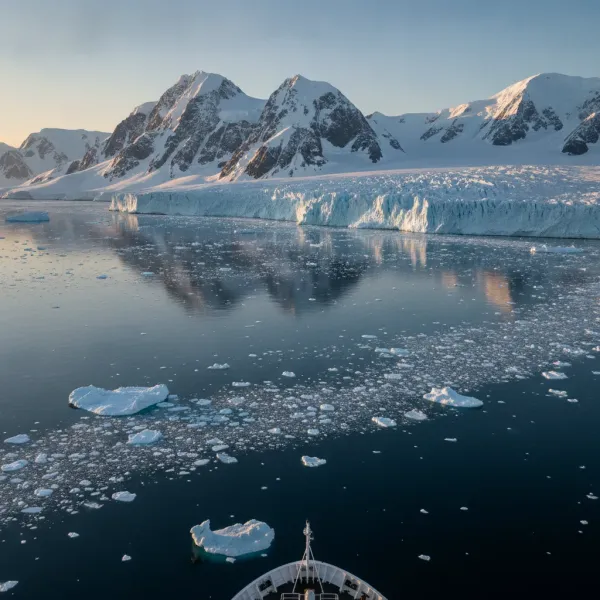
After two days the water settles — the ship comes into the lee of the South Shetland Islands. The first icebergs appear, then the coast, then penguin colonies, which you hear well before you see them.
Beyond that lies the Antarctic Peninsula: channels between walls of ice, seals hauled out on floes, zodiac trips into bays no ship can enter, and a silence so dense that a city dweller’s ears have forgotten it exists.
We run three programmes to the seventh continent: Peninsula and Weddell Sea in December, New Year on Scenic Eclipse, and the February expedition In the Wake of Charcot. All three begin the same way — with two days in the Drake Passage.
For what an Antarctic voyage costs and what makes up the price, see Antarctic Expedition: What It Costs and How to Get There. And if you are curious about water at the other end of the scale, read about the saltiest sea in the world.