The saltiest sea on the planet is the Red Sea. The Dead Sea is eight times saltier — but it is not a sea.
The average salinity of the world ocean is 35 parts per thousand: 35 grams of salt per litre. That is an average in the loosest sense: in places it is half that, in others considerably more.
The record among true seas belongs to the Red Sea — about 40 parts per thousand, rising to 41–42 in the northern gulfs of Aqaba and Suez. A litre of water here holds roughly two tablespoons of salt.
Why the Dead Sea does not count
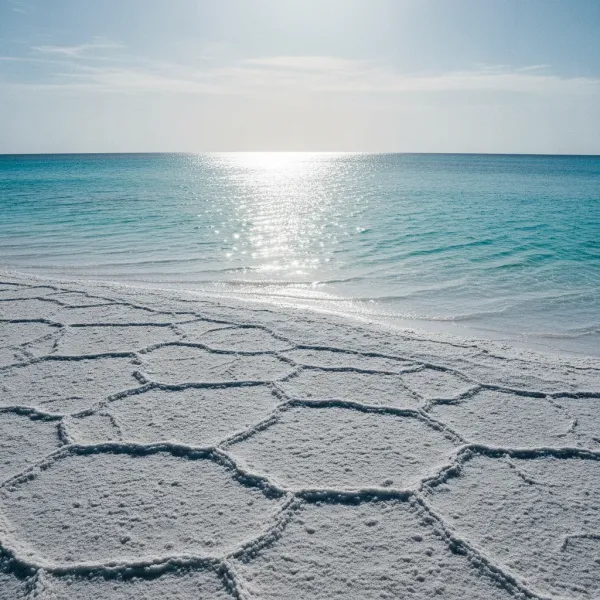
The first thing anyone recalls at the word “salty” is the Dead Sea, with its 340 grams per litre. That is ten times saltier than the ocean and nearly nine times saltier than the Red Sea.
But the Dead Sea is not a sea. It is an endorheic lake: it has no connection to the world ocean and never had one. The Jordan flows in, nothing flows out, water leaves only by evaporation and the salt stays. Its surface lies 430 metres below sea level — the lowest point of land on the planet.
For the same reason Lake Assal in Djibouti (about 350 parts per thousand) does not count, nor does the thoroughly exotic Don Juan Pond in Antarctica — 44% salt, the saltiest water on Earth. It does not freeze even at minus fifty, because the salt is not sodium chloride but calcium chloride.
A sea is part of the ocean. Of all the parts of the ocean, the saltiest is the Red Sea.
Three reasons it turned out this way
Not one river. Not a single permanent watercourse flows into the Red Sea. Around it lie the deserts of Arabia and Africa: the Sahara to the west, the Arabian Desert to the east. There is nowhere for fresh water to come from.
That, incidentally, makes it kin to the Sargasso Sea — the only sea without shores, which also receives no rivers, for an entirely different reason.
Evaporation of up to two metres a year. A column of water as tall as a person rises into the air from every square metre annually. There is almost no rain: the coast receives 50–100 millimetres a year, in places less. The water leaves, the salt stays.
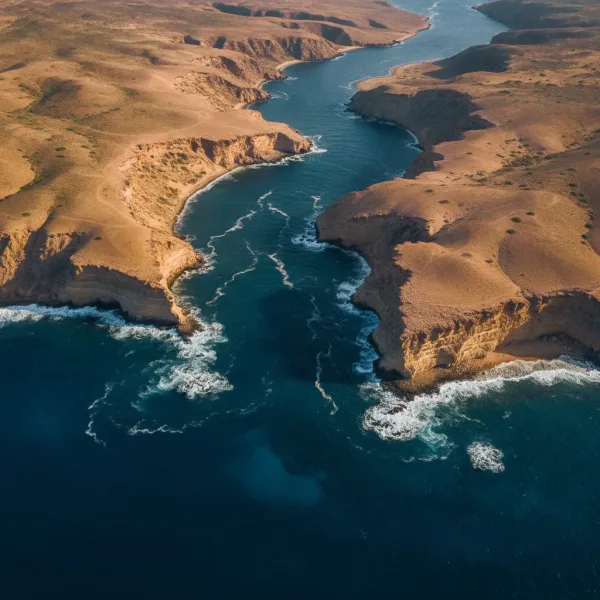
A narrow doorway. The Red Sea connects to the Indian Ocean through the Bab el-Mandeb Strait, about 26 kilometres wide and around 130 metres deep at the sill. Exchange happens, but slowly: a complete turnover of the water takes several hundred years.
Add the temperature. The Red Sea is the warmest sea in the world: 21–28 degrees at the surface in winter and up to 30–32 in summer, while at two hundred metres it holds a steady 21–22 all year. Warm water evaporates faster.
Underwater lakes with shorelines
The strangest feature of the Red Sea lies on its floor.
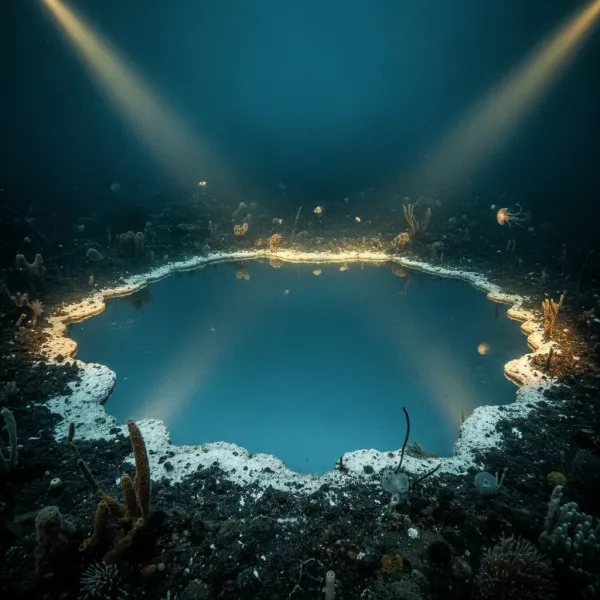
In the deep basins — Atlantis II, Discovery, Chain — at around two kilometres down sit brine pools. This is water with a salinity of up to 260 parts per thousand, seven times the surrounding sea.
Such brine is so dense that it does not mix with the water above it. It lies on the bottom as a separate layer, and it has a real surface with waves and a real shoreline. A submersible lowered into one of these lakes leaves a wake behind it — underwater, two kilometres down.
The temperature in the Atlantis II basin is 68 degrees: the brine is heated by the tectonic rift along which Africa and Arabia are separating by a couple of centimetres a year. Metals settle there too — zinc, copper, silver, gold. The sediments of these basins are considered among the richest ore deposits on the seafloor.
There is almost no life in the brine itself — but at the boundary, where brine meets ordinary seawater, microbial communities live that are studied as a model for possible life on other planets.
What salinity means for a diver
There are three practical consequences, and all of them are pleasant.
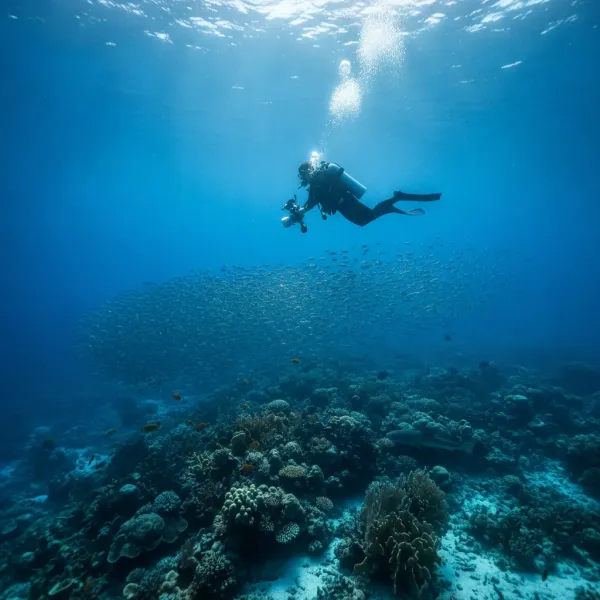
More buoyancy. Denser water holds you better. In the Red Sea a diver needs 1–2 kilograms more weight than in fresh water, and about a kilogram more than in the average ocean. Instructors account for it, but if you arrive with your own kit, allow for the correction.
Excellent visibility. No river runoff means no suspended sediment. Standard visibility in the Red Sea is 20–30 metres, and 40 or more at the good sites. That clarity is why people come.
Water you do not get cold in. Above twenty degrees all year. In winter a 5 mm suit is enough; in summer many dive in a 3 mm or a shorty.
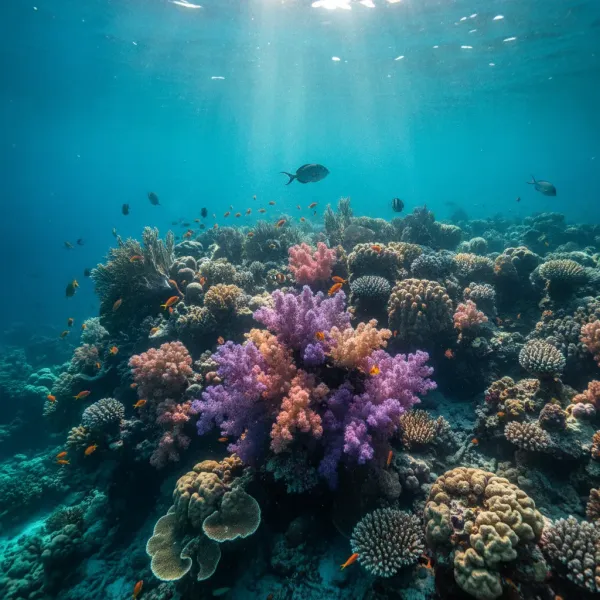
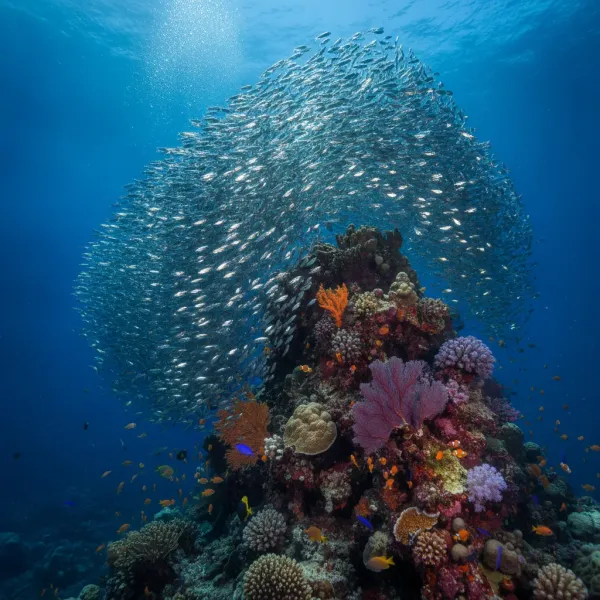
Salinity has also shaped the life here. Isolation and unusual conditions produced high endemism: of roughly 1,200 fish species in the Red Sea, about 15% occur nowhere else. There are over 200 coral species, and these reefs hold up at temperatures that already bleach reefs in other oceans.
The other end of the scale
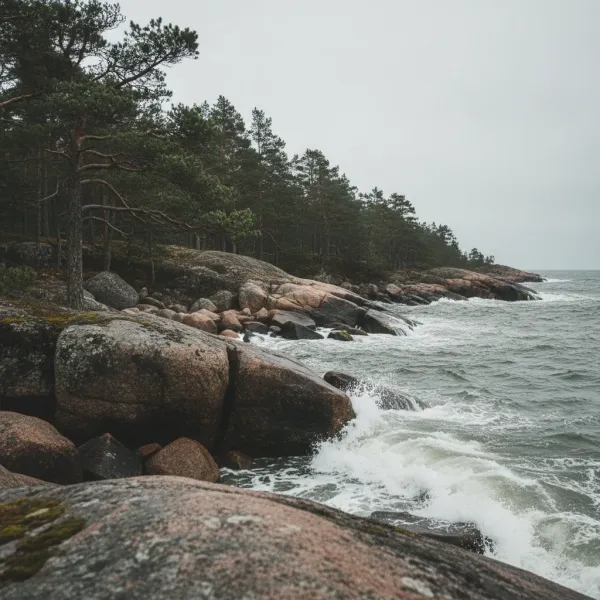
For contrast, the freshest sea on the planet: the Baltic. Salinity in the Gulf of Bothnia falls to 2–3 parts per thousand and rises to 8–10 near the Danish straits. The reason mirrors the Red Sea: hundreds of rivers flowing in, a cold climate, weak evaporation and a narrow outlet that keeps salt water from pushing inside.
So which sea is saltiest
In short:
| Body of water | Salinity | Status |
|---|---|---|
| Don Juan Pond, Antarctica | ~440 ‰ | Lake, saltiest water on Earth |
| Dead Sea | ~340 ‰ | Endorheic lake |
| Lake Assal, Djibouti | ~350 ‰ | Lake |
| Red Sea | 40–42 ‰ | Saltiest sea |
| Mediterranean Sea | 38–39 ‰ | Second among seas |
| World ocean | 35 ‰ | Average |
| Baltic Sea | 2–10 ‰ | Freshest sea |
The Red Sea holds first place among seas — and remains the most accessible of them for a traveller: a short flight, a year-round season and reefs considered among the best on the planet.
For what a Red Sea dive safari is and how it differs from shore diving, see What Is a Dive Safari. The vessels that run these routes are in the catalogue.