The only sea on the planet without a single shore. And the only one no river flows into.
Every sea is bounded by something. The Mediterranean has three continents, the Black Sea the coasts of six countries, the Red Sea the Arabian Peninsula and Africa. Even the most open of them run into land somewhere.
The Sargasso Sea runs into nothing. It lies in the middle of the Atlantic, between America and Africa, and its borders are not land but water: four ocean currents closed into a ring.
Inside that ring is roughly 1,100 kilometres of width and 3,200 of length. The area is comparable to half of Europe. And not a metre of coast.
Borders made of currents
The ring is formed by four flows of the North Atlantic Gyre.
To the west, the Gulf Stream, running north from Florida. To the north, the North Atlantic Current, the Gulf Stream’s continuation heading for Europe. To the east, the Canary Current, descending along Africa. To the south, the North Equatorial Current, returning toward America.
The circle closes. The water inside rotates slowly, clockwise, and barely exchanges with the surrounding ocean.
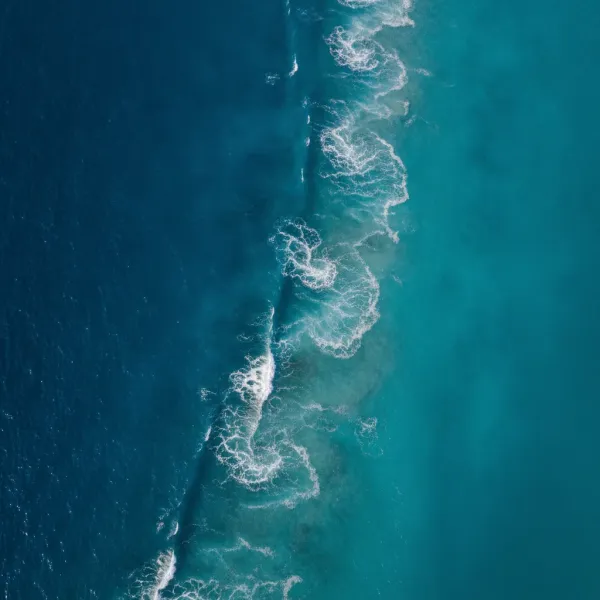
That is why the Sargasso Sea has sharp physical borders even though there is nothing but water around it. Crossing them, everything changes at once: colour, temperature, clarity, plankton composition. Sailors notice without instruments.
Why no rivers flow in
This is the most common question about the Sargasso Sea, and the answer is almost disappointingly simple.
Rivers flow into seas that touch land. The Sargasso Sea touches no land at all: the nearest shore is Bermuda, a speck inside the area, and even there is not a single permanent river.
From which follows its defining property: no fresh water arrives, no river silt, no continental runoff. Hence its record clarity for the Atlantic — underwater visibility reaches sixty metres, and the water has a deep blue rarely found elsewhere in the ocean.
For the same reason its salinity is higher — 36.5–37 parts per thousand against an Atlantic average of 35: evaporation works and there is nothing to dilute it. For where salinity reaches its extremes, see The Saltiest Sea in the World.
A floating forest
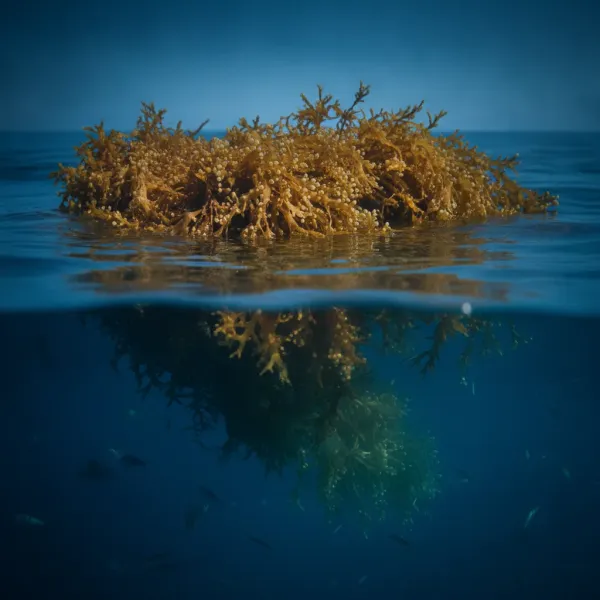
The sea takes its name from the weed — sargassum, Sargassum natans and Sargassum fluitans.
These are the only large algae in the world that spend their entire lives in open water and never attach to the bottom. They have no roots, reproduce by division while afloat and stay near the surface thanks to tiny bladder floats resembling grapes. Portuguese sailors saw a likeness to the sargaço grape — hence the name.
The weed gathers into fields and windrows kilometres long. From above it looks like a meadow spilled across the ocean.
Christopher Columbus described it in 1492. His crew, seeing “meadows” in mid-ocean for the first time, concluded that land was near — and were wrong by about two thousand kilometres.
Who lives in this forest
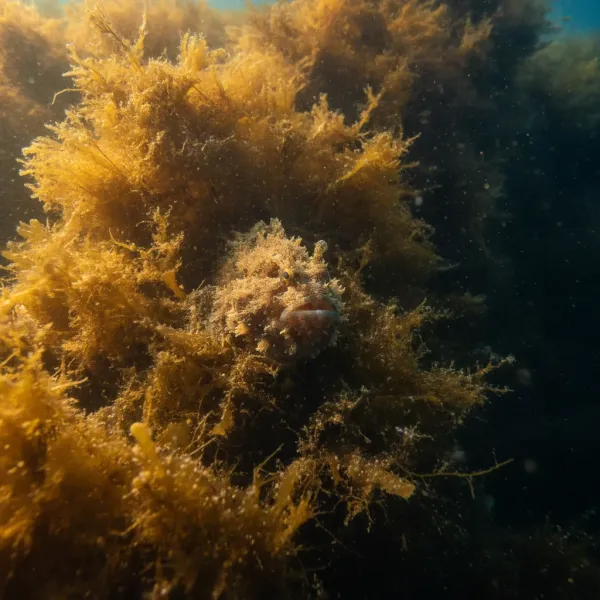
The floating fields are a full ecosystem with endemic species of their own. And nearly all of them are disguised as seaweed.
The sargassum frogfish (Histrio histrio) is a fish that looks like a piece of weed with eyes: same colours, same fronds, same broken outline. It swims poorly but can “walk” through the mat, gripping with its pectoral fins like hands. It ambushes prey and swallows it in six milliseconds — one of the fastest strikes in the fish world.
The sargassum shrimp and sargassum crab use the same tricks at the same address.
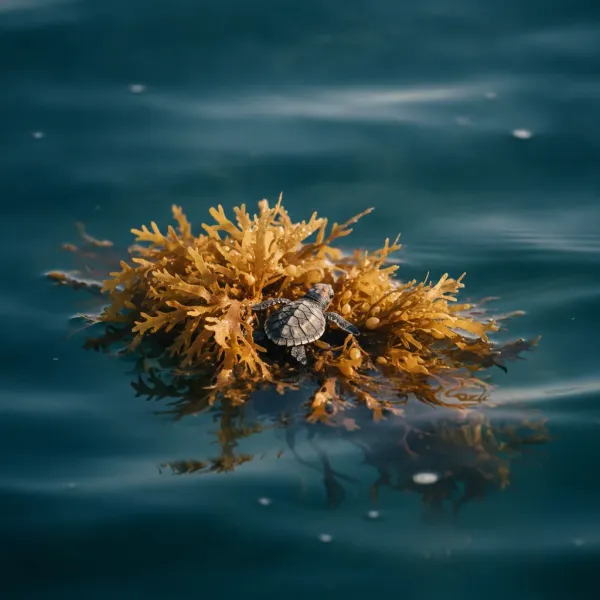
Young sea turtles. Biologists have a term for it: the “lost years”. Hatchlings emerging on the beaches of Florida and the Caribbean head out to sea and disappear from view for several years. It turns out they spend them here, in the sargassum fields, where there is both food and cover from predators.
The riddle that was never fully solved
The most famous story of the Sargasso Sea is about eels.
The European eel lives in the rivers and lakes of Europe, from Spain to Scandinavia. On reaching maturity it sets off to spawn. And for that it crosses the entire Atlantic — six thousand kilometres — to spawn in the Sargasso Sea specifically.
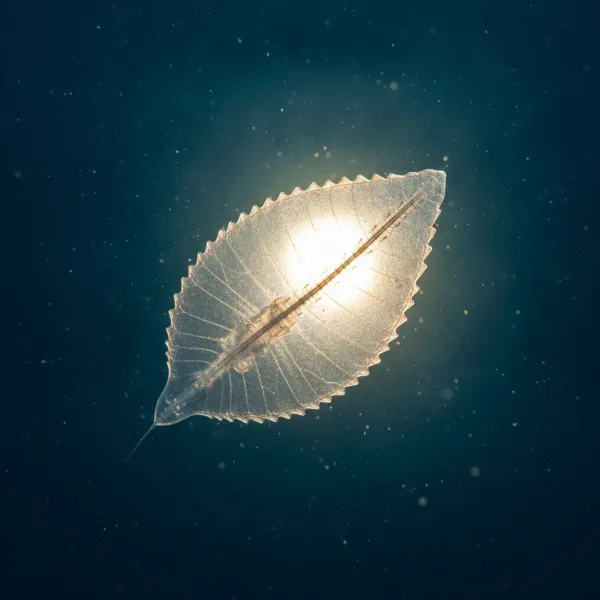
The larvae, transparent and flat as willow leaves, are picked up by the Gulf Stream and drift back toward Europe for one to three years. Near the coast they become “glass eels”, enter rivers and work upstream, sometimes crossing rapids and weirs through wet grass.
The American eel does the same from the other side of the Atlantic — and spawns in the same sea, in a neighbouring sector.
The Danish biologist Johannes Schmidt worked out the mechanism: from 1904 to 1922 he crisscrossed the Atlantic catching larvae and noting where they were smallest. The smaller the larva, the closer to the spawning ground. The trail led to the Sargasso Sea.
And here is the detail that makes the story genuinely remarkable: no one has ever observed eels spawning in the wild. Not a single adult eel has been caught in the Sargasso Sea in the act of reproducing. There are satellite tags tracking fish to the approaches, there are larvae, there is undeniable arithmetic — but nobody has seen the scene itself.
A century-old riddle, still open.
The sea that became visible from space
Since 2011 the Sargasso Sea has had a new storyline.
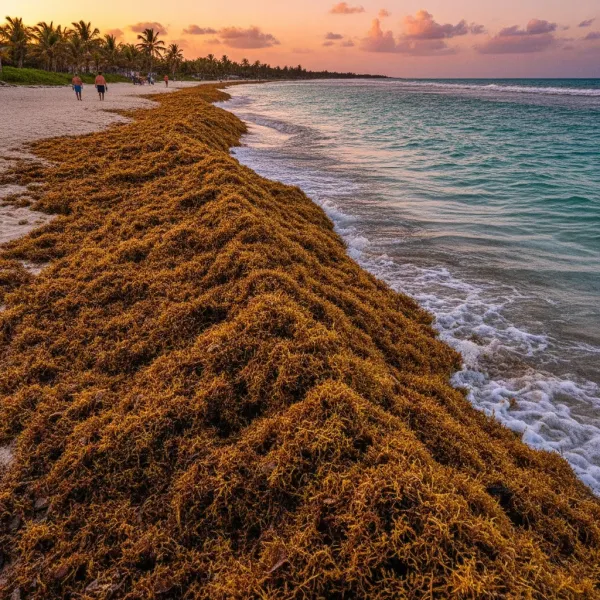
In the tropical Atlantic — south of the historic area — the Great Atlantic Sargassum Belt began to form: a band of weed that in some years stretches from West Africa to the Gulf of Mexico and weighs millions of tonnes. It is visible from satellites.
The causes are debated: nutrient outflow from the Amazon, shifts in winds and sea surface temperature, upwelling off Africa. For Caribbean beaches it has become a problem — the weed washes ashore by the tonne. For oceanographers it has become a reason to study sargassum far more closely than in all the preceding centuries.
The Sargasso Sea itself, meanwhile, remains what it always was: a slowly turning blue circle of water without a single shore.
Speaking of triangles
The famous Bermuda Triangle lies almost entirely inside the Sargasso Sea. Calm, motionless water, weed fields to the horizon and a complete absence of landmarks — an ideal set of ingredients for a legend.
For how that legend was assembled and what the checks turned up, see The Bermuda Triangle: How Legends Are Made.