Three to five dives a day. Reefs 180 kilometres from shore. Gear assembled once and left on the deck all week. A dive safari is a different format entirely. Here’s how it works.
What is a dive safari
A dive safari (liveaboard) is a multi-day trip on a specially equipped yacht with diving. Divers live on board: sleeping in cabins, eating in the saloon, diving straight from the dive deck. The yacht moves from one dive site to the next — usually overnight, while everyone sleeps.
Duration ranges from 5 to 14 days. The standard is a week. In that time the yacht covers a route of 10–20 dive sites, many of which are in the open sea and unreachable by day boats from shore. Liveaboards with schedules and prices by destination are in our dive safari catalog.
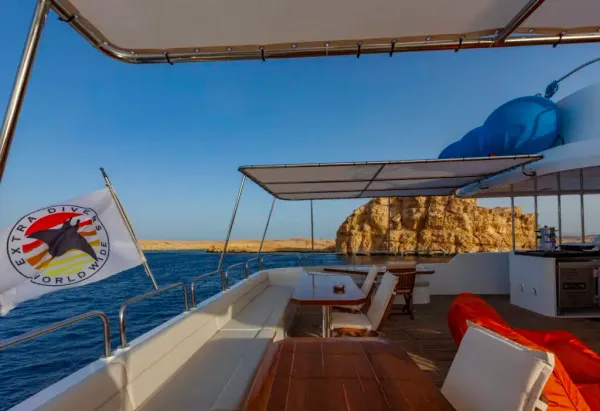
How it differs from shore diving
| Shore diving | Dive safari | |
|---|---|---|
| Dives per day | 2 | 3–5 |
| Gear | Assemble and disassemble daily | Assemble once for the whole week |
| Dive sites | Nearest to port, within an hour’s reach | Remote, including open ocean |
| Transfers | Hotel → pier → boat → pier → hotel | None — you live on the yacht |
| Night dives | Rare, extra charge | Included in the programme |
| Total per week | 8–10 dives | 20–27 dives |
The main advantage of a safari isn’t the number of dives — it’s access to places that day boats can’t reach. Daedalus reef in the Red Sea sits 180 kilometres from the Egyptian coast. Darwin’s Arch in the Galápagos is a 36-hour sail from the nearest port. Cocos Island is 500 kilometres off Costa Rica. The only way to reach these sites is on a liveaboard yacht.
A typical day
A standard schedule on a dive safari:
6:00–7:00 — wake up, light breakfast, coffee
7:00–7:30 — briefing: the dive guide draws the reef profile on the board, explains depths, currents, entry and exit points, what you might see
7:30–9:30 — first dive (40–60 minutes underwater)
9:30–11:00 — full breakfast, surface interval, relaxing on deck
11:00–12:30 — second dive
12:30–14:30 — lunch, rest, surface interval
14:30–16:00 — third dive
16:00–19:00 — free time, dinner
19:30–20:30 — night dive (not every day)
Between dives there’s a dry law — alcohol is only allowed in the evening, after the last dive. This isn’t a whim of the captain: dissolved nitrogen in the blood combined with alcohol increases the risk of decompression sickness.
What’s included in the price
On most yachts the price covers:
- Cabin — twin, with air conditioning, en-suite bathroom and shower
- Meals — three a day, plus snacks and soft drinks
- All dives — including night dives (3–5 per day)
- Tanks and weights — for the entire programme
- Nitrox — enriched air (on many yachts)
- Dive guide services — briefings, in-water accompaniment
Usually not included: flights, visa, personal gear rental (regulator, BCD, wetsuit), alcohol, crew tips.
Where dive safaris go
Red Sea, Egypt
The most popular destination for divers. Direct flights from many European cities. The route: the yacht departs from Port Ghalib and in a week covers Daedalus, Zabargad, and Rocky Island — all in the open sea. At Sha’ab Sataya — a lagoon with permanent pods of dolphins. Hammerheads, barracuda, turtles. Eight days from €1,760.
Maldives
Eleven nights on a yacht across the Ari, Felidhu, and Malé atolls. 27 dives over 9 days. The channels between atolls are where reef sharks, mantas, and whale sharks cruise through. Water temperature +28–29°C year-round. From $3,850.
Galápagos
Wolf Island and Darwin’s Arch — two dive sites with the highest concentration of hammerhead sharks on the planet. Strong currents, depths to 30–40 metres, water temperature +18–24°C — a route for experienced divers. From $7,395.
Cocos Island, Costa Rica
500 kilometres from the mainland, 36 hours by sea. A national park, entry permit $500 per person. Hammerheads, mantas, whale sharks — and virtually no other boats. 12 days from $7,860.
What certification do you need
Minimum — PADI Open Water Diver (or equivalent from another agency: SSI, CMAS, NDL). This is the basic certificate allowing dives to 18 metres.
For most liveaboard routes, Advanced Open Water Diver is recommended — it permits dives to 30 metres and includes experience with drift dives and night dives.
On advanced routes (Daedalus, Galápagos, Cocos) — strong currents, depths to 40 metres, dives in blue water. Here you need Advanced Open Water and at least 50 dives in your logbook.
Beyond the certificate, real experience matters: confident buoyancy control, ability to equalise on the move, composure in a current. If your last dive was more than a year ago, consider a ReActivate course (skills refresher) before the trip.
How much does a dive safari cost
| Destination | Duration | Price | Flights |
|---|---|---|---|
| Egypt, Red Sea | 8 days | from €1,760 | ~€400 (direct) |
| Maldives | 13 days | from $3,850 | ~$800 (direct) |
| Galápagos | 8 days | from $7,100 | ~$2,000 (2–3 stops) |
| Cocos, Costa Rica | 12 days | from $7,860 | ~$1,500 (1–2 stops) |
Cost per dive on a safari: $65–142 (including accommodation and meals). For comparison: a single boat dive at a tropical resort costs $80–100, without accommodation or food.
What to bring
Your own gear (if you have it): regulator, BCD, computer, mask, fins, wetsuit. Personal gear is more familiar and hygienic, especially for a week of daily diving.
If you don’t have your own — most yachts offer full rental kits. But notify them when booking: popular sizes go fast.
Essential: - Dive certificate and logbook - Reef-safe sunscreen (no oxybenzone) - Seasickness tablets (it can get rough during transits) - Light clothing and a hoodie (it’s cool on deck in the evening) - Camera with underwater housing (if you have one)
Where to start
First safari. The Red Sea is the classic starting point. Direct flights, straightforward logistics, comfortable conditions. Eight days from €1,760 is enough to know whether this format suits you.
For experienced divers. The Maldives — 27 dives over 13 days, mantas and whale sharks in atoll channels. The Galápagos — walls of hammerhead sharks at Darwin’s Arch, strong currents and cold water, diving at the edge of your certification.
For those who’ve seen it all. Cocos Island — 500 kilometres from the mainland, twelve days in the ocean, $500 permit. Or St Helena — whale sharks in the middle of the Atlantic. These are expeditions you don’t go on for pretty reefs — you go for what most divers will never see.