Nothing on a reef uses venom to hunt humans. Venom here is defence, without exception. Hence the one rule: don’t touch.
Venomous reef life is a favourite topic of people who do not dive. Divers regard it roughly the way a city dweller regards household wiring: interesting to understand, useful to know where not to put your fingers, and no obstacle to daily life.
Let’s go through the main characters — who they are, how their chemistry works and why the incident statistics among divers are so pleasantly dull.
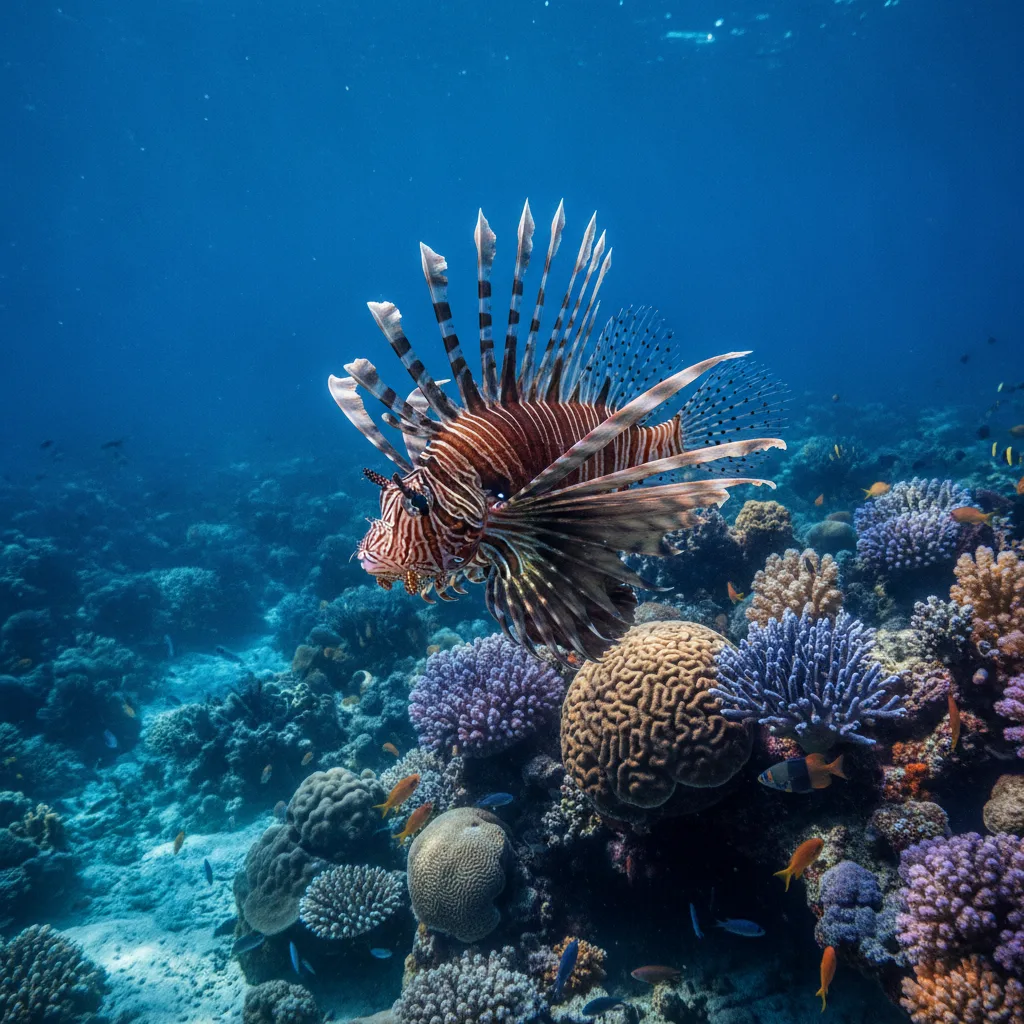
Lionfish
The most recognisable venomous fish in the tropics. Fan-like fins, striped livery, slow and stately movement, and no fear of humans whatsoever.
The venom sits in the fine spines of the dorsal, pelvic and anal fins. It is purely defensive equipment: the lionfish hunts with its mouth, engulfing small fish in a lightning strike, and keeps the spines for anyone thinking of eating it.
There is exactly one way to get stung: press the fish against yourself or grab it. Swimming alongside, photographing it and watching it hunt are entirely safe — a lionfish neither attacks nor pursues.
If a sting does happen, the pain is severe and the first aid is simple: hot water, around 45 degrees, for 30–90 minutes. The protein venom breaks down with heat. Every dive vessel carries the means.
The irony is that in the Atlantic the lionfish became a problem of the opposite kind: introduced into the Caribbean, it multiplied without natural predators and now eats through the local juveniles. Dive centres run lionfish culls and restaurants put it on the menu — the flesh is white and good, and cooking destroys the venom.
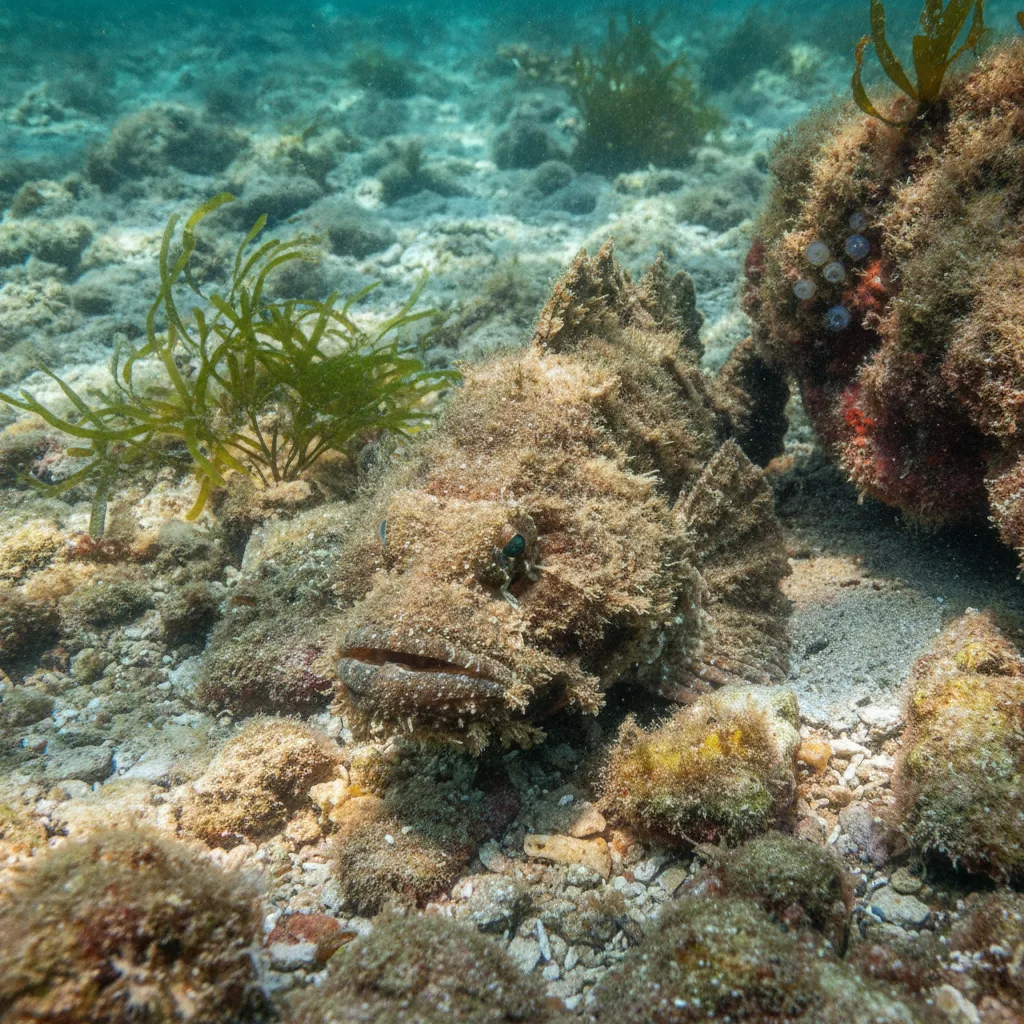
Stonefish
The most venomous fish in the world, and the least visible.
It looks like a rock overgrown with algae. It lies motionless on the bottom for weeks, sometimes half-buried in sand. It does not flee when approached: its strategy is invisibility, and it is so confident in it that it stays put even when touched.
Thirteen dorsal spines carry venom released by pressure.
Every known case involves stepping on one barefoot in the shallows. A diver in fins, swimming in the water column and not settling onto the bottom, has essentially no chance of meeting one.
Hence the shallow-water rule: when you walk into the sea from a tropical beach, shuffle your feet rather than step. Any ray or stonefish will leave in advance, and the surprise stays undiscovered.
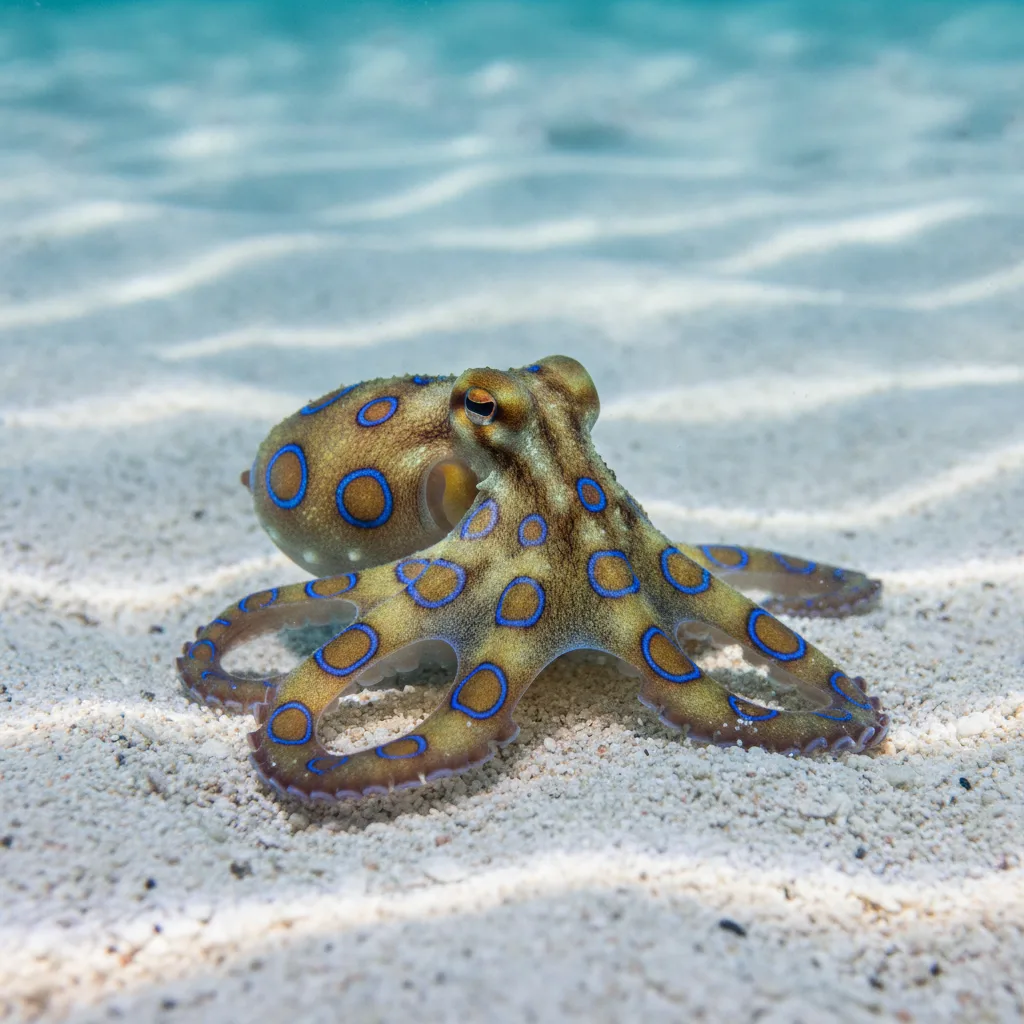
Blue-ringed octopus
The size of a golf ball, living across the Indo-Pacific, usually in shallow lagoons and tide pools.
At rest it is a drab grey-beige. Disturbed, it flares brilliant blue rings that pulse across its body. That is a warning, and an entirely unambiguous one.
The toxin is tetrodotoxin, the same compound found in pufferfish. It is produced by symbiotic bacteria in the octopus’s salivary glands.
This small animal illustrates a rule that applies to the whole reef: do not pick up anything you do not have to pick up. Every incident with a blue-ringed octopus involves an “interesting pebble” lifted off the bottom, or a shell with someone living in it.
Cone snails
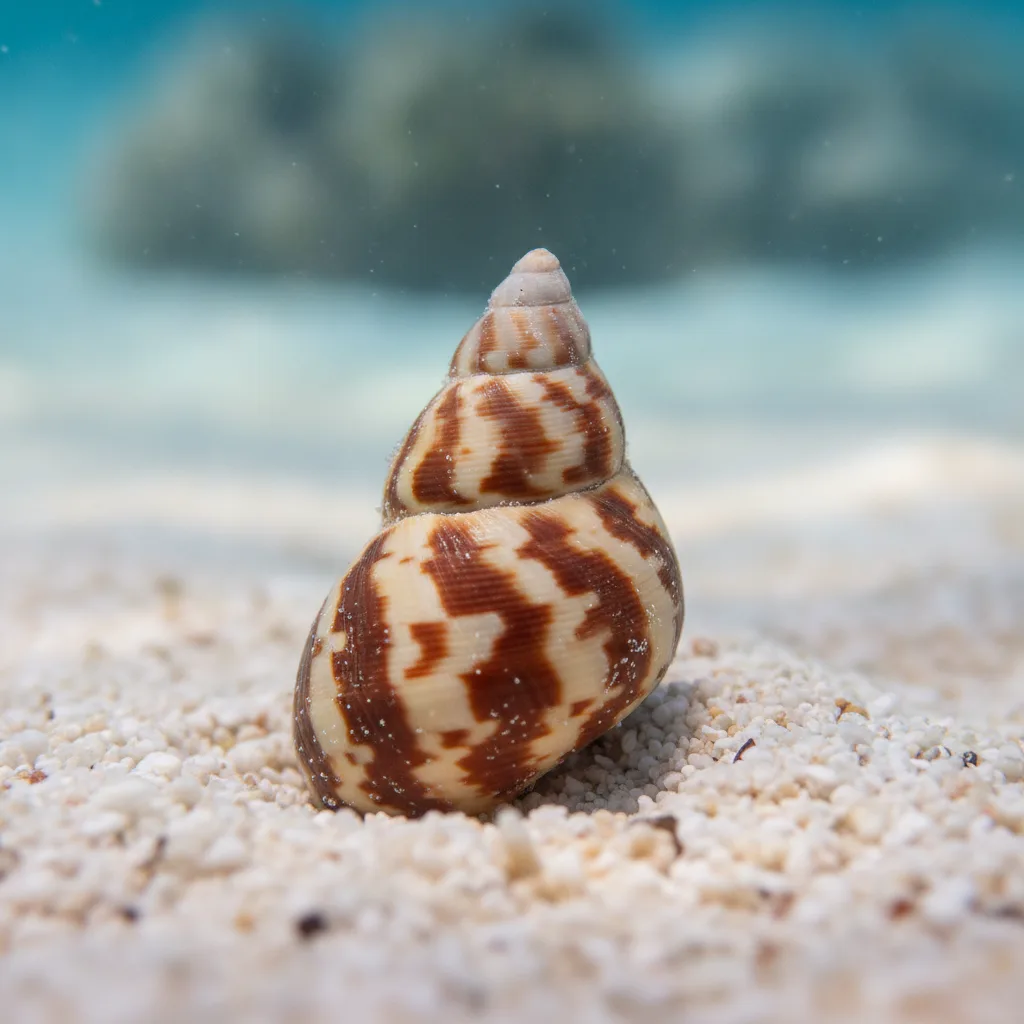
Beautiful patterned shells, collected for centuries for exactly that reason. Inside lives a predatory snail with a harpoon.
The mechanism deserves its own admiration. The cone fires a modified tooth on an elastic “spring”, injects a cocktail of hundreds of different peptides and reels the prey back in. Every cone species has its own chemical set, and more than ten thousand have been described — one of the richest natural chemical libraries on the planet.
Rich enough that pharmacology takes it seriously: ziconotide, a painkiller a thousand times stronger than morphine and non-addictive, comes from cone snail venom.
For a diver the rule is the same: a beautiful shell stays on the bottom. All the more so since exporting shells is illegal in most countries.
The mantis shrimp: a punch at bullet speed
The one character on this list that dispenses with venom entirely. Mechanics are enough.
The peacock mantis shrimp is a creature about fifteen centimetres long, coloured as though assembled from the leftovers of every other reef resident: emerald carapace, red claws, blue antennae, eyes on moving stalks. Divers hunt it with a macro lens, and it is one of the most sought-after shots on a tropical reef.
Its weapon folds under the head like a praying mantis — hence the name. It unfolds in three milliseconds.
Strike speed: up to 23 metres per second. The acceleration is comparable to a small-calibre bullet. The force reaches fifteen hundred newtons, thousands of times the animal’s own weight. With it, the mantis shrimp opens crab shells and snail shells — precisely the things nature considers unbreakable.
Then comes the physics that makes it a serious research subject.
The club moves so fast that the water behind it cannot close in time, and for a fraction of a second a cavity forms — a cavitation bubble. When it collapses, it produces a second shockwave, a flash of light and a moment of intense heat. The prey is hit twice: by the club, then by the collapsing bubble. A mantis shrimp that misses still stuns its target.
The striking surface does not shatter in the process — it is built in layers that arrest cracks. Engineers copy that architecture in composite materials for aviation and protective panels.
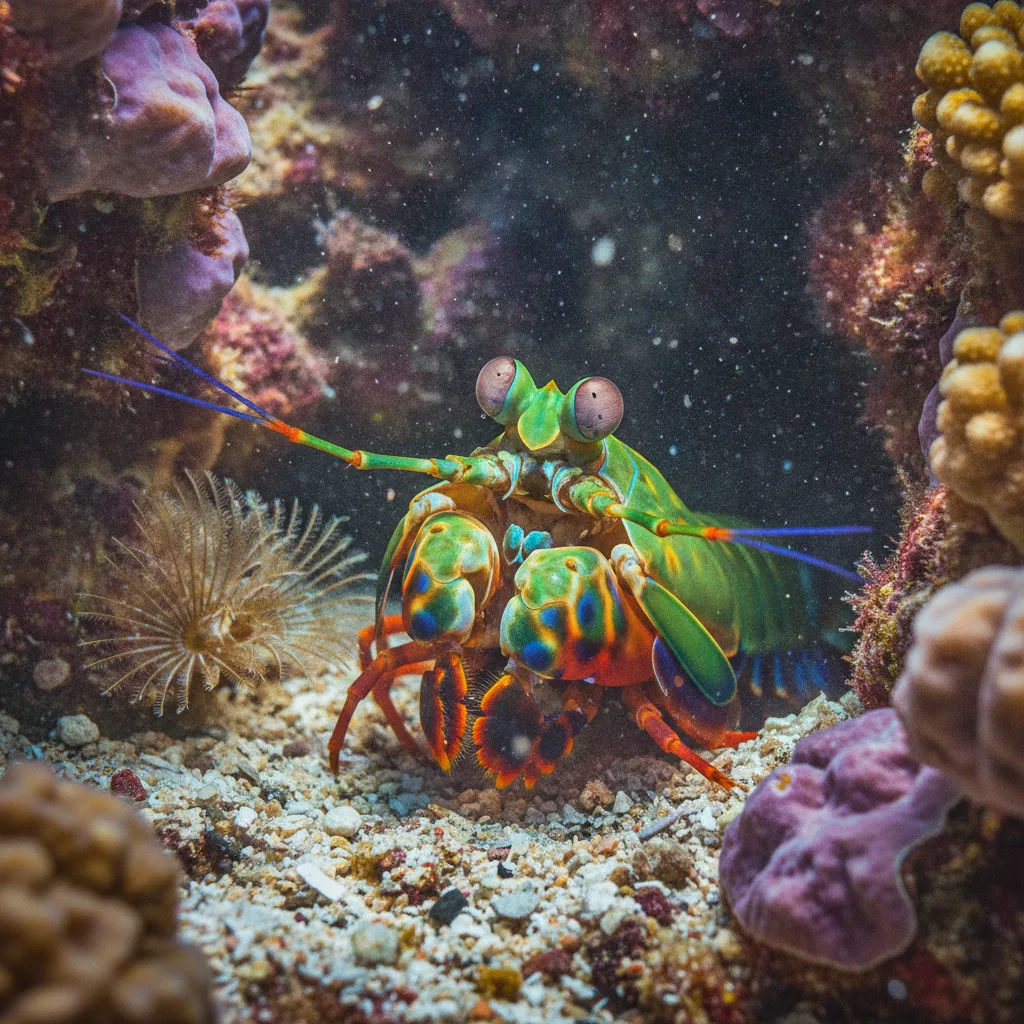
And then there are the eyes. Humans have three types of colour receptor; the mantis shrimp has twelve to sixteen. It sees ultraviolet and polarised light, including circular polarisation — an ability no other animal on Earth is known to possess. Each eye moves independently and delivers depth perception on its own.
Among aquarium keepers it has a reputation as an unwelcome tenant: there are documented cases of a mantis shrimp cracking aquarium glass. Its English nickname is the thumb splitter.
On a reef none of this poses any threat. The mantis shrimp lives in a burrow, watches from it, never approaches a diver and uses its strike only on whatever climbs into its home. The rule is the same familiar one: look as long as you like, hands off.
Fire coral
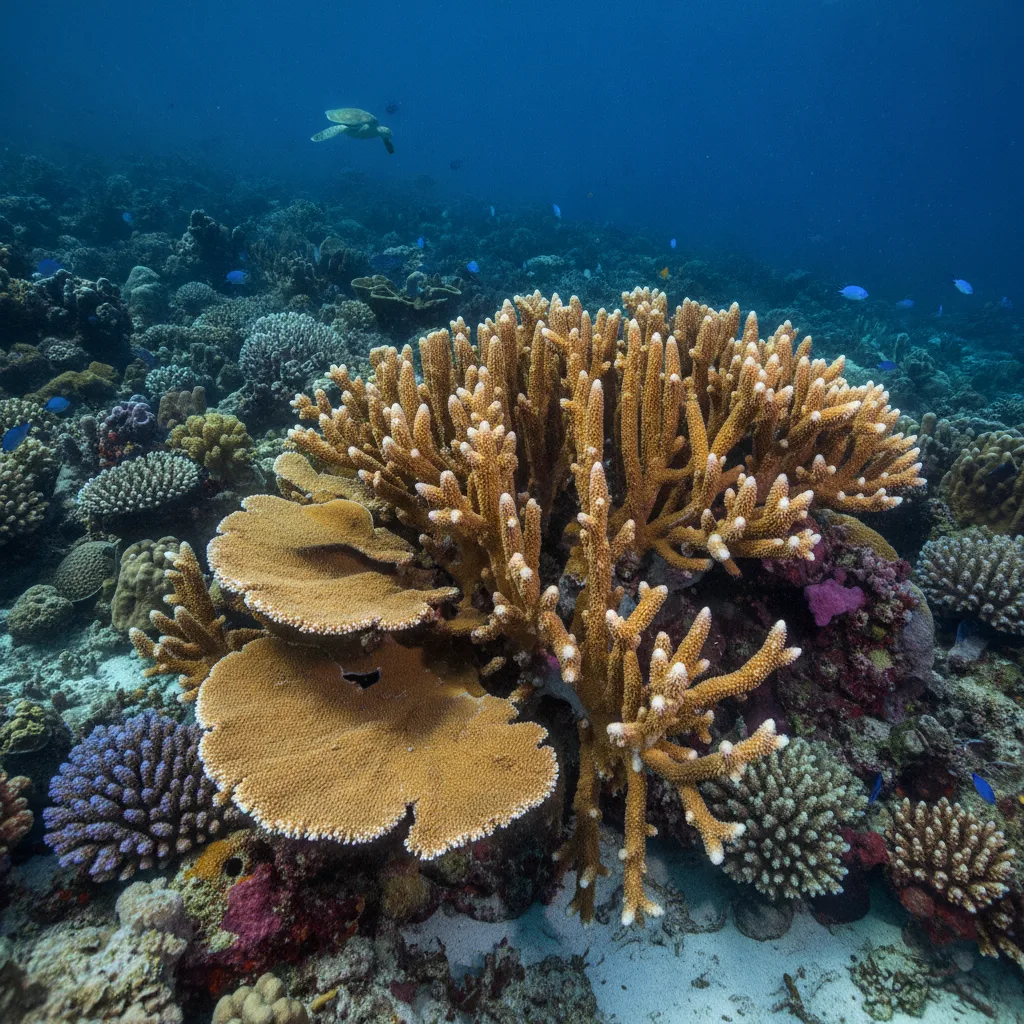
Not a coral at all but a hydrozoan, a relative of jellyfish. It grows in mustard-yellow branching plates with white tips and is found on reefs everywhere.
Its stinging cells fire on contact and produce a nettle-like burn, only stronger. It passes within a couple of hours; the marks can last a week.
This is the most common “injury” on a reef — and almost always the result of poor buoyancy control: a diver brushing the reef with a hand or a knee. Which, beyond the discomfort, damages the reef itself: the colony dies back where it was touched.
That is why an experienced diver stays half a metre off the coral — not out of fear, but out of manners.
Jellyfish
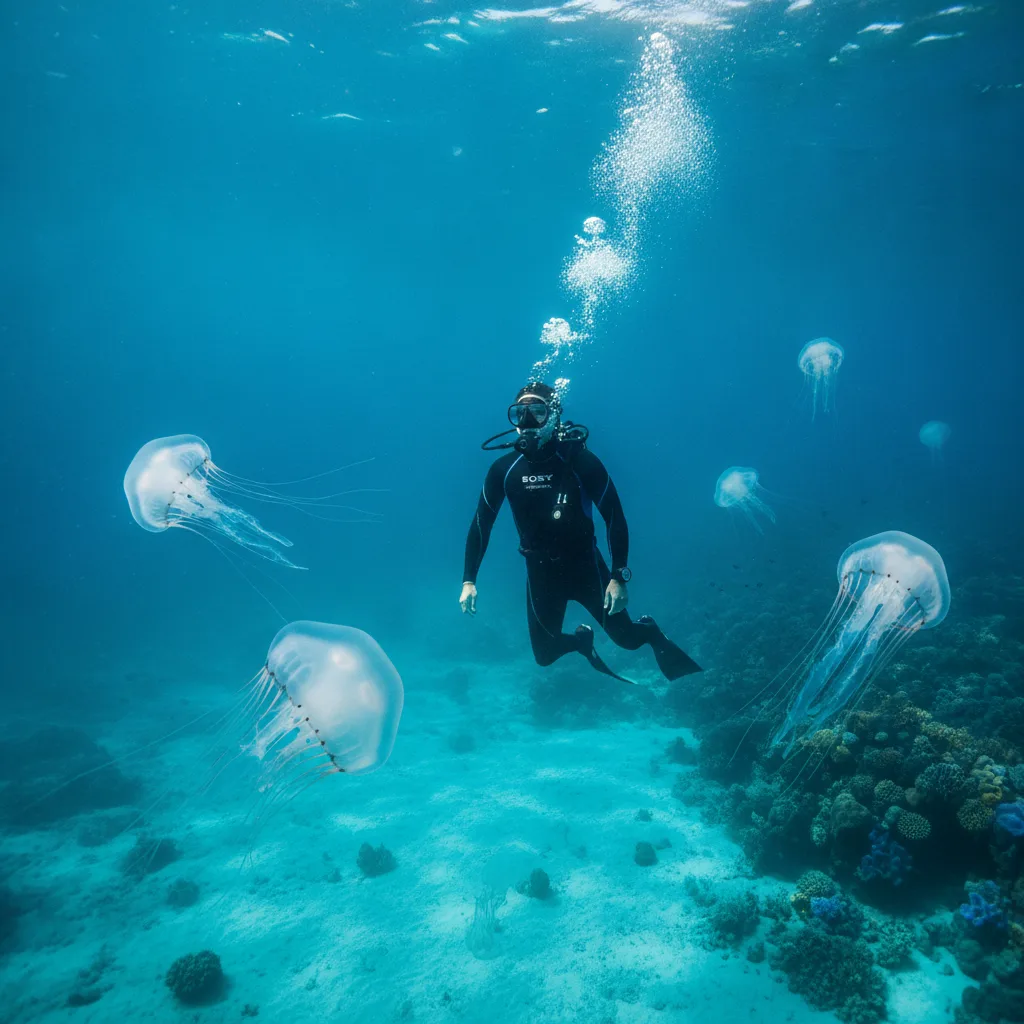
Most tropical jellyfish deliver anything from a tickle to a nettle sting. Box jellyfish and irukandji in northern Australian waters and parts of the Indo-Pacific are a separate matter: their stinging cells are serious, and the season is tracked officially by local authorities.
The solution exists and is simple: a stinger suit — a thin elastic garment covering the body completely, hands and feet included. In jellyfish season in Australia everyone dives in one, instructors included. A stinging cell fires on chemical and mechanical contact with skin — through fabric it does not fire.
First aid after contact with a box jellyfish is vinegar, which neutralises the undischarged cells. A bottle of it is on every Australian dive boat and every beach in season.
What about sharks, morays and rays
They are usually named in the same breath as the venomous — although they do not belong on the list.
Sharks are the reward of a dive trip, not the risk. The overwhelming majority of encounters go like this: the shark passes by and leaves. Divers travel to the Maldives, Egypt, the Bahamas and Mexico specifically for it.
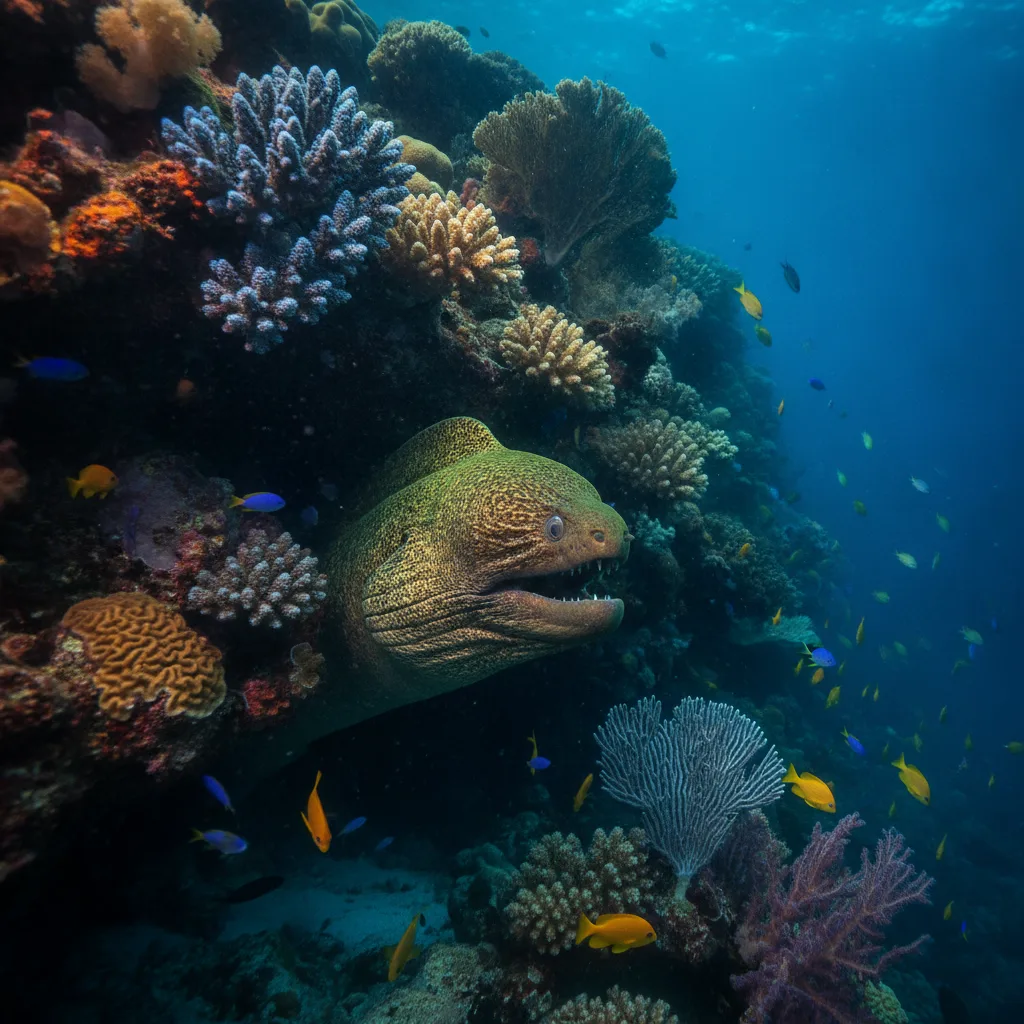
Morays are not venomous. They bite if you put a hand into their crevice — which is precisely the case where the party with teeth is not the one at fault.
Stingrays carry a serrated barb on the tail and use it only when stepped on. In the water they move away from a diver well in advance.
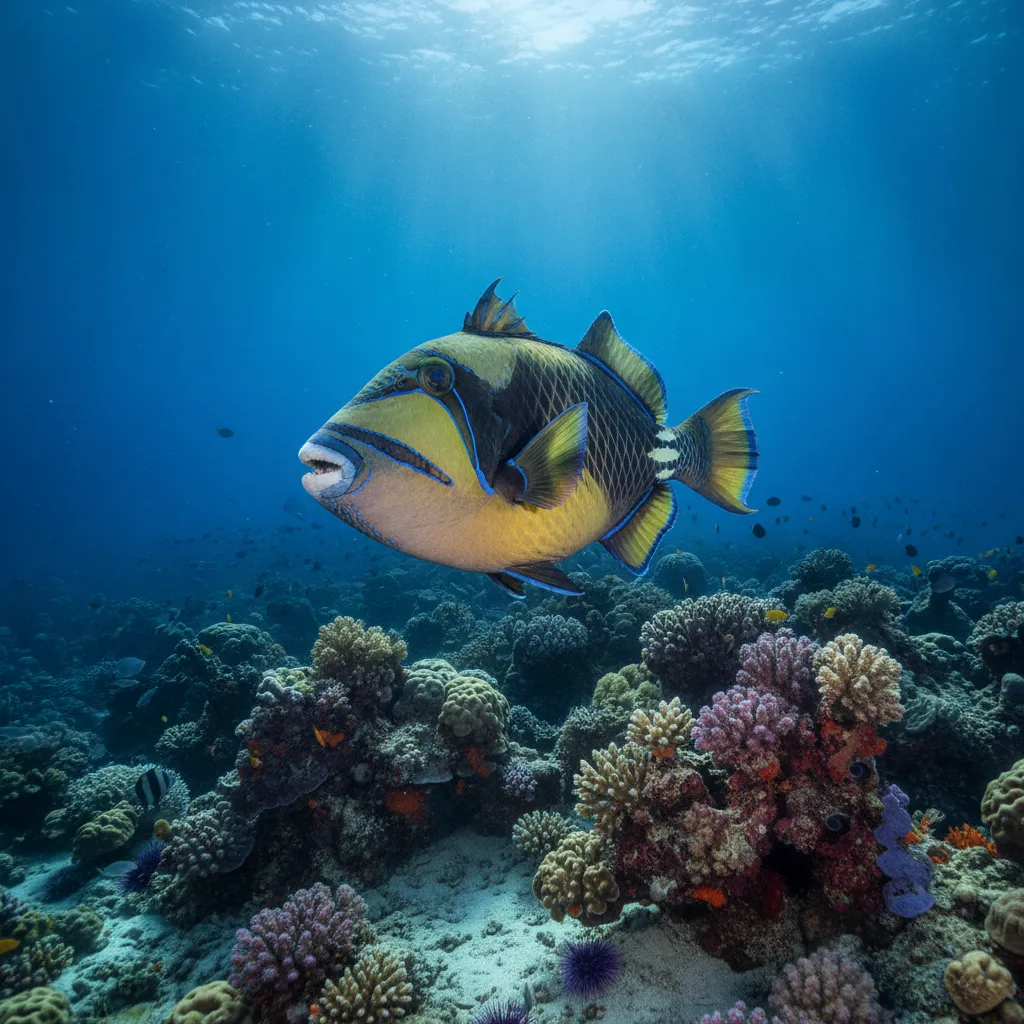
The titan triggerfish is the one reef resident capable of genuine aggression: during nesting season it defends its territory and will chase a diver off. Not venomous, but determined. The rule is simple: move away horizontally, not upward — its territory is a cone that widens toward the surface.
Five rules that cover almost everything
- Touch nothing. Not a fish, not a shell, not coral, not an “interesting rock”. This one rule removes the overwhelming majority of the risk.
- Hold your buoyancy. A diver who never touches the bottom will never meet a stonefish or fire coral.
- Look where you put your hand. If you must steady yourself, use bare sand or dead rock, after looking.
- Wear a suit. Even a thin lycra one protects against stinging cells and accidental contact.
- Shuffle your feet in the shallows. Entering from the beach, shuffle rather than step.
And the thing worth understanding about a reef: it is not about danger. All of these mechanisms exist so that the animal is not eaten — and not one of them was designed with humans in mind.
A diver on a reef is a guest nobody invited and nobody fears. It is enough to behave like a guest.
For how the physics of diving works, see The Physics of Diving, and for the rules that make diving predictable, Safe Diving Without Decompression Sickness.