15 people. 4.9 out of 5. 10 days. Four imperial cities. A night in the Sahara. A pass through the Atlas. Hollywood made of clay. A square that never sleeps. And goats in trees.
Morocco is a country where colors speak louder than words.
White Casablanca — Morocco’s economic capital, the city Humphrey Bogart never actually saw (the film Casablanca was shot on a Hollywood soundstage). The Hassan II Mosque — hovering above the ocean, with a 210-meter minaret — the tallest religious monument in the world, higher than any cathedral, higher than any pagoda. The Corniche promenade — Atlantic surf, cafés, sunset. The colonial French quarter — Mohammed V Square, Art Deco, fountains.
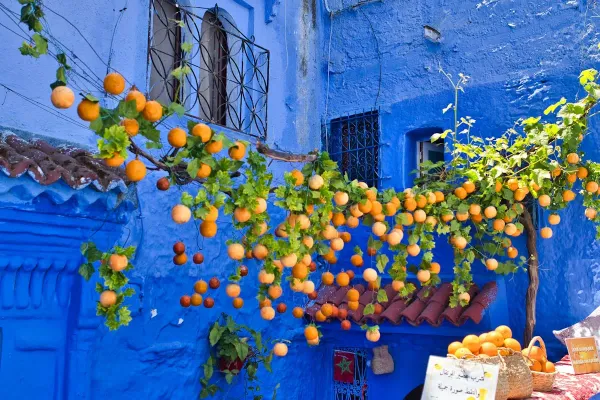
Blue Chefchaouen — a city painted blue by Jewish refugees in the 1930s. A tradition that became an identity. Mint tea on a blue terrace, in the silence of the Rif Mountains. Cats — hundreds of cats — on blue-painted steps.
The capital Rabat — the Mausoleum of Mohammed V with royal guards in white. The Kasbah of the Udayas — a 12th-century fortress with blue-and-white alleyways (like Chefchaouen, but older). The Chellah — Phoenicians, Romans, Merinids — three civilizations on a single patch of ground.
Golden Fes — the oldest university in the world, founded by a woman in 859. The largest pedestrian zone in the world — 9,400 buildings. Tannery vats from the 11th century — pigeon dung, saffron, cedar bark. A smell that makes your eyes water. Zellige — mosaic made of thousands of hand-cut pieces. The golden gates of the Royal Palace.
Ifrane — “the Morocco Switzerland”: chalets among cedar forests, Barbary macaques by the roadside. A pass through the Middle Atlas. The Ziz River Gorge — a canyon lined with palm oases.
Yellow Sahara — a night in the desert. A camel caravan at sunset, crossing the dune ridge like silhouettes from Lawrence of Arabia. Bedouin drums and songs around the campfire. Stars — no light pollution, no clouds, no humidity — brighter than any planetarium. Sunrise — the dunes burn pink, then orange, then gold.
Brown Ouarzazate — Hollywood made of clay. The largest film studio in the world. Sets from Gladiator and Game of Thrones. Ksar Ait Ben Haddou on the caravan route — UNESCO-listed, living medieval architecture built from rammed earth. Todra Gorge — walls 400 meters high, ten meters wide, silence like a cathedral. The Tizi n’Tichka pass — 2,260 meters of switchbacks through the High Atlas.
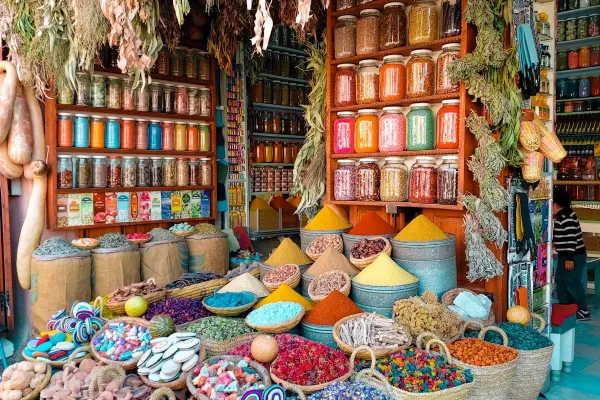
Red Marrakech — Djemaa el-Fna Square, the first UNESCO Intangible Cultural Heritage site: snake charmers, storytellers, Gnawa drums, meat grills, a thousand smells at once. The Majorelle Garden — a blue oasis saved by Yves Saint Laurent, featuring “Majorelle Blue,” a patented shade of ultramarine. The souk — a labyrinth of a thousand stalls: spices in conical mounds, carpets with Berber patterns, leather babouches, hammered brass. Bargaining is mandatory; the opening price is always three times the real one.
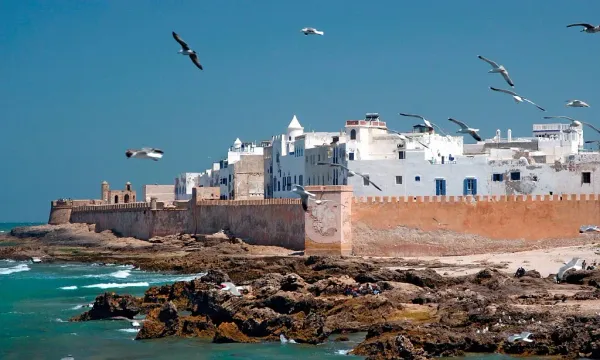
Blue Essaouira — the Atlantic Ocean, wind, a fishing harbor with brightly colored boats. Goats in argan trees — defying the laws of physics with the composure of creatures who have no idea physics exists. 16th-century Portuguese cannons on the ramparts. And — the ghost of Jimi Hendrix drifting through the alleyways, though evidence of his presence amounts to exactly nothing.
10 days. A small group — 2 to 6 people. This is the most compact journey in our catalog. Not ten or twelve, as is typical — two to six. Almost private. The guide isn’t holding a microphone in front of a crowd; they’re right beside you, like a friend who knows this country better than their own apartment.
A Russian-speaking licensed guide for the entire itinerary — except the final day (a free morning in Marrakech). They will lead you through the Fes medina without getting lost (that’s a skill that qualifies as a superpower). They’ll explain why Chefchaouen is blue and not green (and you’ll know more than 99% of the photographers who come here for a picture, not for the story). They’ll tell you how to tell real saffron from fake (rub it between your fingers: the real thing stains your skin orange and smells of honey). They’ll show you how to eat couscous properly (with your right hand, rolling the grains and vegetables into a small ball). And they’ll tell you which tagine to order (lamb with prunes and almonds — the right answer. Always).
Accommodation — 4-star hotels and traditional riads. A riad is a Moroccan home built around an inner courtyard, with a fountain and zellige mosaic walls. This is not a “hotel” — it is architecture. Every riad is unique: carved doors, cedar ceilings, mosaic floors, orange trees in the patio. In Fes — a night in an authentic riad inside the old medina: sleeping in a house that is 300 years old, with a carved cedar ceiling, zellige walls, and the scent of sandalwood and incense. You wake up to the first call to prayer and the ringing of copper trays downstairs, where the host is setting out breakfast. In the Sahara — luxury tents with Berber rugs, beds with proper linen, and hot water (solar-heated — in the desert, there is more than enough sun).
Flight assistance. All transfers included in the program. Breakfast every day. Two dinners: in Skoura (among palm oases, under the stars) and in the Sahara (by the campfire, with tagine, couscous, and mint tea). All entrance tickets — Hassan II Mosque, the madrasa in Fes, Atlas Film Studios, the Majorelle Garden, the Bahia Palace. And — guide and driver gratuities are included in the price. That’s rare — on most journeys, tips are paid separately. Here, they are not. Everything is accounted for. You simply enjoy.
€2,670 — one of our most affordable journeys. And one of the most packed. Ten days. Four imperial cities — each with its own history, each a former capital. A night in the Sahara — camels, drums, stars that make your head spin. A pass through the Atlas — 2,260 meters of switchbacks, from +35°C below to +15°C at the top, from desert to green valleys. Hollywood made of clay — a plaster Colosseum, a Game of Thrones throne, Scorsese’s Tibet. A square that has never slept in a thousand years — snake charmers, storytellers, Gnawa drums. Goats in trees — defying physics with the composure of goats. And colors — so many colors that your camera gives out before you do.
Fatima al-Fihri founded the oldest university in the world in 859 — and it is still operating. Jewish refugees painted Chefchaouen blue in the 1930s — and the city became an icon. The tanners of Fes have been curing leather in pigeon dung for a thousand years — and the technique has not changed a single step. Berber builders mold kasbahs from clay — and UNESCO puts them on the register. Morocco is a country where the past does not end. Where thousand-year-old techniques are not museum exhibits but everyday life. Where the paint on a wall is a religion. Where the smell of mint is a ritual. Where color is history.
Morocco is a country that cannot be described with a single color. Because it has all of them. White (Casablanca), blue (Chefchaouen, painted by refugees), gold (Fes, city of Fatima al-Fihri), yellow (the Sahara, where there are more stars than people), brown (Ouarzazate, Hollywood made of clay), red (Marrakech, the square that never sleeps), blue (Essaouira, ocean, wind, goats in trees). Seven colors — like a rainbow. Only not in the sky — on the ground. Underfoot. All around. Within you. And on the walls. Because in Morocco, even the walls tell stories.
October 2–11, 2026. Morocco. From the Ocean to the Sahara. From €2,670.