Jemaa el-Fna. A square with no walls but a thousand stories. A snake charmer squats on his heels, a cobra swaying before his flute. Nearby — an acrobat balancing on one hand. Nearby — a woman drawing henna on someone’s palms. Nearby — a man shouting and waving his arms, telling a story. A hundred people sit around him and listen.
Marrakech is the red city. Walls, mosques, palaces — all built from red sandstone. The colour is warm, dusty, the colour of sunset. Marrakech is not white, not blue, not golden — it is red. Like blood, like spices, like a sunset over the Atlas.
Jemaa el-Fna is the heart of Marrakech and a UNESCO Intangible Cultural Heritage site. Not a building — a square. For the first time in history, UNESCO designated not a monument but an event as intangible heritage. Because Jemaa el-Fna is not a place. It is a performance that has been going on for a thousand years.
By day, the square is a bazaar. Orange juice — squeezed in front of you, from enormous Moroccan oranges, for fifty cents. Dates — dozens of varieties, from dry and firm to soft as caramel. Nuts piled in cones on trays. Spices — cumin, cinnamon, turmeric, saffron (the real thing costs ten dollars a gram, the fake kind costs ten cents; only someone who knows can tell the difference). Carved lanterns that cast lace-like shadows. Leather babouche slippers in every colour. Berber carpets — every pattern carries meaning: the diamond stands for female fertility, the zigzag for water, the cross for protection against the evil eye.
At night — a different world. Rows of charcoal grills with meat — dozens of them, columns of smoke, the smell of roasting lamb hanging over the entire square. Lights — lanterns, candles, strings of electric bulbs. Gnawa music — ritual drums whose roots reach simultaneously into Sufism and the traditions of enslaved people brought from West Africa. A heavy beat that vibrates in your chest. And — the storytellers. Hlaiqi — one of the last living oral traditions in the world. A man stands in a circle of a hundred seated listeners and tells a story. Not reads — tells. He shouts, whispers, gestures, laughs, weeps. The stories are never written down — they are passed mouth to mouth, from storyteller to apprentice. Generation after generation. Century after century. That is exactly what UNESCO recognised as intangible heritage.
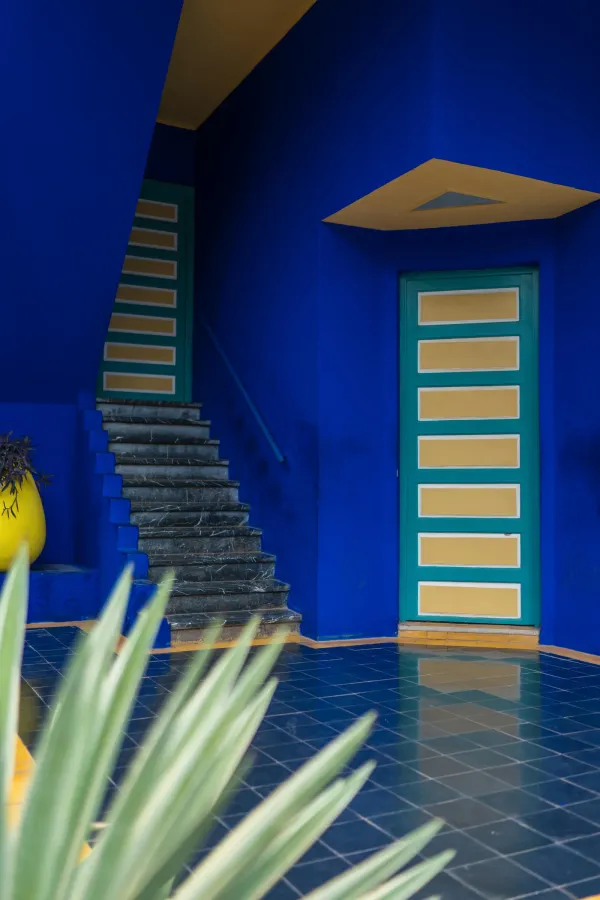
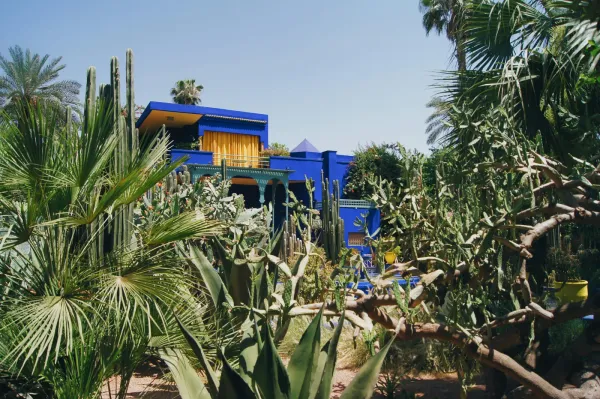
Majorelle Garden is the other pole of Marrakech. Silence. The French painter Jacques Majorelle created this garden in the 1920s: exotic plants from around the world, bamboo alleys, water lilies, cacti. And — colour. “Majorelle blue” — a vivid, ultramarine shade, a patented hue that Majorelle used to paint the pavilions and walls.
The garden fell into neglect after Majorelle’s death. In 1980, Yves Saint Laurent bought it — and saved it. He restored it, opened it to the public, and turned it into an oasis in the middle of chaotic Marrakech. Beside it stands the Yves Saint Laurent Museum. After the couturier’s death, his ashes were scattered in this garden.
The Bahia Palace dates from the 19th century: mosaics, carved plasterwork, gardens of orange trees. The Koutoubia Mosque is from the 12th century — a minaret 77 metres tall that served as the model for the Giralda in Seville. The medina is a labyrinth of thousands of stalls: spices, babouches (leather slippers), fabrics, copperwork, carpets. Bargaining is mandatory. The opening price is three to four times the real one. It is not a swindle — it is a game. And both sides know the rules.
The following day brought Essaouira. The ocean. The wind. The fishing port. And goats in trees.
Along the road — argan trees. Endemic to Morocco — they grow nowhere else in the world. Their fruit is pressed into argan oil — “liquid gold,” a litre of which costs ten times more than olive oil. Women’s cooperatives along the roadside do everything by hand: gathering the fruit, cracking the shells with stones, pressing the kernels on stone millstones. The process is slow, laborious. One litre of oil — from thirty kilograms of fruit. The scent is nutty, warm, deep.
And — the goats. Goats in argan trees. Not a photo edit. Not a staged scene. Argan trees are not tall, but they have wide-spreading branches and sturdy bark. Moroccan goats — nimble, fearless, hungry — have learned to climb them and eat the fruit. The sight is surreal: ten or fifteen goats perched in the branches of a tree like birds, chewing nuts with the composure of creatures who have no idea they are breaking the laws of physics. Along the road from Marrakech to Essaouira — dozens of trees with goats. Each one is a reason to stop for a photo. Every photo is extraordinary. And every one is real.
Essaouira is a city on the Atlantic. A different Morocco. Not hot — windy: the Atlantic breathes a cool freshness. Not red — white and blue: whitewashed walls, blue shutters, blue boats in the harbour. Portuguese fortifications from the 16th century — the Skala de la Ville — with cannons aimed at the ocean and towers where seagulls perch.
The fishing port is alive, noisy, smelling of fish and salt. Bright blue boats with painted eyes on the prow (to ward off the evil eye). Fishermen haul in nets. Seagulls cry. On the grills — freshly caught sardines, cooked for you in five minutes, right there in the port, for a couple of dollars.
Jimi Hendrix, so the story goes, lived here in 1969. Locals point out the house where he supposedly stayed. They show the café where he supposedly played. They say the song “Castles Made of Sand” is about Essaouira. There is no proof — Hendrix wrote the song before his journey to Morocco. But the legend lives on. And, honestly — it is beautiful. A city where the wind sings deserves a rock legend.
Blue Essaouira. The final colour in Morocco’s palette. White (Casablanca) — sky blue (Chefchaouen) — golden (Fes) — yellow (the Sahara) — brown (Ouarzazate) — red (Marrakech) — blue (Essaouira). Seven colours. Seven worlds. One journey.