You take a breath. Underwater. And nothing happens. That’s where it all begins.
You can’t explain your first scuba dive to someone who hasn’t tried it. Not because words fall short — there are plenty of words. It’s that your brain refuses to believe it actually works.
You put your face in the water. You breathe in through the mouthpiece. Air comes — dry, cool, with a faint taste of rubber and metal. This is compressed, filtered, and dried air from the tank, stored at 200 atmospheres of pressure. The regulator drops that pressure down to what you need — and you breathe. Underwater. Nothing stops you. Your lungs expand just like normal. You exhale — bubbles drift upward in a silvery cloud, and you hear the sound: a muffled gurgling that, within half an hour, will feel as familiar as the ticking of a clock.
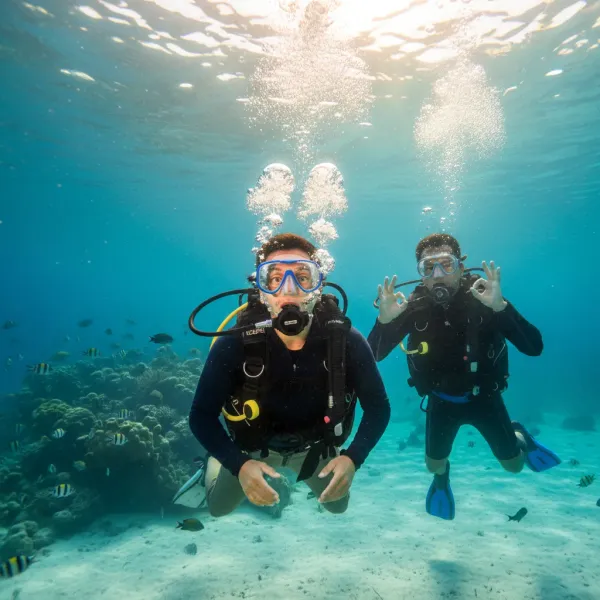
The first five seconds are shock. Not fear. Pure shock: your body can’t believe it’s been allowed to breathe somewhere breathing isn’t supposed to be possible.
The First 5 Meters
The instructor gives you the “OK” sign — a circle made with thumb and index finger. You mirror it back. He points down. You begin to descend.
At one meter, your ears press. You pinch your nose through the mask and gently equalize. A click — and the pressure levels out. Another meter. Equalize again. By the third meter, it’s automatic.
Somewhere between two and three meters, it hits. Not panic — more of an internal clenching. Every part of your body says: we are not supposed to be here. You grab the instructor’s hand. He looks at you through his mask and calmly shows “OK” — but not the round kind they taught you. His fingers are pinched tight together, no gap.
You look at the gesture and don’t immediately understand. Then you do — and you start laughing into your mouthpiece. Because the instructor just showed you the exact diameter of what your sphincter has clenched down to. And there was nothing to be afraid of.
Laughing underwater is gurgling, a fountain of bubbles, and a mouthpiece that keeps trying to pop out. But after it, the fear leaves. Physically. Like it got washed away.
At five meters, you stop thinking about the gear. About the technique. About the fact that “people aren’t actually supposed to breathe underwater.” Five meters is the threshold. Before it, you’re managing. After it, you start to look.
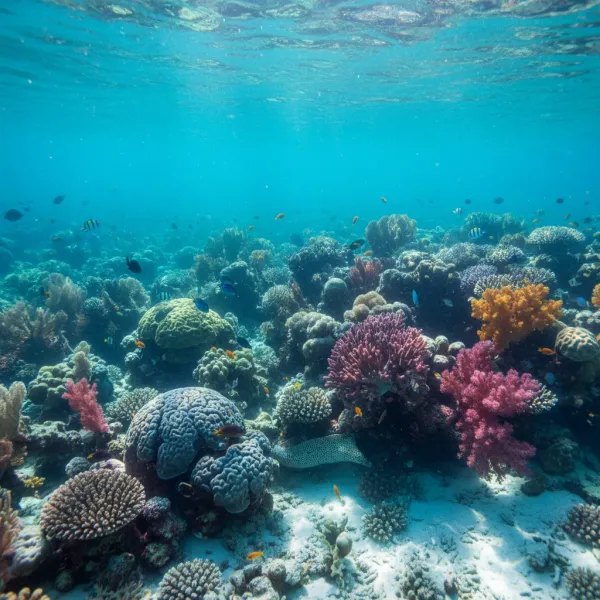
And that’s when the world flips.
A World Without Gravity
Underwater, there’s no up or down. Or rather, there is — the bubbles show you where the surface is. But your body doesn’t feel it. You hang suspended in the water like an astronaut in zero gravity, except instead of the blackness of space, you’re surrounded by light, color, and life.
Light passes through the water and bends. Colors shift — deeper, more saturated. Red disappears first, already at 5 meters. Then orange. By 15 meters the world has gone blue-green, as if someone has dialed one filter over all of reality. But inside that filter there are endless shades you’ve never seen before.
And silence. Not complete — you hear your own breathing, the clicking of the reef (that’s parrotfish biting corals — literally, with their jaws), sometimes the distant hum of a boat engine. But no voices, no street noise, no notifications. Just you and the water. Sound travels 4.5 times faster in water than in air — so the clicks seem three-dimensional, coming from everywhere at once.
People who meditate spend years trying to achieve a state of “here and now.” A diver needs five meters of depth.
The First Encounter
A clownfish. Orange, with white stripes, about the size of a palm. It lives in an anemone — a soft coral with venomous tentacles that are harmless to it. You swim closer. The fish doesn’t swim away. It looks at you. Literally — it turns and stares right into your mask.
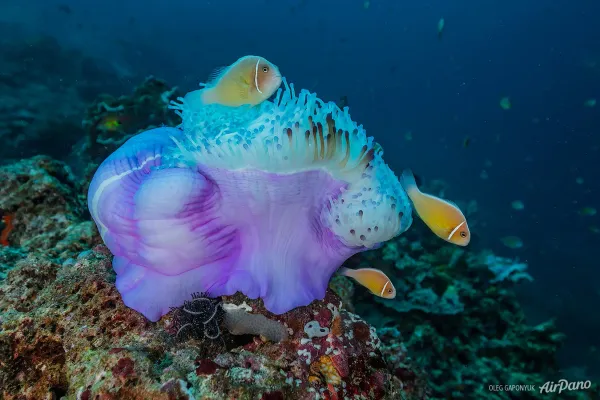
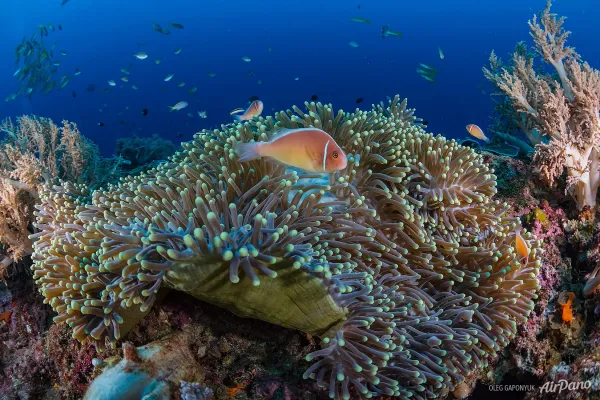
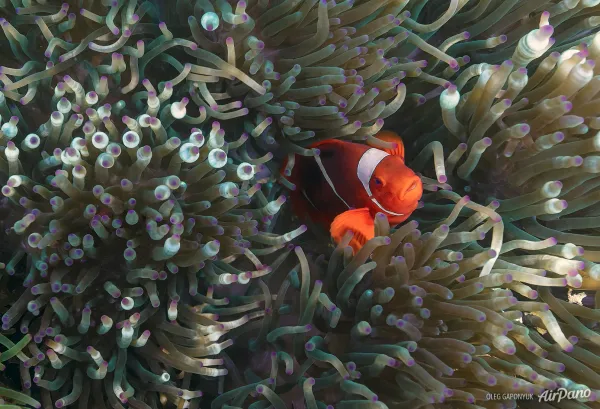
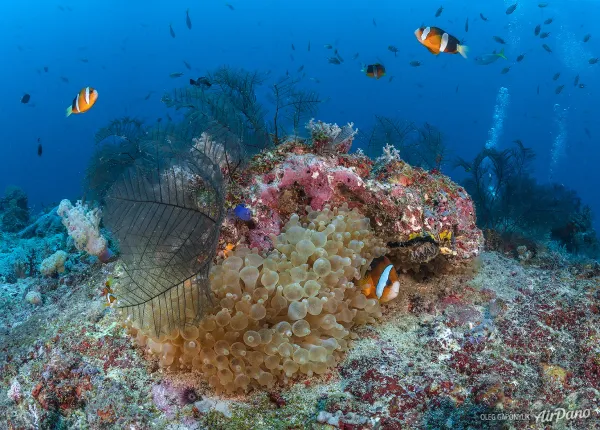
You freeze. It freezes. For two seconds you look at each other. Then it decides you’re not interesting and retreats back into the tentacles.
Two facts about this moment: 1. You just made eye contact with a creature that appeared on Earth 400 million years before you did 2. It decided you were not interesting. And somehow, that stings
What Happens to Your Body
The cold doesn’t come immediately. In the tropics the water is 28°C — for the first 20 minutes you feel nothing but a pleasant coolness. In the Red Sea in winter it’s 22°C, and after half an hour your 5mm wetsuit will remind you it exists for a reason.
Your breathing slows. Not because you’re trying — it just happens. Underwater, you automatically start breathing deeper and less frequently. Your heart rate drops 10–25%. Scientists call it the “diving reflex” — an ancient mechanism that triggers when cold water touches your face. Every mammal has it: dolphins, seals, you. The body switches into conservation mode: blood vessels in the extremities constrict, blood shifts toward the heart and brain, metabolism slows. In seals, the heart rate drops from 125 to 10 beats per minute. In humans it’s gentler, but enough to feel.
You’re not meditating. You’re diving. But the effect is the same. Psychotherapists, incidentally, use this reflex to stop panic attacks: submerge your face in cold water for 30 seconds. It works.
45 Minutes
A standard dive at 12 meters lasts 45–50 minutes. When the instructor signals to go up, you don’t believe that much time has passed. It feels like ten minutes, maybe fifteen.
You ascend slowly. You stop at 5 meters for three minutes — the safety stop. You hang in the water and look down at the reef that was just your entire world. Bubbles drift toward the surface. Sunlight pours through from above in shafts.
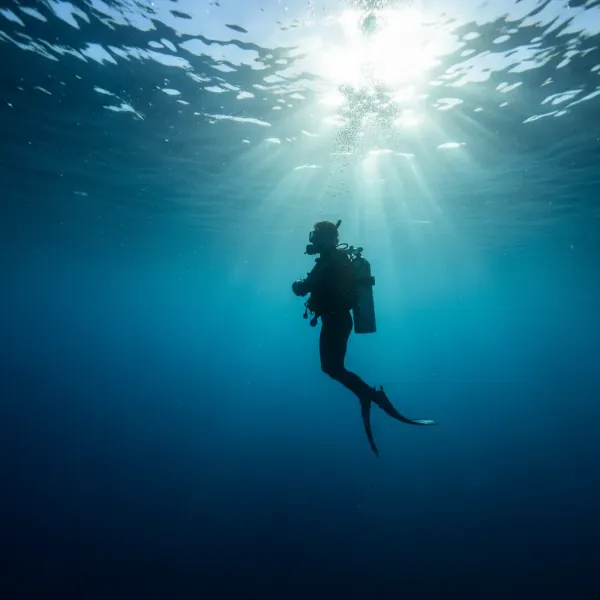
At the surface — heat, noise, the rocking of the boat. You pull off your mask. The world feels too loud, too bright, too dry.
And the first thought is the same for everyone who has ever dived for the first time: When can I go again?
How to Start
Your first dive is called a Discover Scuba Diving session (or intro dive). No certification needed, no experience required, no Olympic-level swimming ability — you just need to be comfortable in water and at least 10 years old.
The instructor covers the basics in 30 minutes on shore: how to breathe, how to equalize, how to communicate with hand signals. Then you get in the water — waist-deep first, then deeper. The maximum depth for an intro dive is 12 meters. That’s enough to see the reef, the fish, a sea turtle (if you’re lucky), and to know whether you want to continue.
If you do — the next step is the PADI Open Water Diver course. Four days. After that: a certification that’s yours for life and the right to dive to 18 meters anywhere in the world.
18 meters is the coral walls of the Red Sea. The turtles of Sipadan. The mantas of the Maldives. The underwater pinnacles of the Azores. An entire world that begins with a single breath underwater.
And if you want to understand what happens to the body at 30, 60, 100 meters — read How Deep Can a Human Dive.