December 31. Midnight Moscow time arrives here in the middle of the day — you meet it on the ice, glass in hand, among penguins. The second midnight comes in the evening, at the gala dinner. Between them: six hours and a day that never ends.
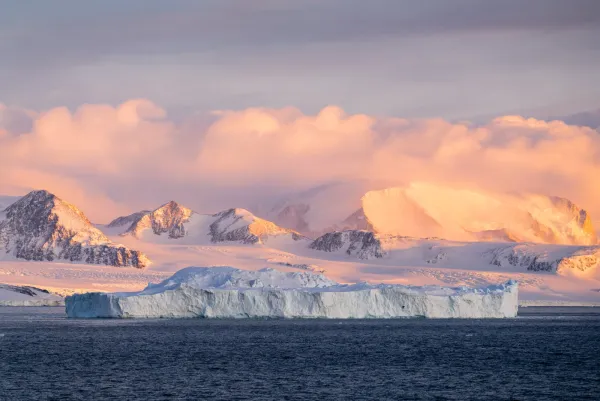
In late December the sun here barely sets. Twilight stretches on for hours, the icebergs turn pink and never fade, and at three in the morning there are people standing on deck who only came out for a minute.
One day. Two New Years. And not a single photograph that will convey what it was like.
The light needs explaining separately, or it won’t be believed.
The Antarctic Peninsula lies at roughly the sixty-fourth degree of south latitude. In late December that means twenty-odd hours of direct sunlight, and what remains can only be called twilight with some generosity: the sky doesn’t go dark, it simply turns pink and stays that way for several hours running.
The practical consequence is simple: there is no night. People lose track of when to go to bed. At three in the morning the deck is full of those who stepped out for a minute forty minutes ago. Someone brings out something hot. Nobody goes to sleep, because over there, at the edge of the ice, something is breathing again.
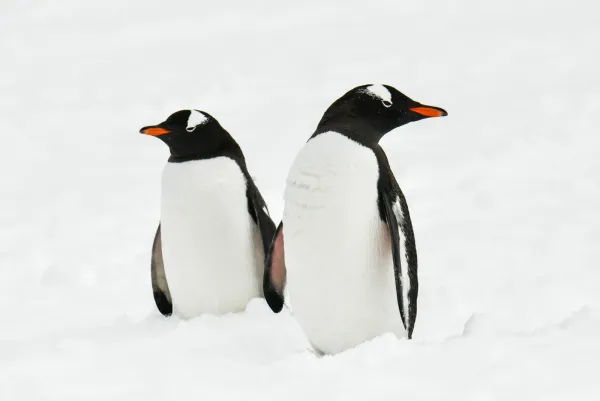
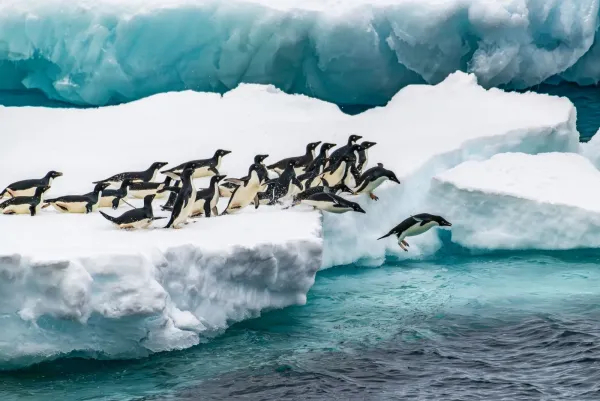
Late December is fortunate for another reason. Right in the middle and at the end of the month, the Adélie and gentoo chicks begin to hatch. The colonies are at their loudest and most chaotic: the slopes teem with grey fluffballs, parents shuttle back and forth with food, someone has lost someone, someone has stolen someone else’s pebble. And all of it round the clock, because there is no darkness and no reason to take a break.
Polite writing leaves out the smell, which is a pity: you hear a colony before you see it, and you smell it before that. Four thousand pairs of gentoos on a dry, sun-warmed rock smell sharp, warm and nothing like the sea — the wind carries it half a kilometre, and the whole boat pulls the same face at once. Ten minutes later you stop noticing. Half an hour later you’re sitting on a rock watching one particular parent return to the wrong nest for the third time in a row — and somehow this turns out to be more interesting than anything you’ve watched in the past year.
Now the night itself, because that is what all of this is for.
On December 31 the day goes on as usual: a landing, Zodiacs, lunch. The difference is that somewhere around lunchtime, Moscow midnight arrives — Argentina is six hours behind.
You meet it wherever it finds you: usually on the shore or on the ice. The expedition team brings out champagne, someone has thought to pack tinsel, someone is wearing an expedition parka over evening dress. Penguins wander about, entirely indifferent to the proceedings: it’s the height of their season, the kids are screaming, there’s work to do.
The toast is short — you can’t talk for long in the cold. Then everyone clinks glasses, laughs and takes pictures, and out comes the most absurd and best-loved photograph of the whole trip: fifteen grown adults with glasses in the middle of Antarctica, a penguin in the frame, half the glasses already empty because it’s cold.
Then back on board, a shower, a change of clothes — and here begins the second part, the one worth packing that dress for.
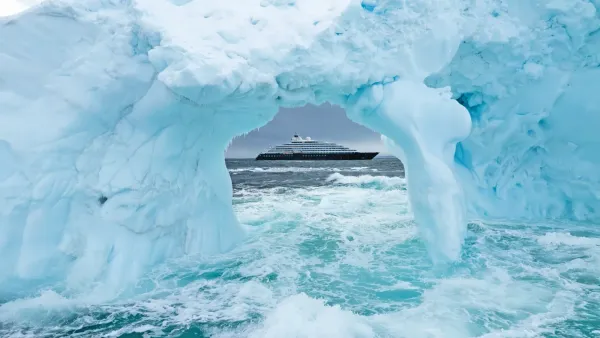
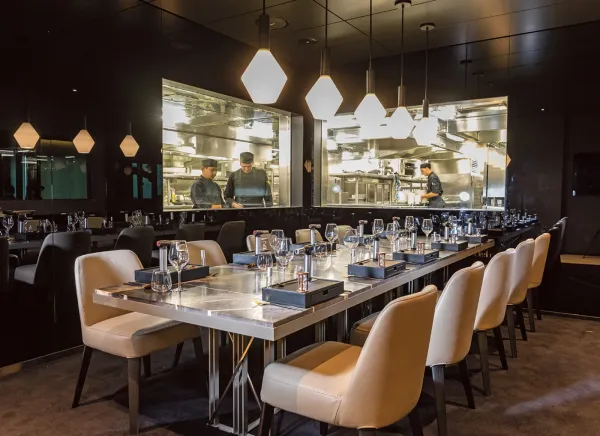
The gala dinner, on Argentine time. The ship lies still, the icebergs glowing pink beyond the panoramic windows because the sun has no intention of setting. The table is long, the captain gives a speech, the chefs come out into the dining room. The second midnight arrives the proper way — with chiming clocks, with music, and with people who two weeks ago had never met.
The menu for this evening is prepared separately and in advance. Over two weeks the chefs have had time to learn who doesn’t eat what, and at the gala dinner this suddenly shows: what is set in front of you is exactly the right thing. Argentine sparkling wine, then something to go with the fish, then the course that keeps people at the table to the very last. Two hundred people in evening dress in the middle of Antarctica look absurd right up until the moment you find yourself among them.
By one in the morning half the room has moved out on deck, because it’s light out there. By three, they’re still standing there.
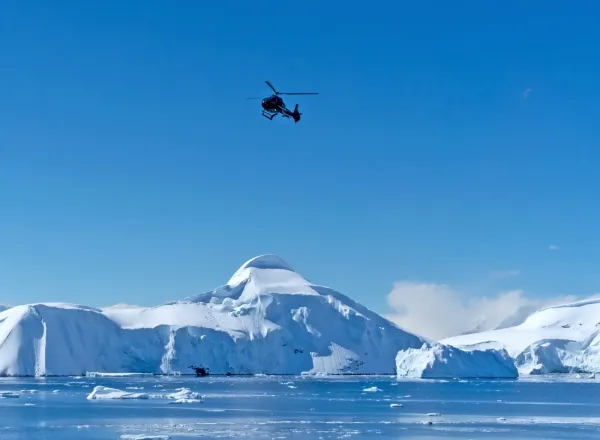
The New Year departure is December 28, thirteen days. The helicopter flight is included in the price.
The December departure is December 3, sixteen days. That’s the one with the Weddell Sea and the emperor penguins of Snow Hill Island, accessible only at the very start of the season, while the fast ice still holds.
The difference between the two departures isn’t in the days but in the ice. By late December the fast ice in the Weddell Sea retreats, and Snow Hill closes itself off — not by decision, but by physics. That’s why the December departure is longer and more expensive: it goes where, three weeks later, there is no getting through. The New Year departure takes something else — the light, the chicks, and that one date.
Sixteen days, December 3 — €22,575. Thirteen days, December 28 — €19,765. A Russian-speaking group on both, a Russian-speaking guide and lecturer, both departures on the same ship.
Briefly, about the New Year itinerary itself.
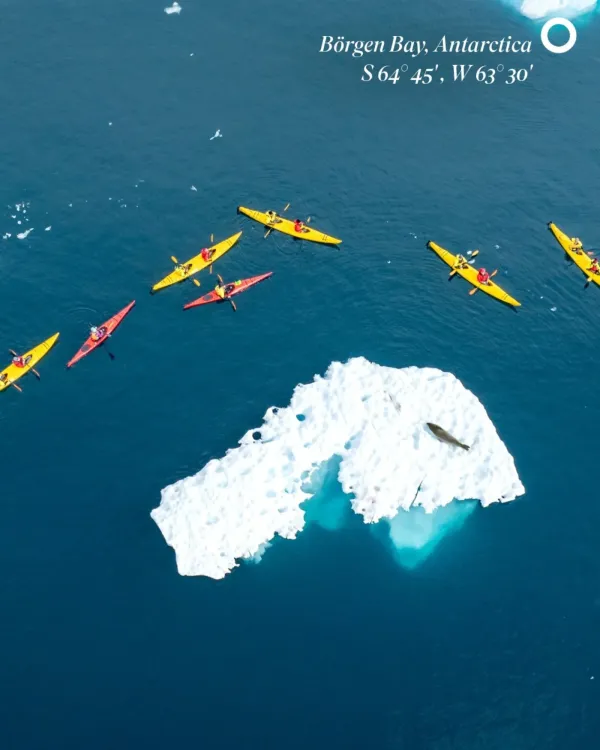
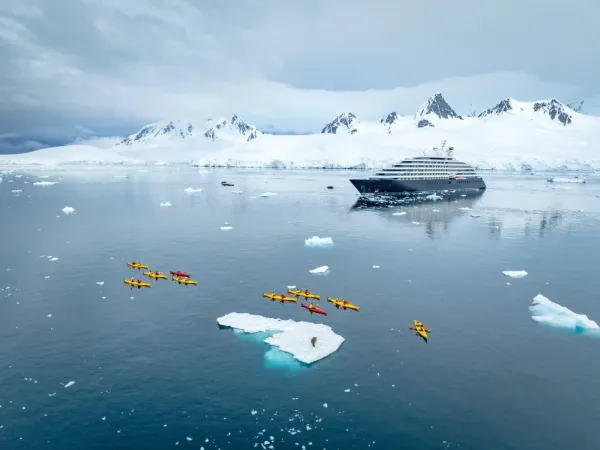
Thirteen days: Buenos Aires, a charter flight to Ushuaia, two days across the Drake Passage, then a week along the Peninsula with landings, Zodiacs, kayaks and the helicopter — and the Drake back again. The programme is rebuilt every day, according to the weather and wherever the whales happen to be: the expedition team announces the plan in the morning and calmly changes it by lunchtime.
A separate word about who you’ll be travelling with.
A Russian-speaking group isn’t a formality, and it isn’t about language. It’s about not having to explain a joke at dinner or translate a toast. About the guide and lecturer telling you about icefish in Russian, looking at you rather than into a headset. About everyone understanding, on December 31, why you’re walking out onto the ice in the middle of the day with a glass in your hand — because at that very moment, the Kremlin chimes are striking in Moscow.
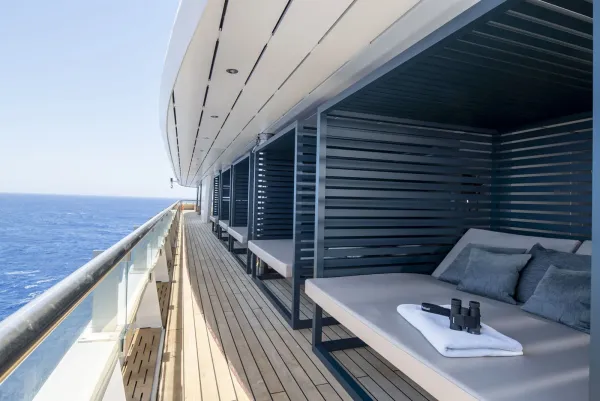
The crowd on such departures is predictable and pleasant: people who have already been everywhere that’s easy, and have come for what can’t be bought ready-made. Couples, families with grown children, groups of friends who once a year do something big together.
By day three everyone knows everyone. By day seven the bar has its regulars. By the final evening it emerges that half the table has friends in common — and honestly, this happens on every trip like this.
And this, incidentally, is the only part of the journey that can’t be planned in advance. The ship, the helicopters, the dinners — those can be bought. The company at the table can’t. It assembles itself, out of people whose time, means and desire to spend December 31 exactly this way, rather than somewhere warmer, happened to coincide. That coincidence happens to roughly a hundred people a year on the entire planet.
A separate word about the final days, because they usually go undescribed, and that’s a pity.
The return crossing of the Drake is not lost time. The deck watch continues: the whales are heading the same way you are, and they escort the ship for hours. The team puts on evenings where the footage is shown: over the voyage the photographers gather thousands of frames and cut a film, and you watch yourself two weeks ago — a person who did not yet know what silence in the Weddell Sea sounds like.
At these evenings a curious thing emerges: everyone’s pictures are different. One person shot nothing but ice. Another only birds. A third spent two weeks photographing his wife against ice and birds. The shared film is cut from all of it at once — and the result is a journey that nobody had on their own.
On the last evening, the captain’s farewell dinner. It turns out unexpectedly warm, because over two weeks two hundred people stop being two hundred strangers. Someone gives a toast, someone arranges the next trip, contacts are exchanged, and half of those contacts will actually come in useful later.
In the morning, Ushuaia. Mountains, the port, gulls, warmth, a sense of being overwhelmed by the sheer number of objects around you. Two days later — home.
Home is the most interesting part.
For the first few days you catch yourself finding it too noisy. Not loud — noisy: too many sounds made by people, and they never switch off. It passes in about a week, and almost everyone who has been there remembers that feeling afterwards, rather than the icebergs.
And people will ask how the trip was.
You’ll start to tell them — and stop at the second sentence, because the words aren’t there, and in the photographs everything looks smaller than it was. An iceberg the size of a city block comes out as a white streak on the horizon. The roar of four thousand birds doesn’t come out at all. The silence even less so.
They’ll ask you to say it again. Not because they didn’t understand — because they can’t picture it.
And they really can’t. Last season, one hundred and thirteen thousand five hundred people visited the whole of Antarctica — out of eight billion alive. Of those, a small fraction entered the Weddell Sea: the ice lets you in there, not the ticket office. The number who reached the colony on Snow Hill could be seated in a single room.
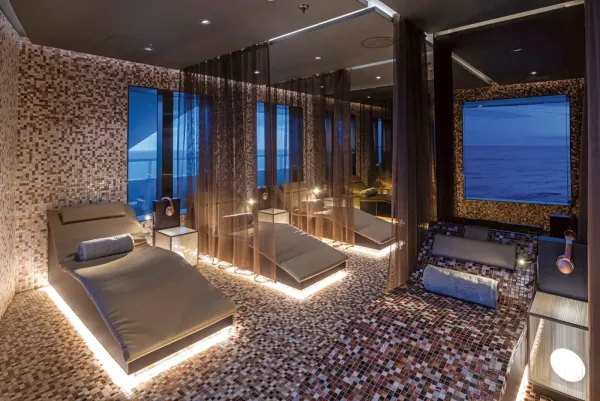
So the question this all began with — why a ship heading where there is nothing needs two helicopters, a submarine and a butler — has a dull answer. Because otherwise you won’t see any of it. The helicopter gives you scale, the submarine gives you depth, and the butler, the spa and proper food give you what runs short by day ten — the strength to go out on deck one more time.
And that stays with you. Not in the telling — the telling won’t work. In your head: the roar of the colony, an exhalation five metres from the hull, blue light beyond the submarine’s porthole, two midnights in a single day.
On December 31, at three in the morning, it will be light on deck. Someone will bring out something hot. Nobody will go to sleep.