In the morning, your butler presses your expedition jacket. Two hours later you will be wearing it, knee-deep in snow, walking toward the penguins. The penguins won’t care. You will.
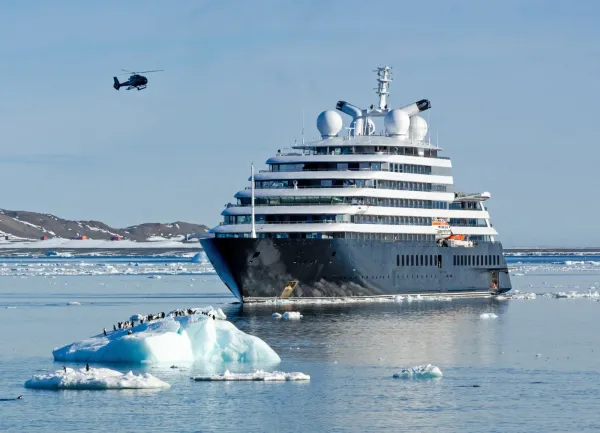
Scenic Eclipse carries two hundred and twenty-eight guests, and on polar voyages — two hundred: fewer people on board, more landings a day. The crew is almost one to one. Every suite comes with a butler. The hull is ice class 1A-Super, the highest among passenger ships.
Why so much service in a place where all you need to do is look out the window?
Because two weeks in the least hospitable place on the planet can be spent in one of two ways. Endured — or lived. The difference isn’t snobbery; it’s how much energy you have left to look around on day ten.
And because here the size of the ship decides not comfort, but access.
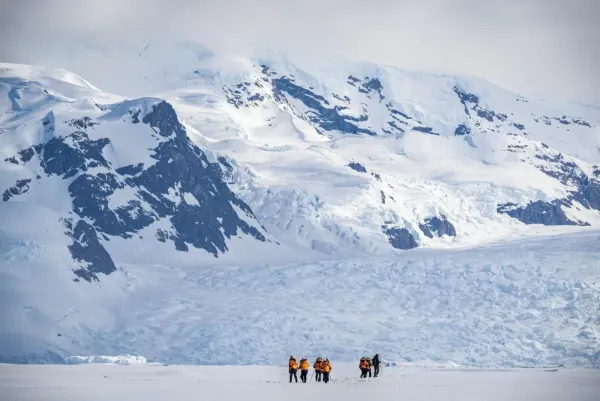
The rules in Antarctica are simple and strict. No more than a hundred people may be ashore at any one time. Ships carrying more than five hundred passengers are not allowed to land anyone at all — they sail past and look from the deck. For every twenty guests ashore there must be a guide.
This is observed to the letter. Before and after each landing, boots are washed and disinfected, and jackets and tripods are vacuumed for seeds: nothing living may be brought ashore. The procedure takes a minute and looks like a formality — right up until you see how much shakes out of the velcro on your sleeve.
Hence all the arithmetic. Scenic Eclipse carries two hundred and twenty-eight guests, and on polar voyages — two hundred. Two hundred people split into groups of a hundred, the groups alternate, and everyone gets ashore several times a day. On a ship with six hundred passengers you would never set foot on land at all. The two-hundred cap isn’t about exclusivity; it’s about whether you will stand on an Antarctic shore or look at it through glass.
The crew is almost one to one with the guests. Every suite comes with a butler. The hull is ice class 1A-Super, the highest among passenger ships: it doesn’t merely “sail in ice”, it works in it.
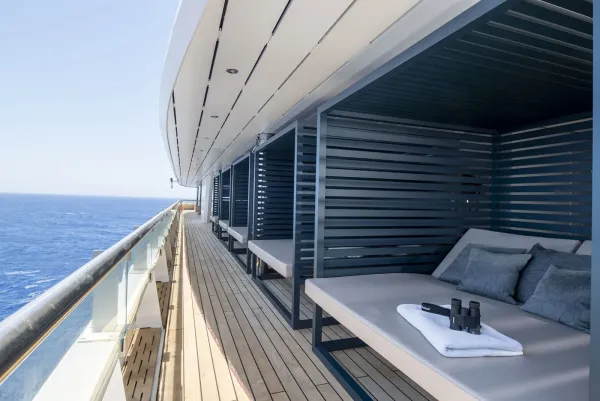
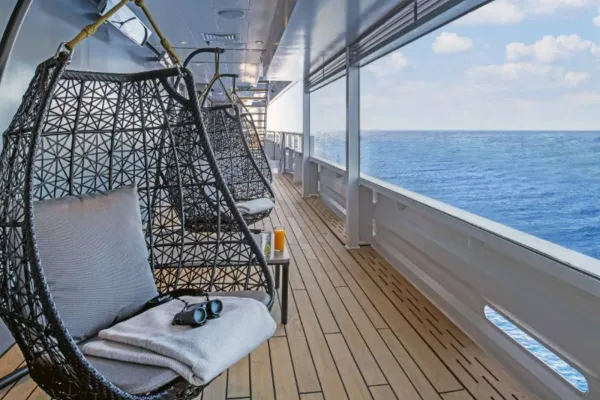
The day goes like this.
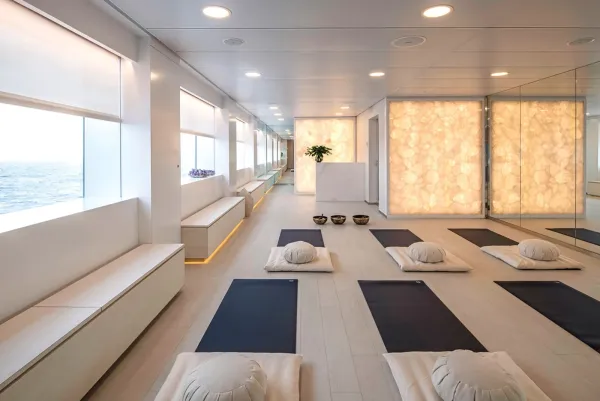
Morning begins in the yoga studio: floor-to-ceiling panoramic windows, singing bowls, and icebergs drifting slowly past the glass. Or it doesn’t begin there — breakfast is brought to your cabin, if you’ve asked. You open the curtain, and there is a glacier.
By day — Zodiacs, landings, kayaks, lectures in the theatre. The expedition team works by the weather, not by the timetable: the plan for the day is announced in the morning and calmly changed by lunch, because a passage has opened over there, and whales have settled over here. This, too, is part of the pleasure — discovering that the route adapts to what is happening, not the other way round.
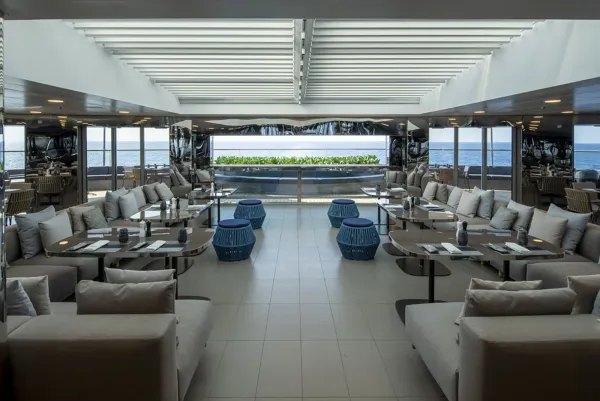
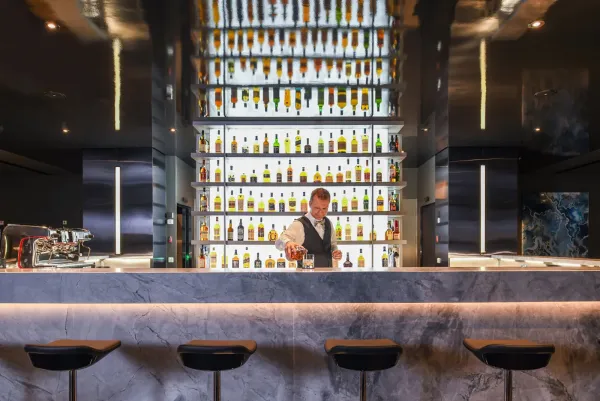
Evenings — the restaurants. French, Asian, Japanese, a steakhouse, an open kitchen where you can watch the chef’s hands. A bar with a marble counter and a display case holding a hundred and thirty whiskies. The nearest shop is two thousand kilometres away, so the stock was laid in with a margin.
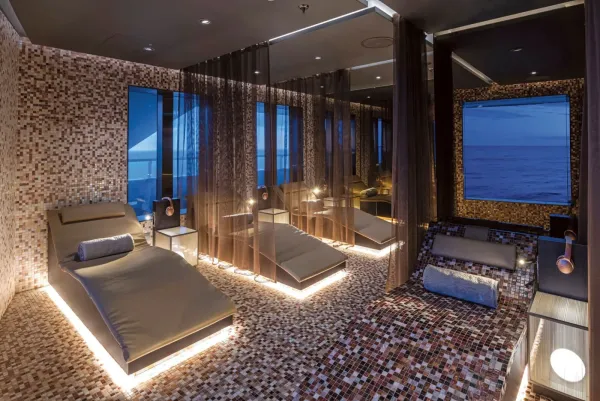
The Senses spa, with a pool and jacuzzi. Everything is included: the bar, the minibar in your cabin, gratuities for the crew. The expedition jacket is yours to keep; the landing boots are issued on board — the very ones nobody wants to take off afterwards.
A separate luxury you don’t notice at once: there is no signal here. For two weeks your phone is a camera, the mail piles up, and nobody expects anything of you. The chance not to reply is not the least of the reasons people come here, though it is rarely said aloud.
And a living person instead of an app. An expedition team, not an audio guide. A Russian-speaking guide and lecturer who explains what you are looking at — looking at you, not into an earpiece. A butler you can simply talk to, rather than file a request with. At the gala dinner it turns out that half the table are people you would gladly have dinner with back home, and the conversation runs until one in the morning — helped by the fact that it’s still light outside anyway.
It all begins, however, not with ice.
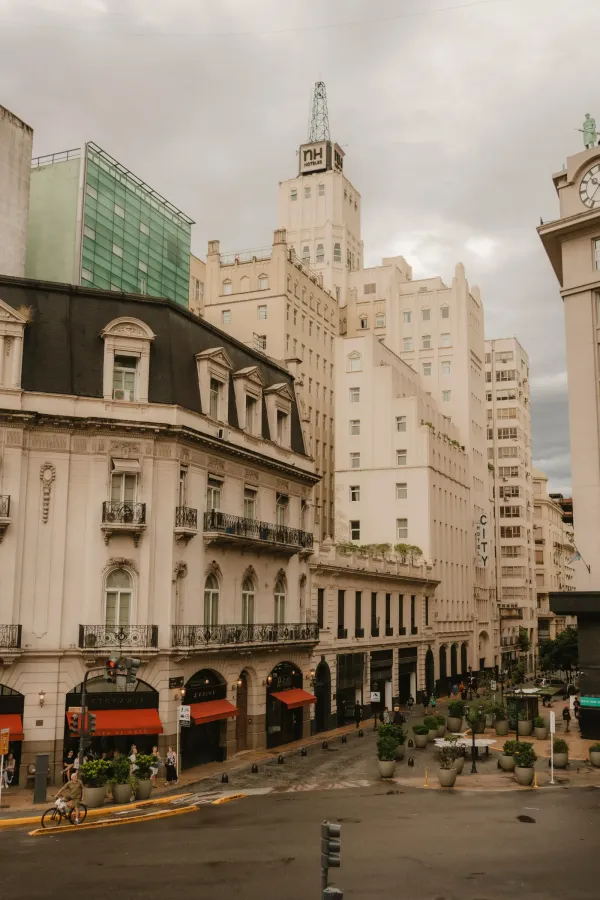
Day one is Buenos Aires: a five-star hotel and a city where you will be hot. The only time on the whole trip. San Telmo with its nineteenth-century mansions, La Boca with its multicoloured facades, tango in the courtyards, and beef that people travel here for on its own. The difference between this evening and what begins a day later is such that your mind later refuses to file them under the same trip.
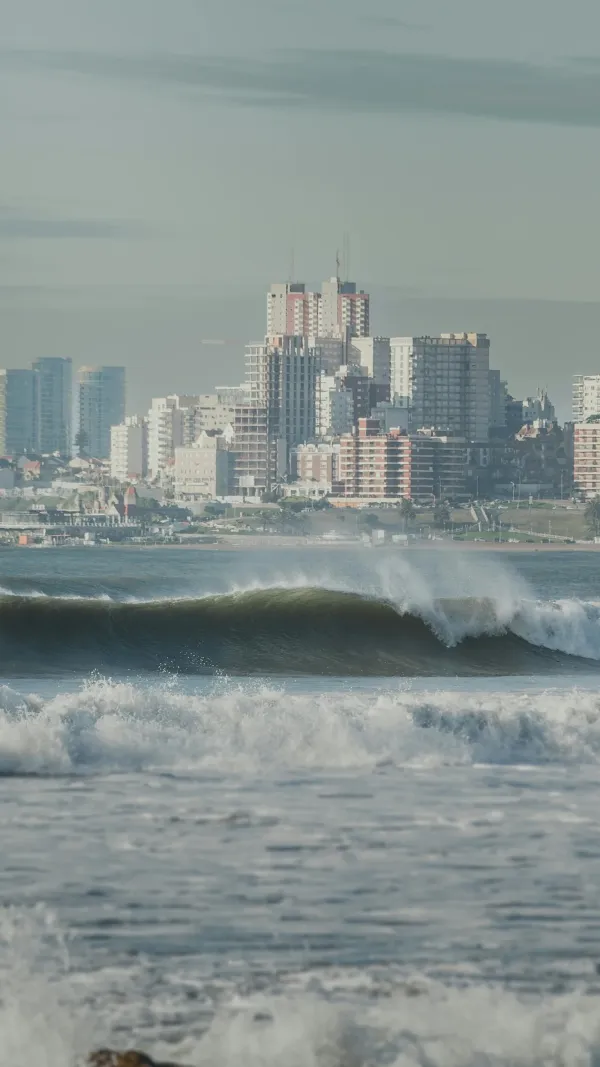
The next day — a charter flight to Ushuaia, the southernmost city in the world. A port, mountains rising right behind the houses, the Beagle Channel. Here you board the ship, and here the signal ends.
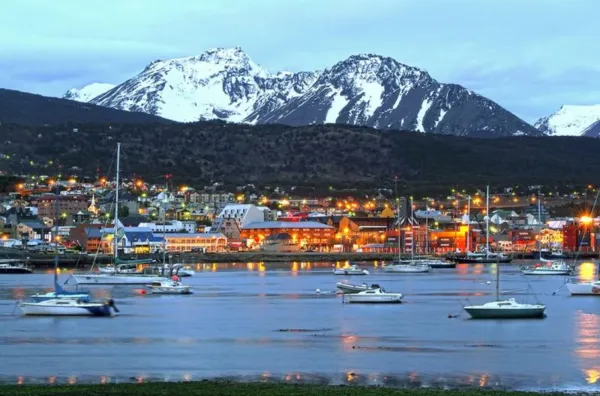
Then two days of the Drake, and they are important days: over them, the group becomes a group.
There isn’t much to do, so everyone goes to the theatre for the lectures. The expedition team are not entertainers: they are ornithologists, marine biologists, glaciologists, polar photographers, each with a subject of their own. In two days you learn how an Adélie differs from a gentoo, how an iceberg is built inside, and why the fish here have transparent blood. By the first landing you already understand what you are looking at — and that changes everything, because what is understood is remembered, and what isn’t is merely beautiful.
The lectures continue after that, every day, for the whole voyage. The schedule goes up in the evening, and by the third day people are choosing them not out of politeness but in earnest: to skip the lecture on ice and then spend half a day looking at ice would be a shame.
Between lectures — lunch, the spa, a book, the deck. Someone is catching an albatross in the lens, someone is asleep, someone has already met everyone. By the evening of the second day a circle forms in the bar that will gather in the same place every remaining evening.
A cabin on this ship is not a cabin in the usual sense. A suite with a separate sitting room, the bed facing a panoramic window, and most categories have a balcony. The minibar is stocked to your list, not to a standard. The butler unpacks your things if asked, and presses your jacket before a landing — that same expedition jacket, the one you will be given, and will later wear at home, prompting questions.
Another thing you only find out on the spot: people eat a lot here and don’t put on weight at all. Landings, kayaks, stairs between decks, and cold that burns calories all by itself. By the end of the trip people are in decent shape, although for two weeks they ate four times a day and tried everything.
Food deserves a more specific word, because “restaurants on board” is an abstraction, and lunch is not.
The kitchens are different and all run at once: French with classic presentation, Japanese with raw fish, Asian fusion, steaks, Mediterranean. There is a place with an open kitchen where you can sit at the counter and watch the work. Breakfast runs long, because everyone comes back from the early landing at different times. Lunch is often laid on deck, weather permitting — eating in the frost under a blanket turns out to be unexpectedly pleasant.
The menu changes daily, and by the fourth day you stop reading it: easier to ask what turned out well today.
A category of its own is what happens late in the evening. The ship is under way, it’s light outside, someone who can’t sleep turns up in the bar, then a second, then someone from the kitchen with whatever is left. Officially the kitchen is closed at this hour. In practice, on a ship like this, that’s a relative notion.
About the crew. Two hundred guests and nearly as many crew means that by day three you are known by sight everywhere on the ship. The bartender remembers what you drink. The waiter remembers what you don’t eat. The butler appears before you’ve managed to ask for anything and vanishes when not needed — a skill rarer than it seems.
This is that very difference between service and being served, and it’s what one pays for here. No app can do it, and none will learn to in the foreseeable future.
You notice it in small things. You come back from a landing — the cabin is already dry and warm, and the wet things have been taken away. You mentioned at breakfast that the coffee was a little weak — the next day it’s different, and nobody told you or reminded you. The point isn’t that it’s expensive. The point is that you don’t have to think about anything.
In the evenings the theatre is open: lectures, documentaries, sometimes live music. Then the bar. By the end of the first week the bar has its own circle, and the talk there isn’t about Antarctica but about everything under the sun, as happens with people kept in one place for two weeks without internet.
Now, honestly, about who shouldn’t come.
Sixteen days is a long time. The Drake Passage is crossed twice, and it comes in two states that sailors call the “Drake Lake” and the “Drake Shake”: in the first case you’ll be surprised there was nothing to fear; in the second, everyone will have tablets in their pocket. The stabilisers help, but the ocean is the ocean.
Landings take place below zero. Wake-up comes in the dark — for the light that lasts forty minutes and is worth it. The programme changes without warning, because the weather decides, not you. If what you need is a predictable holiday by the pool, there are places where that works better and costs noticeably less.
Everyone else gets what is not handed out anywhere else: a noble silence outside the cabin window — and a hot shower twenty minutes after it.
And on one of these departures there comes a night that is celebrated here twice. Six hours apart.