In the ship’s hold sit two helicopters and a submarine. Not decorative, not there for the photographs: seven seats — a pilot and six passengers — with a working depth of three hundred meters.
From above and from below — two views you will never get from the deck. And this is not about a greed for attractions. From the water, the scale of Antarctica simply does not register: the eye has nothing to hold on to, nothing to compare against, and the brain dutifully reports “beautiful” without understanding what it is looking at.
Twenty minutes in the air — and everything falls into place.
First, why any of this is needed at all — otherwise it looks like a collection of expensive toys.
From the water, the scale of Antarctica does not register. The eye has nothing to hold on to: no trees, no buildings, no people, no objects of any known size. The brain dutifully reports “beautiful” and “a lot of white,” but does not understand what is in front of it. People come home with hundreds of photographs in which everything looks half the size it really was — and that is not about the camera, it is about the vantage point.
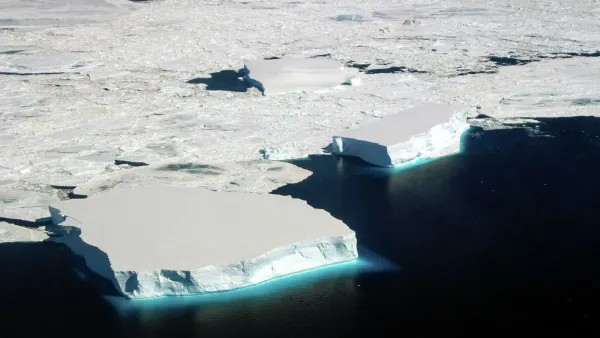
A helicopter solves the problem in twenty minutes.
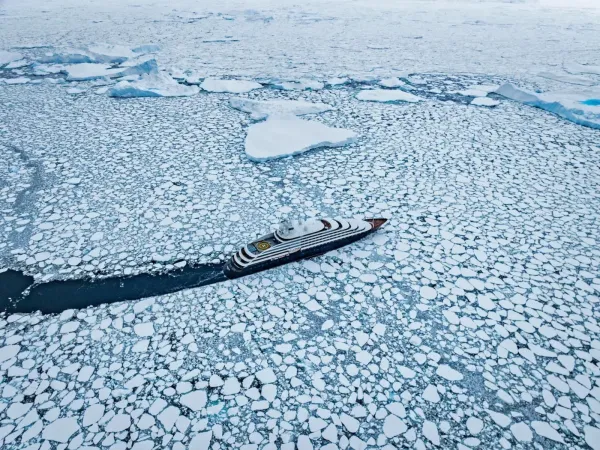
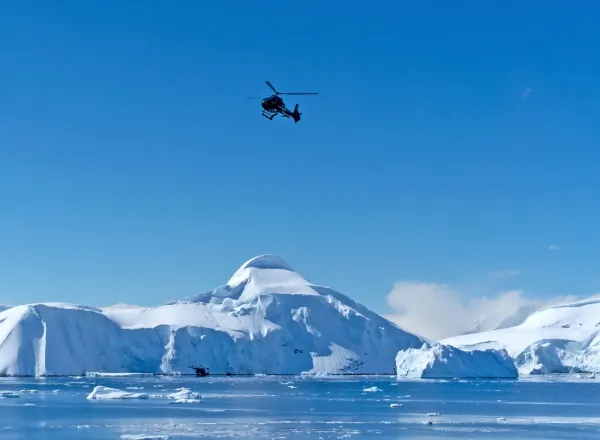
The machine lifts off, and the picture instantly snaps into place. The iceberg that looked “large” from the deck turns out to be the size of a city block. The ship beneath you is a splinter in a white field, and by that splinter you finally grasp the size of everything else. The cracks in the glacier resolve into a pattern invisible from below: from above it looks like skin that has split under tension. On the New Year departure this excursion is included in the price — thirty minutes, twenty of them in the air.
Going down, you take the Scenic Neptune. Seven seats: a pilot and six passengers, working depth three hundred meters. The hatch closes, the sub pulls away from the ship’s side, and the light from above slowly turns blue — that particular blue you only get in water with nothing suspended in it. Remember the disc that was visible at seventy-nine meters? This is it, seen from the inside.
It is not empty down there, as people tend to assume. It is unexpectedly crowded, and the residents are an attraction in their own right, because in cold water living things do not grow by the usual rules.
The phenomenon is called polar gigantism. A sea spider that measures two or three millimeters across in European waters grows to thirty-five centimeters here — the size of a dinner plate. Relatives of the woodlouse reach fifteen centimeters. Sponges live for several hundred years and stand on the seabed like furniture.
The explanation is simple and elegant: a liter of water here holds roughly twice as much dissolved oxygen as in the tropics, and in the cold, metabolism runs slowly. Plenty of fuel, low consumption — you can afford to be big.
An iceberg from below deserves a look of its own. From above it is a slab; from below it is an entirely different object: sculpted by the water, scored with channels, glowing blue from within, and reaching down several times deeper than it rose above the surface. The sub moves along it, and the realization that all this time you had been looking at the very top comes suddenly.
The fish are a story in themselves. Antarctic icefish carry antifreeze proteins in their blood: they latch onto nascent ice crystals and keep them from growing or clumping together. Their blood, meanwhile, is almost transparent. A creature that lives in water below zero and does not freeze, because it has natural antifreeze in its veins.
Even among those who have made it to Antarctica at all, only a handful have gone beneath the surface. The dive sites here have never been properly described — simply because nobody has reached them.
Before the descent, the pilot admits frankly that he does not know what will be outside today. Coming from him, it sounds not alarming but enviable: here is a man who goes to work in a place that is new every time.
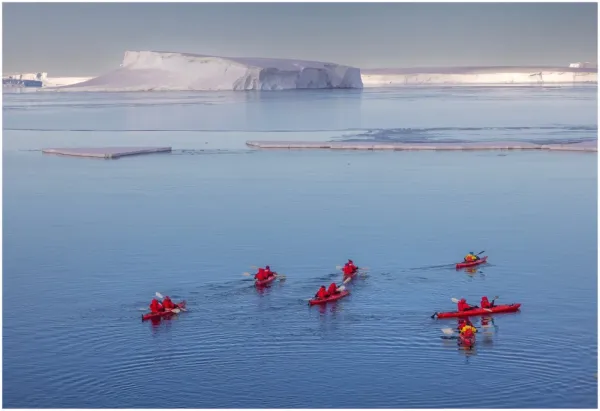
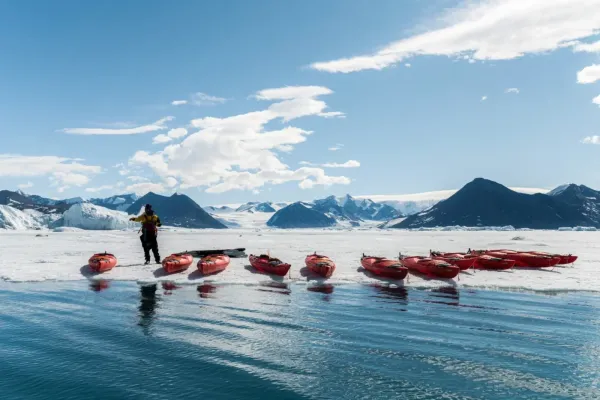
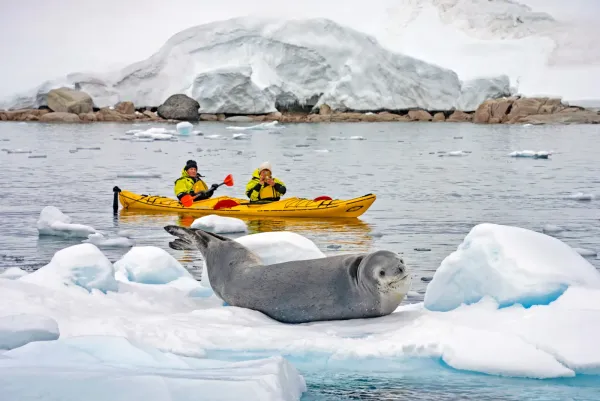
Between the sky and the deep there is a third option, the quietest one, and many end up calling it the best.
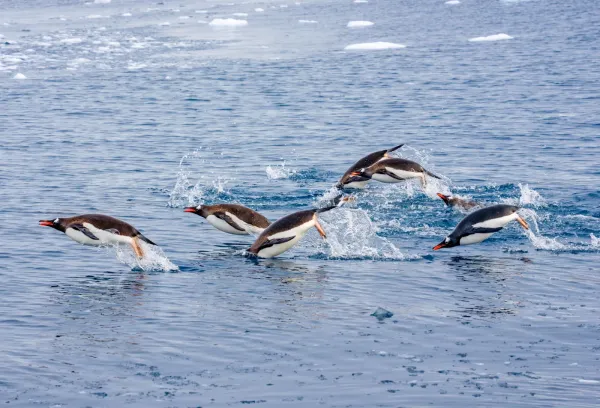
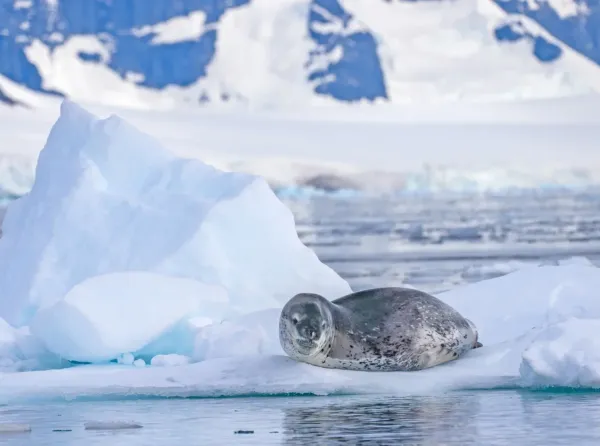
Kayaks and paddleboards go without an engine. This changes absolutely everything: the animals stop registering you as a nuisance. Penguins come up on their own, because you are not in their way, and pass within two meters — like torpedoes, leaving a trail of bubbles behind them. A seal on an ice floe lifts its head and lowers it again.
Physically, it is pleasantly arranged too. The paddle is heavier than it looks; after an hour your palms are buzzing, your back is warm under the membrane, and your face is freezing. You can hear the bow of the boat rustling through fine ice crumb — a sound like ice being crunched in a glass. The guide stays alongside and now and then says “stop,” and everyone freezes, because there is someone up ahead.
And there is a rite that almost nobody passes up — the polar plunge. A jump from the platform into water at around zero degrees. You are on a safety line, the crew is standing right there, and the whole thing takes about thirty seconds: the shock of the cold, a brief moment of total incomprehension, hands on the ladder.
Thirty seconds. You will be telling the story for the next ten years. The best ratio of your life.
Then a bathrobe, the jacuzzi, and that particular state when the body has just been in icy water and now feels very, very good. Someone brings something hot. Beyond the glass, an iceberg the size of a city block drifts slowly past, and you already know it is the size of a city block, because today you saw it from above.
The dive is run as a matter of routine, which only makes it more interesting.
The sub is lowered by crane from the stern, and you board it right at the ship’s side. Inside it is snug and cramped, with a panoramic view — a transparent sphere holding six people and a pilot. The hatch is closed from the outside. Then a brief exchange with the bridge, and the descent begins.
For the first few meters nothing happens. Then the green tint goes, then the yellow. By fifty meters only blue remains, even and deep, and above you can see the surface — from below it looks like a mirror of mercury with waves running across it.
At depth the lights come on, and color appears. It is unexpectedly vivid: red starfish, orange sponges, yellow lichen on the rocks. None of it has been lit by anyone for millions of years, and it had no idea it could be red.
The helicopter route deserves a more precise description too, because “a flight over the glacier” sounds abstract.
The machine pulls away from the ship, and for the first few seconds you look down at your own deck — it is rapidly turning into a toy. Then comes the ice: broken at first, then solid, then the glacier itself, descending from the mountains to the water and ending in a wall as high as a nine-story building. From the water that wall reads as a white stripe; from above you can see that it runs for kilometers, and that pieces regularly break away from it.
On the way back the pilot usually makes a circle over the ship. Two hundred people, ten decks, a helipad, a swimming pool — and all of it a dot in a white field with nothing else in it all the way to the horizon. The moment it finally sinks in where you are.
Flights, by the way, do not happen every day or on a schedule. The weather here changes within half an hour; departures are cancelled, then announced out of the blue — over the PA, ten minutes before boarding. So by the middle of the trip, your jacket and gloves stop going back into the wardrobe and live on the chair by the door.
The paddleboard is the most underrated item on the whole list. Standing on a board, you are higher than in a kayak and can see several meters down into the water beneath you: the very water in which a white disc is visible at seventy-nine. Ice floes pass beneath your feet, and every so often something alive passes too.
Photography here is easy and pointless at the same time. Easy — because there is plenty of light, it is soft, and it lasts for hours. Pointless — because the scale does not carry: a picture of an iceberg the size of a city block looks like a picture of a snowdrift. The only trick that works is to put a Zodiac, a kayaker or a person in the frame. Which, incidentally, explains why all the best Antarctic photographs are taken from the water, not from the ship.
Kayaking is worth going into in more detail, because it is what people remember most often afterward.
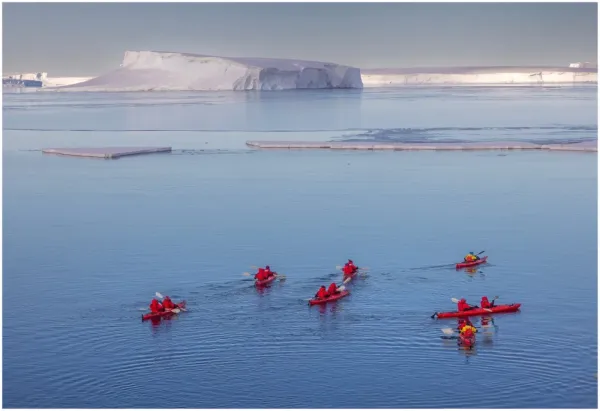
The group is small, and not everyone goes out — it takes a minimum of fitness and a willingness to be cold. You get help dressing: a drysuit, a spray skirt over the cockpit, gloves, a life jacket on top. For the first five minutes everything is uncomfortable. Then you move some two hundred meters away from the ship, the guide asks you to stop, everyone lays down their paddles — and there it is.
You can hear ice crumb rustling along the hull. You can hear the ship’s generator running far behind you, and it is the only mechanical sound in the entire bay. Everything else is water, ice and birds.
A penguin passes beneath the boat and surfaces on the other side. A seal on an ice floe lifts its head. The iceberg you are passing is reflected in the water so precisely that the horizon disappears and you cannot tell which way is up.
The polar plunge is done in different ways, but usually in a sheltered bay and always with the crew standing by. The line forms on its own, and in it stand people who only yesterday were saying there was no way they would go in. Almost everyone jumps.
Declining is perfectly normal, and nobody treats those who decline any differently. It is just that somewhere around the third day it turns out that the person who said a firm “no” two days running is now asking the crew what to wear.
The sensation is described the same way by everyone: a blow, after which the mind stops working for a second. Not “cold,” but a complete shutdown of thought. Then it switches back on, and the first thing you understand is: get to the ladder. You climb out, you are handed a towel and something hot at once, and all around there is laughter and applause.
Then the sauna, the jacuzzi, and an hour during which you feel inexplicably wonderful. The body releases everything it has, and for the next few hours you are in a state that people elsewhere pay extra for.
And an hour after that, you sit down to dinner. Outside the window — a seal colony. In front of you — the wine list.