Orcas find a seal on an ice floe. They charge together, dive at the last moment — and raise a wave that washes the seal into the water. Scientists first saw it in the early seventies. Then they did not see it again for thirty years.
The technique is called wave-washing. When film crews finally arrived here with cameras, the behaviour was written up in numbers: one hundred and twenty waves over twenty-two attempts, three quarters of them successful. This is how Type B orcas hunt, and they live here, off the Antarctic Peninsula.
Most people on the planet have seen it on a screen.
Let us begin with why everyone is here in December in the first place.
The ice retreats, the daylight stretches to twenty hours, the water blooms with plankton — and the krill rise after it. A tiny shrimp-like creature the length of your little finger, gathering in swarms the size of a city block. Everyone that can swim this far comes for those swarms.
Sometimes you can see a krill swarm right from the deck: for a few hundred metres the water turns a rusty pink and stirs ever so slightly. There are always birds hanging over a patch like that, and if you stand and watch for a minute, something will come up to it from below. The whole Antarctic December is built around this little crustacean, and everything you have come to see is, in essence, a queue for it.
The humpback whales arrive from the tropics just in time for December. There are around three thousand of them off the Antarctic Peninsula, and that is one of the most encouraging figures in a century of conservation: the population has recovered to roughly ninety-three percent of its original size. An adult humpback eats up to a tonne and a half of krill a day.
They eat inventively. Several whales spiral in beneath a swarm and release air from their blowholes — the result is a ring of bubbles, a wall the krill dare not cross. The swarm packs into a dense ball, and the whales rise through it from below with their mouths open. From the surface you see only a circle of bubbles, and then — three open mouths breaking the water at once.
The technique is not innate — they learn it from one another, and whales in different parts of the world perform it differently. Which means humpbacks have local traditions that are passed on, altered and spread through the population, like fashion.
The blue whale is the largest animal in the history of the Earth. Up to thirty-three metres. Not “the largest alive today” — the largest, full stop: bigger than any dinosaur you can name. Meeting one is a rarity even here, and when the bridge announces a blue whale ahead, the deck empties in forty seconds.
But what works on you most is not the size — it is the behaviour. A humpback surfaces twenty metres from the ship, rolls onto its side and looks up. With one eye, straight at the deck where you are standing. It lasts about ten seconds, and for those ten seconds nobody says a word — which, for a group of adults, is a near-impossible result.
Then it goes down, showing its tail, and a smooth patch is left on the water — the “whale’s footprint”, flat as spilled oil in the middle of the ripples. It holds for a minute and dissolves.
Now about the orcas and the one hundred and twenty waves.
The orcas of Antarctica are divided into several types that do not mix: different prey, different habits, even a different pattern of markings. Type B are the ones that live along the ice edge and hunt seals. It is to them that a technique worth knowing about belongs.
They find a seal on an ice floe. They approach, lift their heads above the water to get a proper look at it, and spread out. Then they go in formation, all together, gathering speed, and at the last moment dive under the floe in unison. The wave they raise sweeps over the edge and washes the seal into the water, where the others are waiting.
Scientists first saw it in the early seventies. Then they did not see it for about thirty years — they simply never happened to be in the right place at the right moment. When a film crew finally found itself alongside with cameras, the behaviour was described in numbers: one hundred and twenty waves over twenty-two attempts, three quarters of them successful.
Most people on the planet have seen it on a screen, in a documentary, with a voice-over.
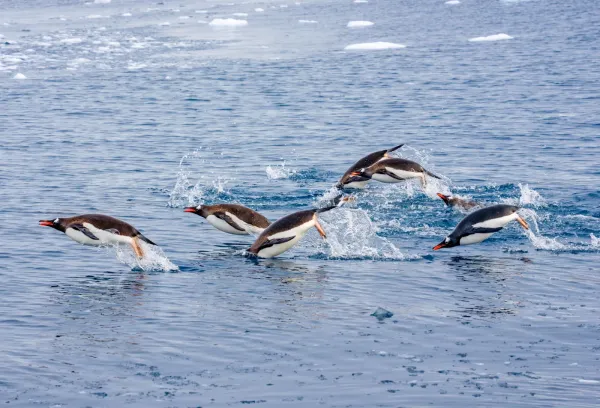
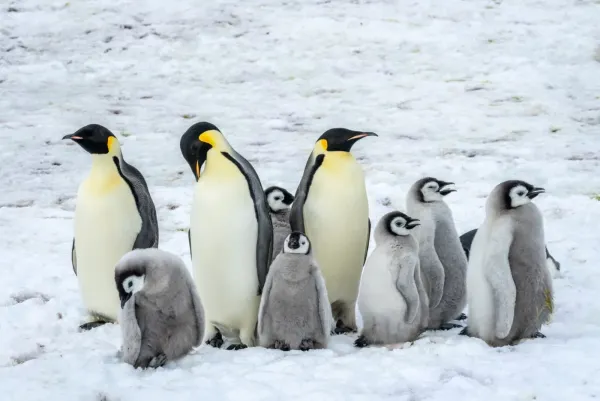
There are around twelve million penguins on the peninsula. The figure means nothing until you find yourself next to a colony: this is not “a little flock on an ice floe”, this is a humming bazaar across an entire hillside, audible from a kilometre away and smelling so strongly that the smell reaches you before the sound.
Everything there is arranged in a remarkably human way. Gentoos build their nests out of stones, stones are in short supply, and so they steal them from one another. Right in front of the owner: walk up, take one, carry it off, come back with an air of complete innocence. The victim goes off to steal from a neighbour. The neighbours know. Everyone steals from everyone, the balance somehow works out, and the colony runs like a stock exchange.
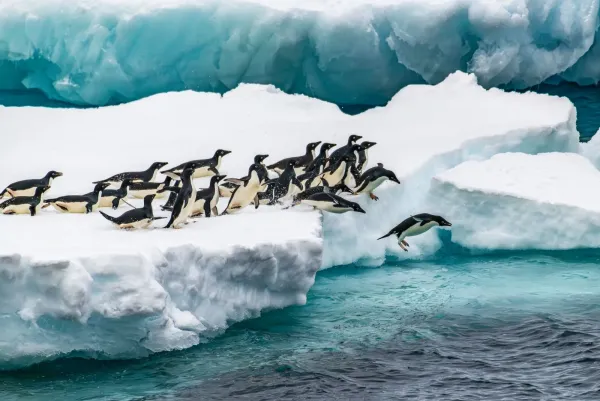
Adélies behave differently. They gather at the edge of an ice floe in a dense crowd and take a long time to decide whether to jump: a leopard seal may be waiting below. They test this in a simple collective way — someone ends up in the water not entirely of their own accord. If nothing happens within a couple of seconds, they all jump at once, in a flawless sequence, in a matter of seconds.
You can watch this for hours, and that is exactly what everyone does: you step out on deck for five minutes and come back an hour later, frozen and content, with four hundred pictures of which you will eventually keep three.
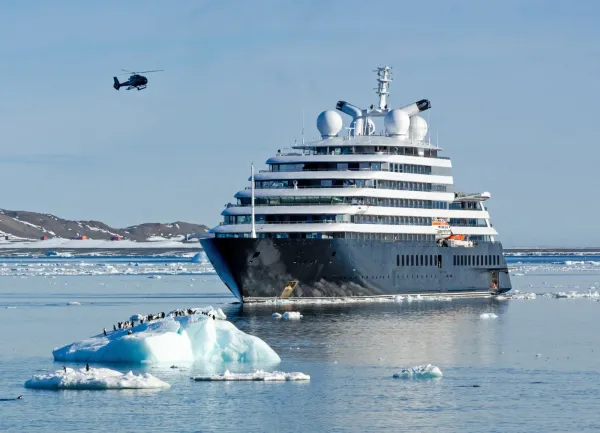
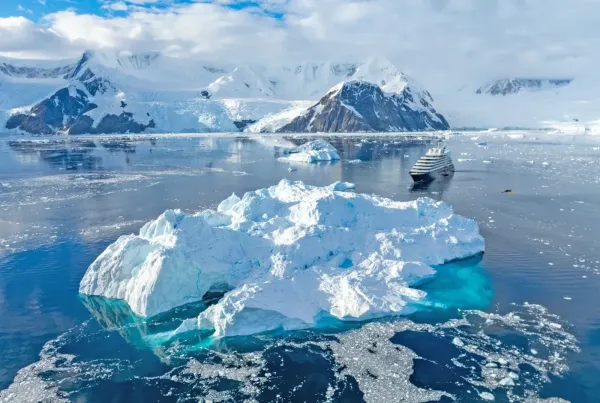
You can see a great deal from the deck. But the two best views in Antarctica are not from the deck.
Since we are on the subject of numbers — here are two figures worth pausing over.
First: Antarctic krill is thought to be the species with the greatest total biomass on the planet. Not the most numerous by headcount — by total weight. Everything alive that swims, flies and lies on the ice floes here exists thanks to this crustacean the length of a little finger.
Second: the crabeater seal. The name is misleading: it does not eat crabs, it eats the same krill, and its teeth are built like a sieve for the purpose. Now, by various estimates there are between seven and fifty-odd million crabeaters in the Antarctic. By the upper estimate that makes it the most numerous large mammal on Earth — ahead of humans.
So you fly to the other end of the planet to look at an animal of which there may be more in the world than there are of us. And almost none of us has ever seen one.
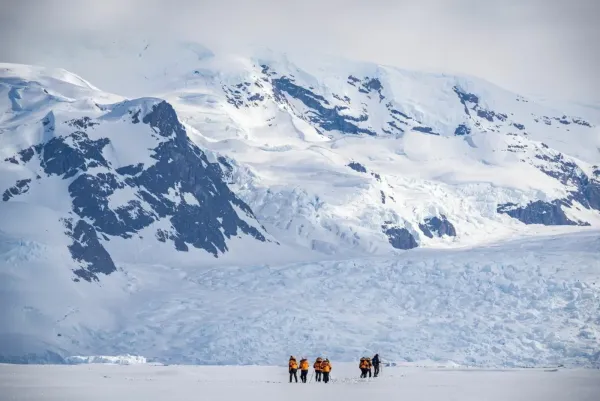
Besides humpbacks and blues, there are fin whales here — second in size only to the blue, up to twenty-six metres, and very fast: they were once called the greyhounds of the ocean. And minke whales, which behave like curious teenagers: they come up to the Zodiac of their own accord, dive beneath it and surface on the other side to see what you will do.
The minke is, in fact, the only one in this company that behaves with outright cheek. It comes right alongside, hovers under the boat, rolls onto its side and leaves — only to do it all over again a minute later from the other side. The guide cuts the engine at this point and spreads his hands: the rules forbid approaching a whale, but they do not forbid a whale approaching you.
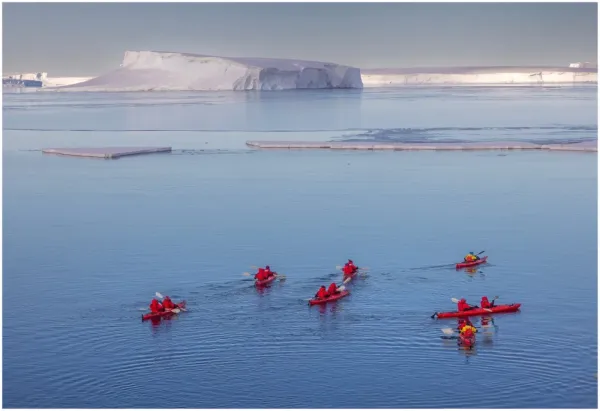
A character in its own right is the leopard seal. A long head, a wide mouth, a gaze that gets it photographed more than anyone else. It lies stretched out on an ice floe and lets you come close. The expedition team keeps a strict distance all the same, and kayaks are not allowed on the water near it.
Above all this runs a layer of birds you do not notice at first. Snow petrels — pure white, the size of a pigeon, they appear at the ice edge and vanish against the white background the moment you look away. Albatrosses escort the ship through the Drake Passage and hang astern for hours without moving their wings: their wingspan lets them ride the updrafts off the waves and spend almost no energy at all.
Watching all of this quickly becomes the main occupation of the day. By the third day people begin telling species apart from the deck, arguing and calling one another over. By the fifth — recognising individual whales by the pattern on their tails, because a humpback’s tail pattern is as individual as a fingerprint.
This is put to serious use: there are open catalogues to which anyone can submit their photo of a tail, and sometimes it turns out that this particular whale has been seen before — off the coast of Colombia, eight years ago. Once or twice a season one of the guests gets lucky exactly this way, and afterwards tells that story more often than the one about the blue whale.
How it plays out over the course of a day is worth describing too, because whale-watching from the deck has a routine of its own.
In the morning the bridge announces who was seen overnight. During the day the bridge works like a control room: spotting a blow, they call the side and bearing over the PA — “humpbacks, port side, thirty degrees”. The deck fills up within a minute. People in jackets over bathrobes, with cups, with cameras; someone in slippers.
The waiting is long and often for nothing: the whale showed itself and left. But when one decides to stay, it stays a long time. Humpbacks are curious and approach the ship on their own; there are known cases of them circling a stopped Zodiac for an hour while the people sat and held their breath.
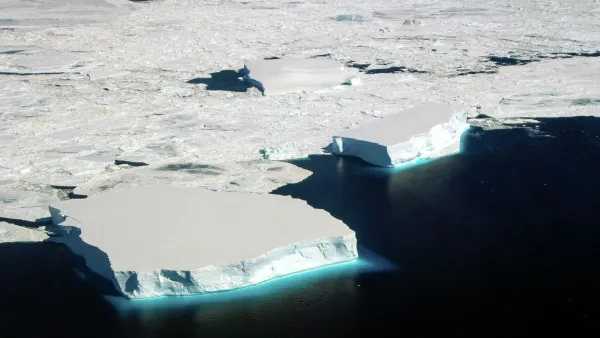
As for the leopard seal, it hunts penguins along the ice edge, and you will most likely not get to watch that in detail — at such moments the expedition team steers the Zodiacs away. The logic is simple: the guests came to see a living Antarctica, not to get in the way of its work.
By the end of the voyage you have statistics of your own. Some count species, some count encounters. By the last day everyone has a personal record to tell over dinner, and that record is usually not about size but about distance: “four metres away” sounds stronger than “thirty-three metres long”.
And both fit in the hold.