October 13, 1986, the Weddell Sea. A white disc is lowered over the side and the line is paid out. Twenty meters — visible. Forty — visible. Seventy-nine — still visible. At eighty it disappears.
This is the world record for water clarity, and it still stands. The Weddell Sea is recognized as the clearest sea on the planet — its water is compared to distilled water. The reason is simple: there is almost no suspended sediment here, no plankton, no organic matter. Nothing gets in the way of seeing.
The purest water on Earth. And almost no one has seen it.
The Weddell Sea is the least visited sea in Antarctica. The ice admits ships for only a few weeks a year, and only a handful come in: it takes a hull that can take a blow and a captain who can read the ice. Most Antarctic itineraries don’t turn in here at all — they run along the peninsula and head back.
The disc deserves a proper telling, because the story is short and a good one. Water clarity is measured with the simplest of instruments: a white disc is lowered over the side, and the depth at which it vanishes from view is written down. In the Mediterranean that’s about thirty meters, and that already counts as excellent. In the tropics, on the best reefs, it’s forty and a little more.
Here the disc was visible at seventy-nine. The record has stood since 1986 and has never been beaten.
The reason isn’t magic but poverty: this water holds almost no suspended particles, no plankton, no dissolved organic matter — none of the things that hang in the water column of other seas and scatter the light. Nothing gets in the way of seeing.
You will feel the practical meaning of that number on your very first outing. The underwater part of an iceberg is visible in its entirety: it slides beneath the boat, pales, turns green and is lost somewhere far below, and for the first time in your life your eye doesn’t run into a murky boundary. The feeling is slightly unsettling — as if there were air beneath you rather than water, and the boat were simply hanging there.
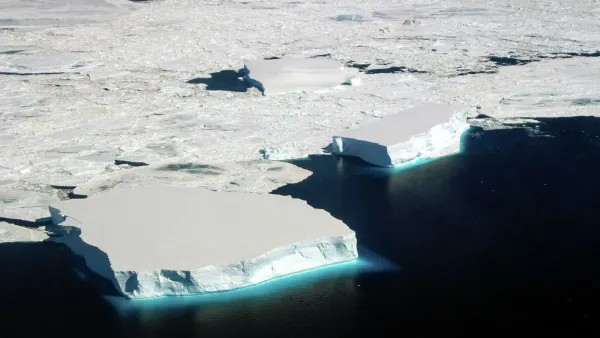
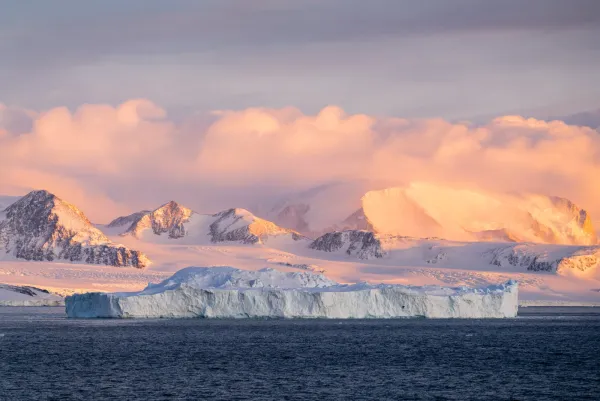
The second thing that breaks the picture in your head is the icebergs. Postcards have trained us to expect jagged blocks with blue facets. There are almost none of those here.
Here the icebergs are tabular: flat white slabs calved whole from the ice shelf, their upper edge as straight as if drawn with a ruler. They don’t look like ice — they look like architecture. Some stretch for kilometers: the ship runs along such a wall for half an hour, and the whole time the window shows the same flawless horizontal, faintly lit from below by reflected light.
Scale deceives constantly here. A wall that looks three hundred meters away turns out to be two kilometers off. Penguins on its rim show as dots — and these are adult birds that reach your knee. The brain has nothing to hold on to: no trees, no houses, no people, and it gets it honestly wrong time after time, until a Zodiac comes alongside — the only object of known size in the frame.
The third is the Weddell seal. The Zodiac comes within three meters, and it doesn’t move. Not out of courage: it weighs four hundred kilograms and sees no reason whatsoever to get up. In the course of the entire landing it will lift its head once, look, and lie back down.
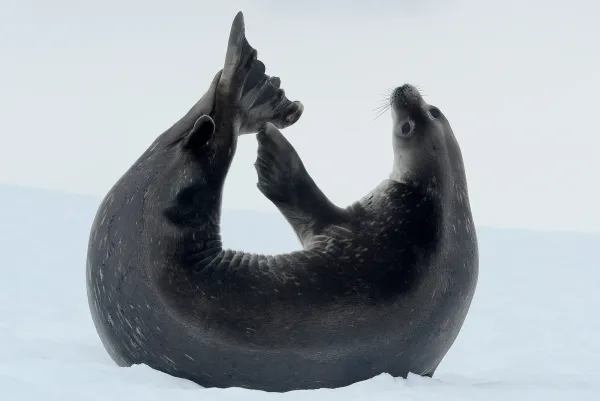
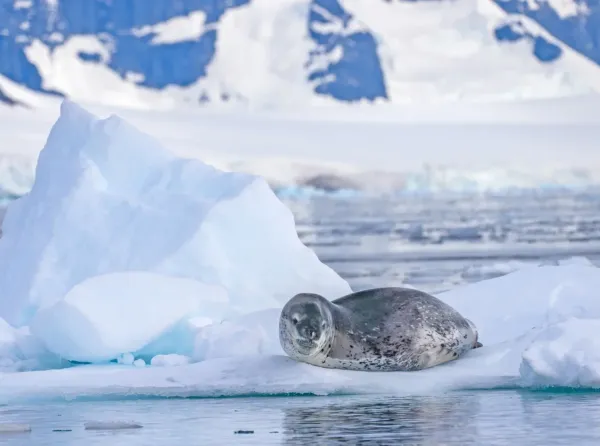
The lazy look is deceptive. This is the southernmost mammal on the planet, and it lives this far south for one reason: it can gnaw ice. Its upper canines jut forward and curve outward — with them the seal saws open and keeps widening a hole in the ice so that it has somewhere to breathe. Nothing else can do that, and so nothing else lives here.
It dives to six hundred meters and stays under for up to eighty minutes. While you stand on an ice floe freezing in three layers, the animal beneath you can go down the height of two Ostankino Towers and come back, in no hurry at all.
And it sings. Under the ice, Weddell seals produce shimmering trills indecently reminiscent of 1970s electronic music: rising whistles, clicks, something like a glissando draining away downward. In calm weather you can hear it right from the deck, and for the first half minute everyone looks around in confusion for whose phone is playing.
And we hear far from all of it. Every male has his own repertoire, and a good part of his sounds go into ultrasound — above twenty kilohertz, past the limit of human hearing. Scientists have counted nine types of such signals, up to fifty kilohertz. Which means that under the ice a concert is going on the whole time, and only the lower half of it reaches you.
The fourth is silence. The guide cuts the Zodiac’s engine, and what follows simply doesn’t exist in ordinary life. Not “quiet” but the complete absence of any sound made by humans. After half a minute you hear the ice crackling: that is air escaping, air that has been locked inside it for a thousand years. A minute later you hear your own breathing, and for some reason it feels awkward.
The ice, if you touch it with a gloved hand, is rough as pumice. Blue inside, as if lit from within, and heavy — a small fragment lifted out of the water weighs noticeably more than you expect.
Beside you, the guide-lecturer explains why it’s blue. Not “beautiful, isn’t it?” — but the physics, in forty seconds, in Russian, looking you in the eye rather than speaking into an earpiece. It’s a separate luxury you don’t notice right away: understanding what you see at the very moment you see it.
In the evening it turns out that everyone has come out on deck to watch the sunset, though nobody arranged it. A December sunset goes on for hours: the sun sinks and never sets, the icebergs turn pink and never fade. Someone brings something hot from the bar, the glass warms your palms through the glove, and the conversation grows quieter of its own accord.
And then, in that silence, comes an exhalation. About five meters high.
On the way to the Weddell Sea the ship calls at a place that deserves a story of its own.
From the water, Deception Island looks like an ordinary island: a solid wall of rock with no way around. In fact it is the caldera of an active volcano fifteen kilometers across, one wall of which collapsed and let the sea in. The gap is called Neptune’s Bellows and is about five hundred meters wide.
The ship enters this slot, rock on both sides, and then the walls fall away — and you are inside a volcano, in a round bay ringed by black slopes. The water in the bay is warm in places: the geothermal activity hasn’t gone anywhere, and readings of seventy degrees have been recorded in spots. The beach is black volcanic sand, and there is snow lying on it — a combination the eye refuses to accept.
Places on the planet where a ship can sail inside an active volcano can be counted on one hand.
Active not just on paper: the volcano last woke in 1970. Today the reminders are warm sand underfoot and steam that rises on a cold day from the water’s edge and drifts across the black beach. Someone always wades in ankle-deep and discovers that the warmth lasts exactly the first half meter.
Beyond that the ice begins, and that is a sensation of its own, one you have to get used to.
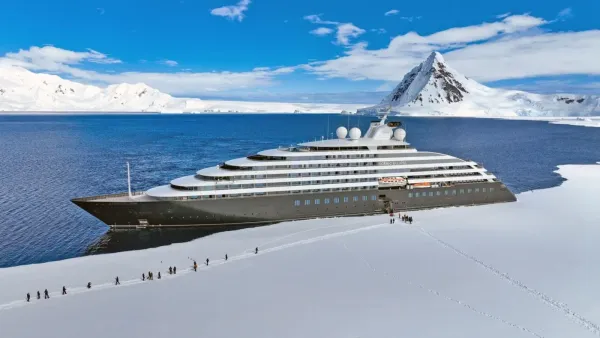
The ship pushes through pack ice — a field of broken ice that has closed into a continuous white surface. The ice-class hull shoulders it aside, and a sound runs through the whole ship: a low grinding, thuds, long drawn-out rasps along the side. At night in the cabin you hear it especially well, and on the first night nobody sleeps — everyone lies there listening. By the second you’re used to it; by the third you start falling asleep to it.
In the morning it turns out the view from the window has changed completely overnight and nobody noticed how. The ship is standing in a field white to the horizon, and the only movement in the frame is a seal turning its head.
Speed drops to walking pace. Floes drift slowly past the window, seals lie on the floes, the seals follow the ship with their eyes and don’t get up. Now and then a lead opens ahead — a strip of clear water, black and perfectly smooth, reflecting everything that stands around it.
A separate category of impressions is the landings, of which there are several in this part of the route.
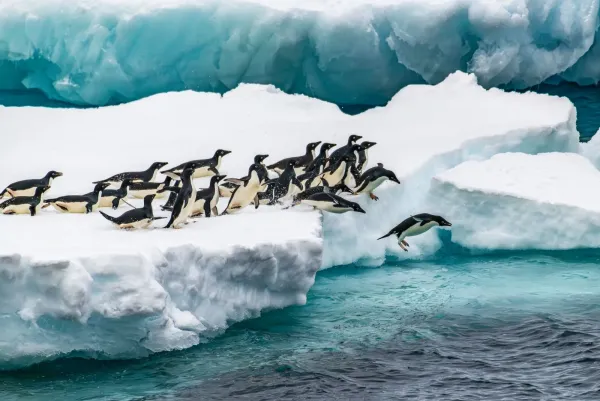
Brown Bluff is a rust-colored cliff nearly eight hundred meters high that drops straight into the water. It is rust-colored because it is the remains of a volcano that erupted beneath a glacier: the rock oxidized and took on the color of rust. Against the unbroken white it looks like a glitch in the image. At its foot is a beach, on the beach an Adélie colony, and the birds walk between the people going about their business, because their route was laid here long ago and nobody intends to change it on your account.
These tracks are called penguin highways: over a season the birds trample deep grooves in the snow from nest to water and back. They walk them strictly in single file. Stepping off them is forbidden to humans by the rules, and rightly so: the track follows the best route, and any groove of yours will lead someone astray.
You could watch this forever. A bird walks the groove with a stone in its beak, an oncoming bird gives way, both stop, both are clearly thinking the situation over — and they pass each other, spending exactly as much time on the maneuver as people do in a narrow corridor.
Devil Island is two black cones with a saddle between them. From there you get a view of the strait, choked with icebergs, and that is the shot that usually ends up as the wallpaper on your phone.
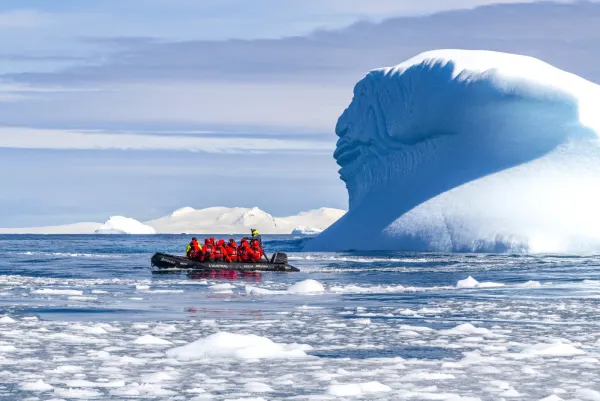
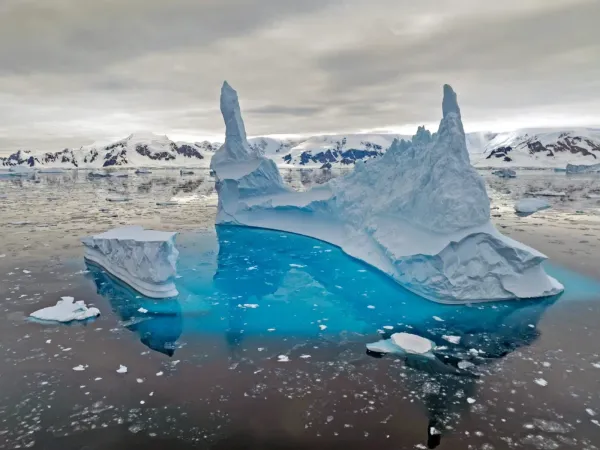
But the strongest thing here isn’t the landings — it’s the Zodiac cruises among the icebergs. The boat moves slowly along an ice wall, the wall rises twenty meters or so, grottoes and arches jut out of it, the water beneath it turquoise from the light below. The guide says nothing, because at that moment nothing needs saying. Everyone is shooting. Ten minutes later they stop shooting and just sit.
In December the light works for you all day long. The sun travels low and in a circle, the shadows are long, and the two or three hours that pass for evening here give an even pink-gold light in which anyone can take a photograph.
December at the peninsula means whales. And that is a story of its own — one with the number one hundred and twenty in it.