The helicopter settles onto the ice, the rotor winds down — and before you see anything, you hear it. A steady, low hum, as if a transformer substation were running nearby. Only it isn’t a substation. It is four thousand birds talking at once.
The emperor penguin colony on Snow Hill Island is open to people for a few weeks a year. Neither the schedule nor the price decides this — the ice does. By early December the fast ice breaks up just enough for a ship to get in, yet stays firm enough for the chicks to have something to stand on. A couple of weeks later, one of those two conditions is gone.
Four thousand pairs. A few weeks a year. A kilometer and a half on foot from the helicopter. What is so special about it?
The emperor penguin is the largest bird in Antarctica: 110 to 130 centimeters tall, up to 45 kilograms in weight. The height of a seven-year-old child, the weight of a large dog. When one stands two meters away from you, the line between “bird” and “creature” stops being obvious.
And it is the only one that raises its chicks in winter.
This deserves telling in detail, or you will not understand what you are looking at. In April, when Antarctica empties and every other penguin heads out to sea, the emperors go the opposite way — away from the water, inland, toward the colony. On foot across the ice, fifty to a hundred and twenty kilometers, one behind another, into the gathering dark. They walk for weeks.
In May the female lays a single egg, hands it to the male and heads back to the sea to feed: she needs to recover, and the journey will take more weeks still. The male stays. For two months he holds the egg on his feet beneath a fold of skin, standing through the polar night at minus fifty in a wind that knocks you off your feet, and all that time he does not eat. Not at all. Over the winter he loses up to half his body weight.
They keep warm together. Thousands of birds pack into a dense huddle, and the huddle slowly rotates: those on the outside gradually work their way in, those who have warmed up move out. Nobody assigns the rota — it simply happens.
By December all of this is behind them. The chicks hatched back in spring, 315 grams apiece, and by the time you fly in they have become grey, knee-high balls of down, standing in groups and shifting from foot to foot.
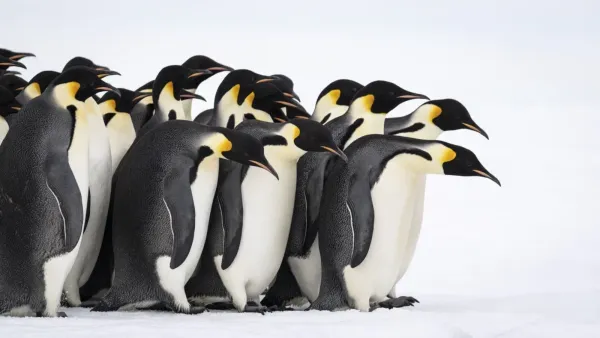
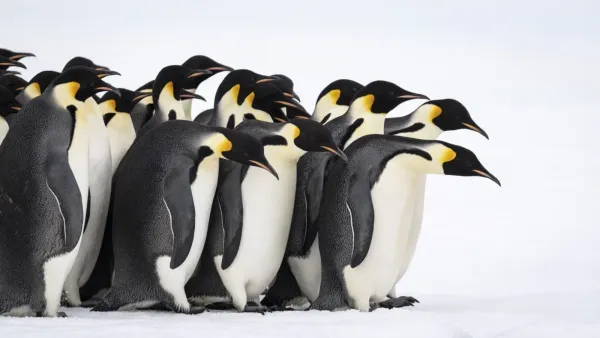
A chick looks up at you with the expression of someone whose holiday has just been postponed. The adults walk in file, stop, turn their heads toward the helicopter — and study it with exactly the face you would give a guest who turned up without calling first.
Nobody runs away. Running from humans is simply not done here: there are no land predators in Antarctica, and a bird’s head has no line in it that would explain that you might be dangerous. That is where all Antarctic photography comes from: the animals neither pose nor flee, they go about their business, and you happen to be nearby.
Now, about how this colony was found in the first place.
Emperors breed on fast ice — ice frozen to the shore. You cannot make them out from a ship: white on white, and the nearest colony may be tens of kilometers away. From space, however, they are perfectly visible. Over a season a colony leaves a large brown stain of guano on the ice, and against the white background a satellite reads that stain far better than it reads the birds themselves.
Going by these stains, eleven unknown colonies were found in recent years, then four more. Today sixty-six are known on the entire continent, and almost all of them number fewer than a thousand birds.
Sixty-six colonies on a planet inhabited by eight billion people. Snow Hill is one of them. And the only one that visitors are taken to.
Half of them have never been seen up close by anyone at all — there is a stain on an image and a set of coordinates, and that is it. Most of the rest cannot be reached: no ice of the right strength, no landing site, no ship that will go there.
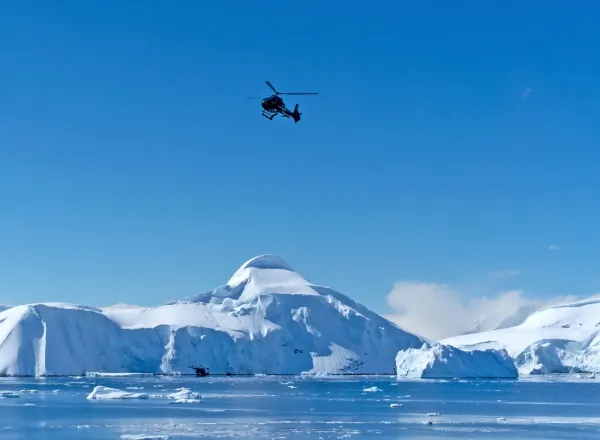
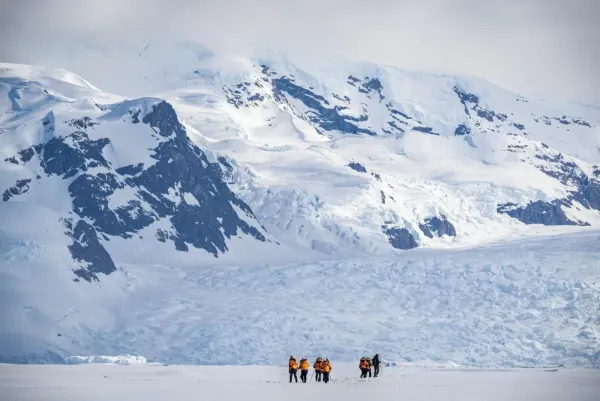
The way in looks like this. The ship comes as close to the ice edge as the ice allows — different every year, sometimes tens of kilometers nearer, sometimes farther. From there the helicopter takes over: seven seats, a short hop, a landing straight onto the ice. Then a kilometer and a half on foot.
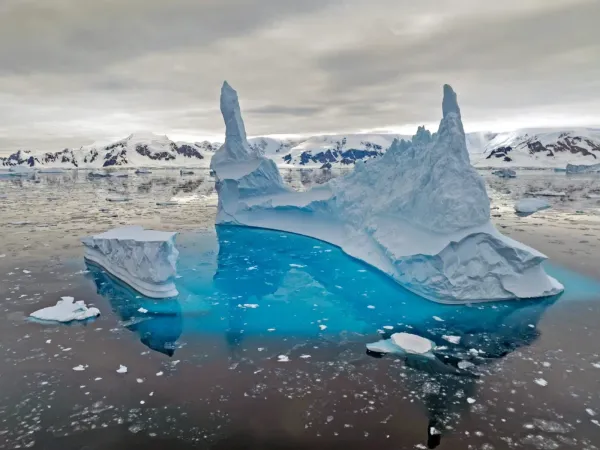
From the air you see what you cannot see from the water: the fast ice is not flat, it is riddled with cracks and pressure ridges, and the helicopter flies low over it, so the whole pattern reads at once. You also see how big everything here really is. An iceberg that looked large from the deck turns out, from below, to be the size of a city block.
Before the first flight everyone is gathered for a briefing, and it is shorter than you expect: how to strap in, where not to walk, what to do if the weather changes while you are out on the ice. Then you are weighed together with your backpack — the helicopter counts kilograms honestly — and seated by weight, not by preference. The first group leaves, the rest stand at the window and watch the machine shrink to a dot above the white.
A kilometer and a half goes slowly. Through your soles you feel that beneath you is not ground but ice over water — a sensation you do not get used to in a single outing. The crust squeaks dryly, in its own particular way. The air smells sharp: fish, guano and something else that does not exist in temperate latitudes. You will remember the smell longer than the views.
And then you come over one more rise and hear it. Not see — hear. A steady, low hum with individual voices inside it, and it does not stop for a second.
Four thousand pairs talking at once. Every pair has a chick that must be found in this crowd by voice — and they find it, every time, without fail, though to a human every call sounds the same.
The trophy shot takes care of itself here. A chick comes within two meters and stops, because it is curious; you are not allowed to shoo it away, so for the next twenty minutes you simply sit on the snow and shoot. Meanwhile the adults walk to the open water and back, paying you no attention whatsoever.
Last season, 113,500 people visited the whole of Antarctica. That is fewer than fit into two football stadiums. Of those, only a small fraction made it to Snow Hill: a handful of ships come here, and only those with helicopters on board.
Now, honestly, about the conditions — this matters more than any promise. The landing at the colony depends on ice and weather. The excursion is paid for separately and takes place if conditions allow. Antarctica does not sign contracts.
And that, when you think about it, is part of the pleasure. Nothing here can be bought in advance. You can only be in the right place during the right two weeks — and after that it is down to luck. Those who made it there know they were lucky, and that knowledge cannot be bought separately for any money.
There is no connection on board. For two weeks your phone works as a camera, the mail piles up and waits. It turns out to be a pleasure of its own — not answering, and feeling no guilt about it.
And here is the strange thing. A ship heading to where there is nothing carries two helicopters and a submarine in its hold, and a butler in every suite. Why so much, in a place where all you need to do is look out of the window?
It is worth saying separately what goes on out on the ice beyond the birds themselves.
The colony lives by its own timetable, and in December its main event is the crèche. The grown chicks gather into groups of their own and stand together while their parents go for food. An adult bird back from the sea walks along this crowd and calls. Out of a hundred identical grey bundles, one answers — hers. How they tell each other apart, nobody really understands except the birds themselves.
The parent may have been away for several days and walked tens of kilometers across the ice each way. It dives deeper than any other bird on the planet — going down hundreds of meters after fish and squid and returning with a full crop.
Their walk, by the way, is funny only for the first five minutes. Then you see that the gait is economical: the bird moves slowly, with a waddle, spending almost nothing, and when it needs speed it simply drops onto its belly and slides, pushing with its feet. On flat crust this is noticeably faster than a human in expedition boots. Especially a human who has stopped to photograph it.
The way back to the helicopter always takes longer than the way there. Not from tiredness — because every twenty meters somebody stops.
And on the ship a hot shower is waiting, a four-course lunch and a lecture about what you have just seen. Between the emperor penguin colony and truffle soup, roughly an hour and a half passes. That is probably the most accurate description of how everything works here.
One more thing worth knowing in advance: the Snow Hill day may not happen.
The ice may prove too solid and not let the ship within the required distance. Or too weak — and then the helicopter has nowhere to land. Fog may settle in, and helicopters do not fly in fog. The expedition team announces the decision in the morning, and the decision is not theirs to make.
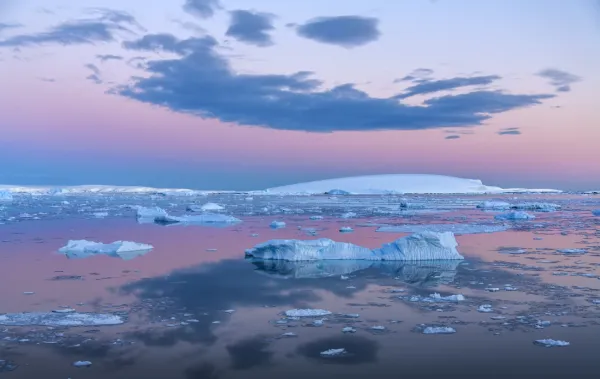
What happens on such a day? The ship carries on into the Weddell Sea, and instead of the colony you get tabular icebergs the size of a district, seals on ice floes three meters from the Zodiac, and a sunset that brings everyone out onto the deck.
Up close, a tabular iceberg does not read as an object at all: it has no beginning and no end — just a white wall running sideways past the edge of the window and standing there motionless while you travel along it for twenty minutes. Scale returns only when a Zodiac appears beside it and turns into a dot.
Nobody counts such a day as lost. You will simply have a different story to tell afterwards.
From here the ship heads south — into a sea where a white disc lowered over the side was once visible at a depth of seventy-nine meters. And at eighty, it vanished.