Solomons Master
 1 / 13
2 / 13
3 / 13
4 / 13
5 / 13
1 / 13
2 / 13
3 / 13
4 / 13
5 / 13
 6 / 13
 7 / 13
 8 / 13
 9 / 13
 10 / 13
 11 / 13
 12 / 13
 13 / 13
Book through Tour Leader Club
37 m · 16 guests · 8 cabins · three dive guides; the operator does not publish the total crew number crew members
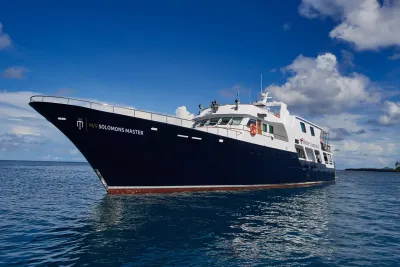
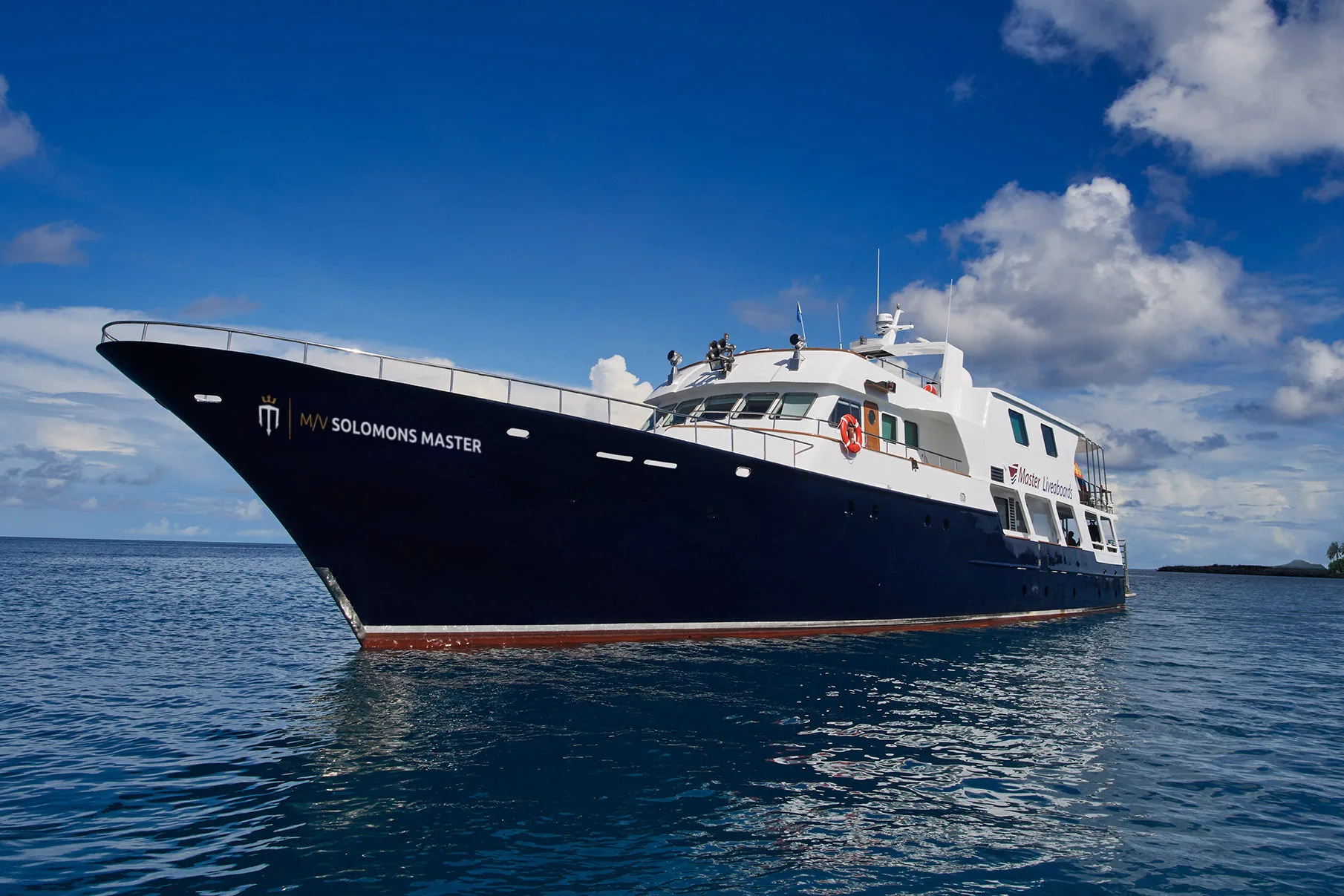
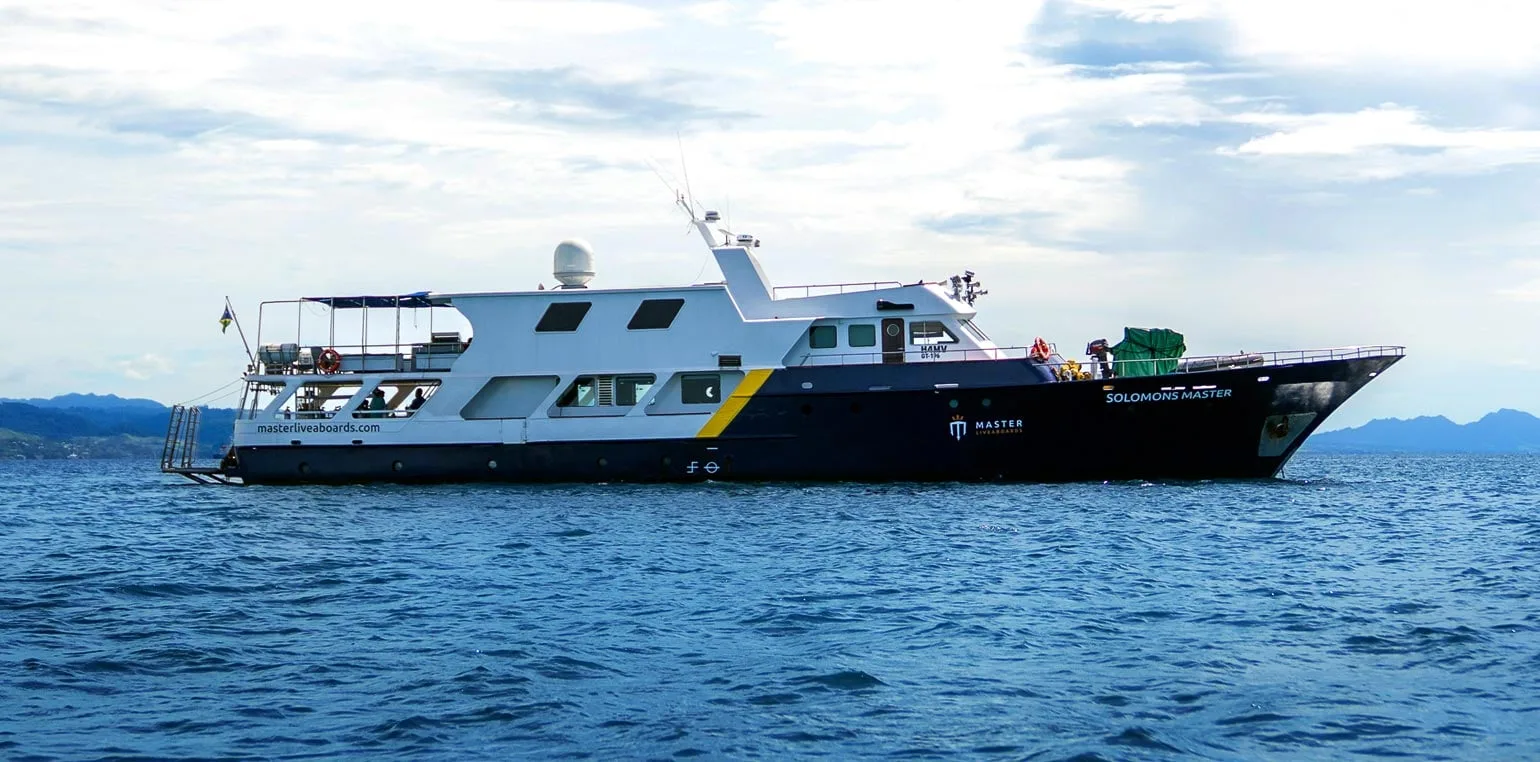
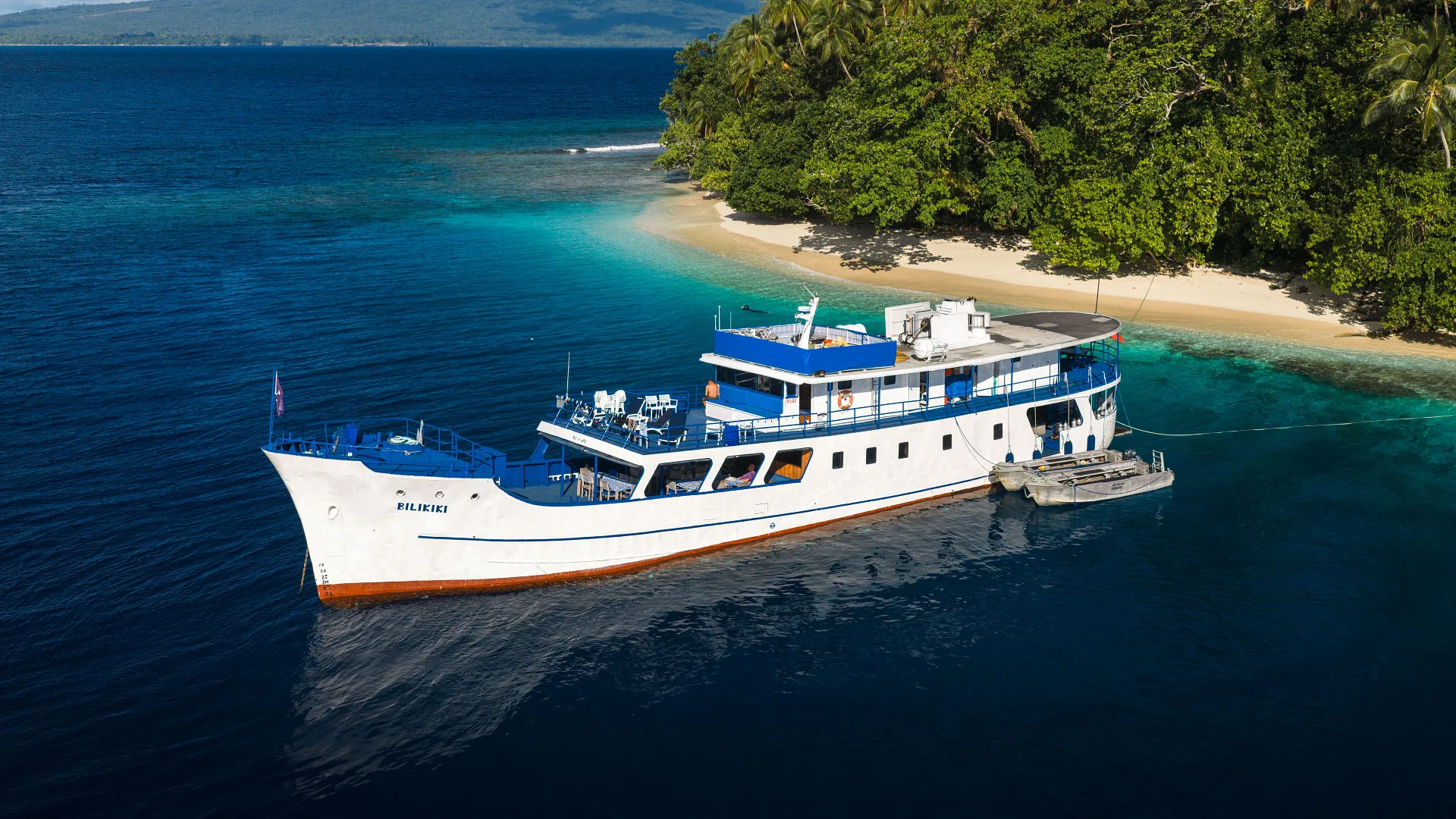
Solomons Master is the only Master Liveaboards vessel in the Solomon Islands and the operator’s only hull in the region. She is a steel monohull built in 1974, 37 metres long and 7 across, with eight cabins for 16 guests. Before the move to the Solomons she worked Truk under the name Truk Master — the operator says so outright, and the old name still shows in the files on its own site: the deck plan is called truk-master-deckplan. It is the same hull. M/V SOLOMONS MASTER is painted in large white letters along the dark blue hull, under a white superstructure and the fleet mark.
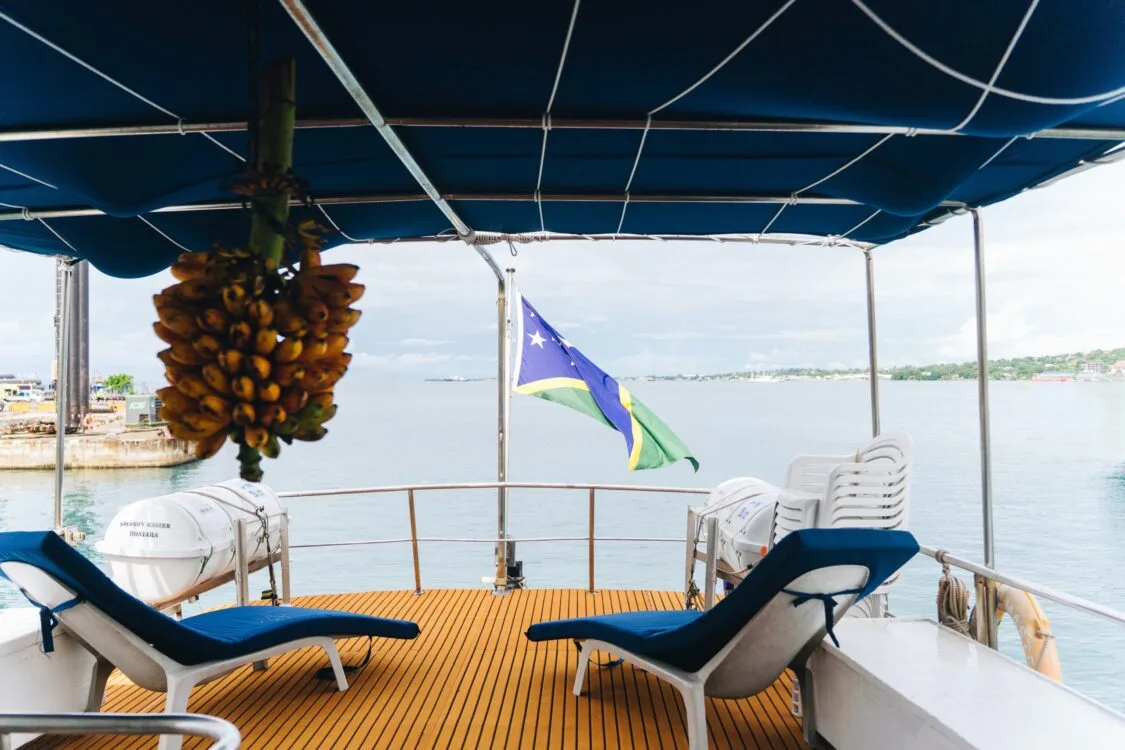
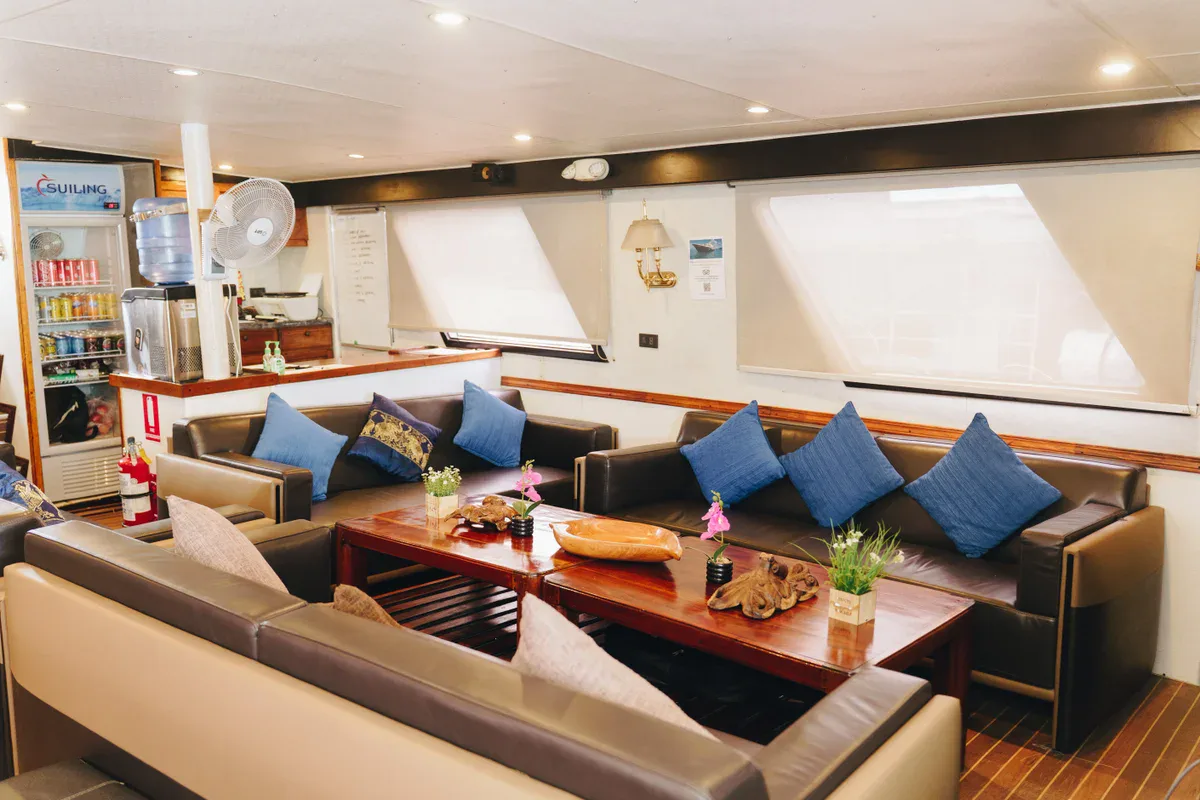
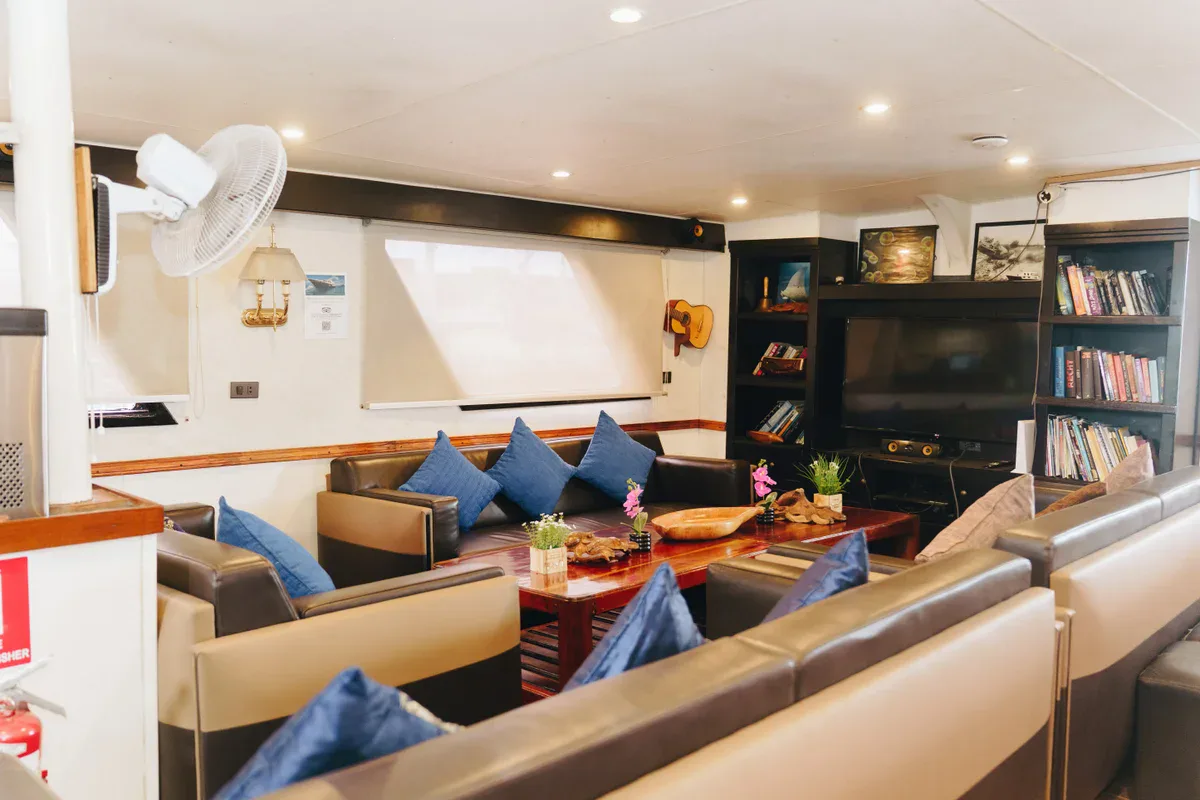
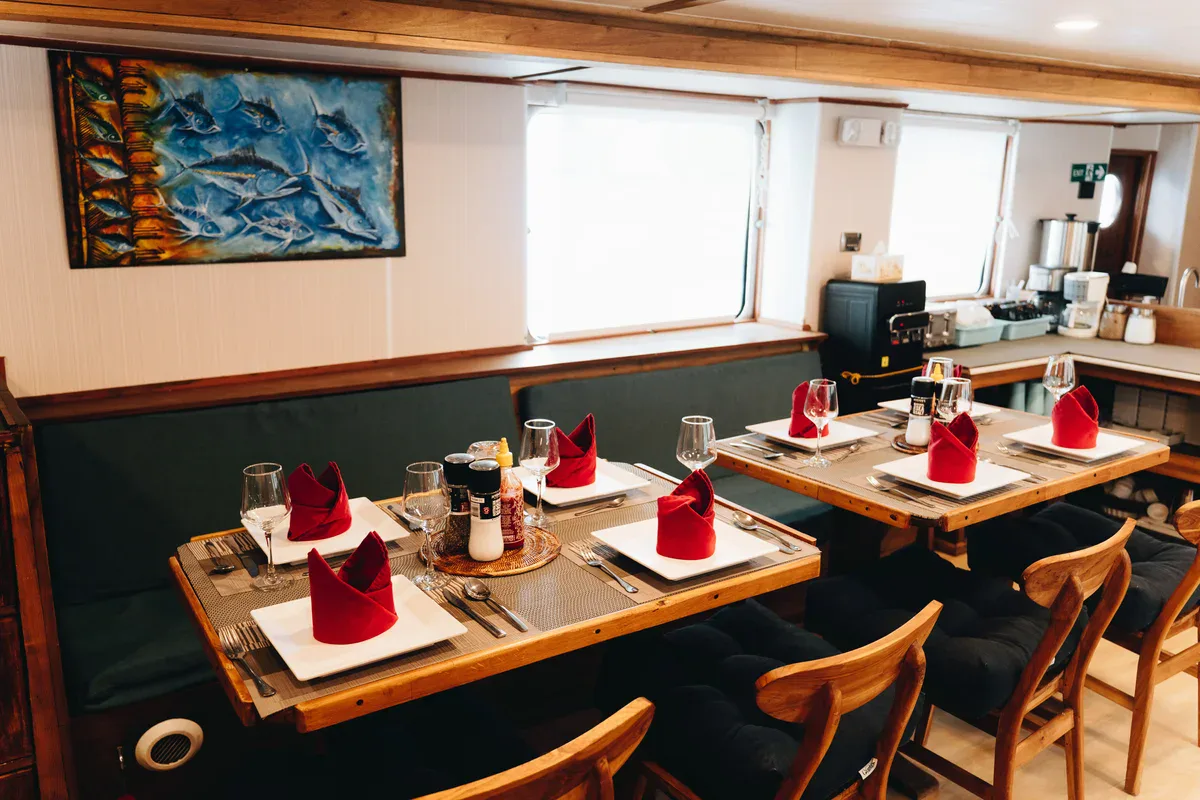
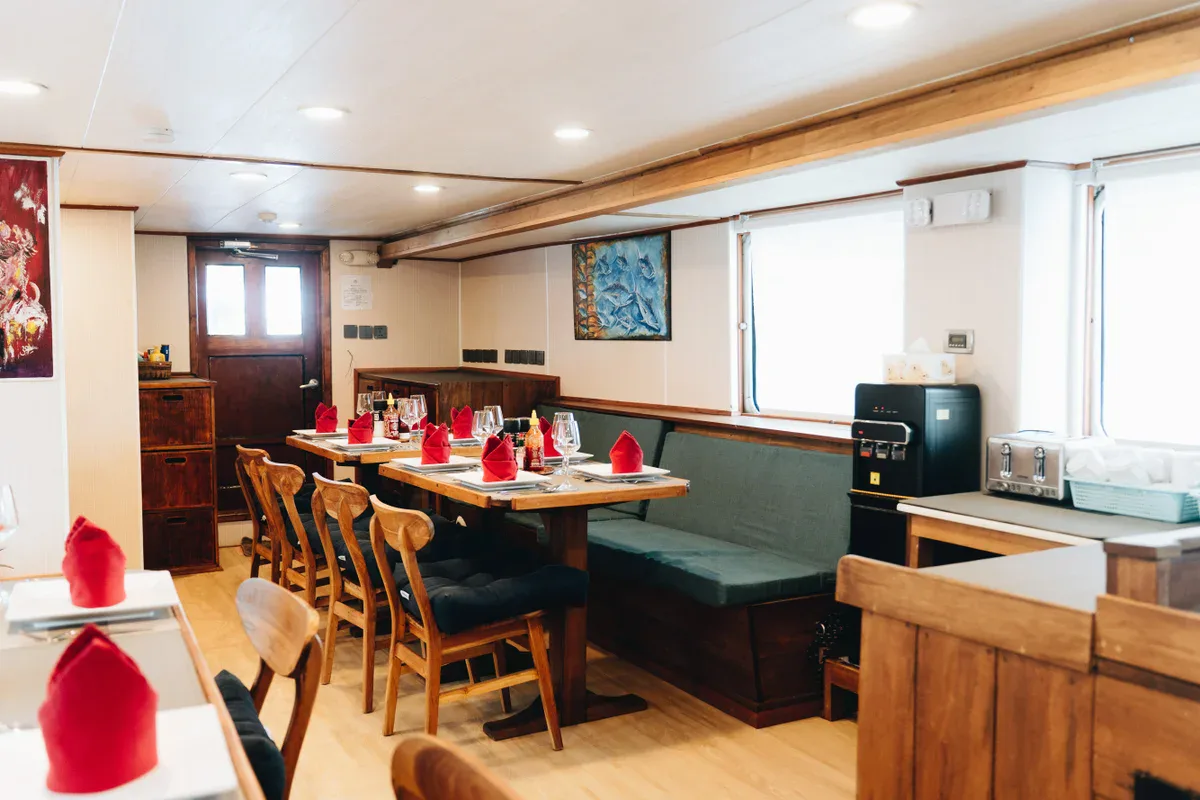
The interior was redone after the move, which matters when you read older photographs online: a 2017 shoot shows dark timber, black leather and red-and-gold fabrics, while today’s boat is pale teak, white bulkheads, green banquettes in the dining room and blue Pacific-print runners on the beds. The photographs on this page are the current ones, from the operator’s 2025 and April 2026 shoots.
Geography and flights
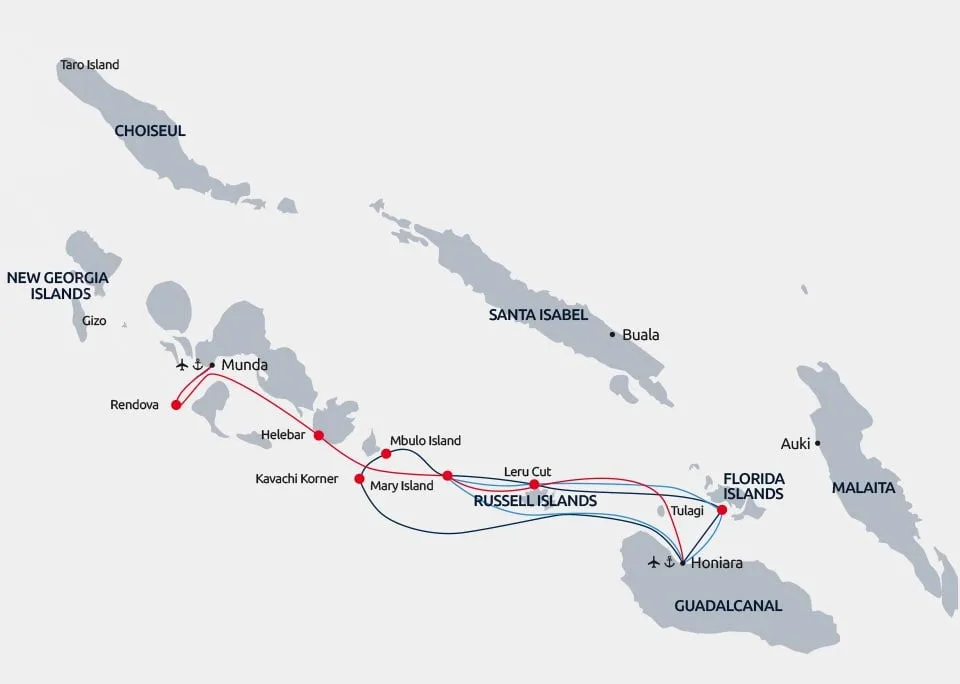
Three of the four routes are round trips out of Honiara (HIR, on Guadalcanal). Honiara is served from Brisbane (Solomon Airlines codeshared with Qantas, and Virgin Australia), from Fiji (Fiji Airways, Solomon Airlines, Air Niugini) and from Port Moresby (Air Niugini). From Europe the easiest routing is via Brisbane. Check transit visas separately: a layover in Australia longer than eight hours, or leaving the airport, requires one, and the airline will not board you without it.
The fourth route — the ten-night Guadalcanal and Western Province — runs one way between Honiara and Munda (MUA, Western Province), and it always appears in the calendar as a pair: one departure out, the next one back. Solomon Airlines flies Honiara–Munda daily, but that hop is not part of the trip price and you book it yourself. The transfer between the domestic airport (or a local hotel) and the vessel on embarkation and disembarkation days is on the operator.
Where the boat works: the Florida Islands around Tulagi, the Russell Islands, Iron Bottom Sound between Guadalcanal and the Florida Islands, and on the ten-night programmes Marovo Lagoon, Mbulo Island, Blanche Channel and White Beach near Munda. The operator’s own route map also marks Mary Island, Kavachi Korner, Helebo and Rendova.
Money: what you pay on board
Places are sold by the berth — “per space” — and the price is the same for every cabin category: the operator publishes no cabin ladder and no single-occupancy supplement. The whole boat can be taken: 14 paying places out of 16, or half the boat at 7 paying places out of 8.
The main compulsory charge is the kastom fee: 210 USD per person on seven-night routes and 300 USD on ten-night ones. This is not a park fee. Reefs and coastal waters in the Solomons are under customary village ownership, and the right to anchor and dive there is paid to the chiefs. The cruise director collects the money and hands it over village by village; it is added to your invoice at booking and paid on board before disembarkation.
Cash on board is accepted only in Solomon Islands dollars, US dollars and Australian dollars — a local banking restriction. Visa and Mastercard are taken, but charged in SBD at the Bank of South Pacific rate on embarkation day, with 3 % added. Tipping is left to the guest; the operator suggests around 10 % of the trip cost, and tips can go on the card at the same surcharge.
The fuel surcharge lives in a separate fleet-wide statement. In the version of 24 August 2026 Solomons Master carries 35 USD per person per night, but only on departures up to 26 September 2026. The first date on sale is 15 November 2026, so at the moment it applies to none of the trips you can book. The statement is reissued, so it is worth re-reading before you pay.
Insurance covering diving, chamber treatment and evacuation is a condition of the contract, not a suggestion: the insurer’s name and the policy number must be given within 14 days of booking, or the operator may cancel the booking and refund you. The chamber in Honiara is volunteer-run, and if things go badly the evacuation is to Australia.
The deposit is 5 %. The operator reserves the right to cancel a departure if the vessel is less than 60 % full — fewer than ten guests out of sixteen — but not within 90 days of departure.
Certification and the rules underwater
On most routes Advanced Open Water is recommended and 40 logged dives are mandatory. On WWII Wreck Week the bar is higher: Advanced Open Water is mandatory plus a minimum of 75 logged dives. Every diver must dive with a computer — if you do not own one, rent it. Solo diving is not permitted; on standard itineraries rebreathers are allowed within recreational limits only, and only paired with another rebreather diver or inside an open-circuit group. Technical diving is possible only on dedicated technical departures or on a full charter, and all technical kit must be brought with you — there is nowhere in Honiara to repair it. Gases, cylinders and sofnolime are ordered at least six months ahead. The operator names no separate permit for diving the wartime wrecks.
The wartime sites in the programme lie within recreational limits, 30–40 m maximum; visibility is usually 25–40 m and the water 28–30 °C all year.
Season
The climate is equatorial and hot all year: around 31 °C by day and 22–23 °C at night. The wet season runs November to April with roughly 270 mm of rain a month, but this is not a monsoon region and prolonged bad weather is rare. The boat runs year round; the calendar leaves a maintenance window of a few weeks each year — January and February in 2027, January and half of February in 2028, late February and early March in 2029.
The things people find out on the jetty
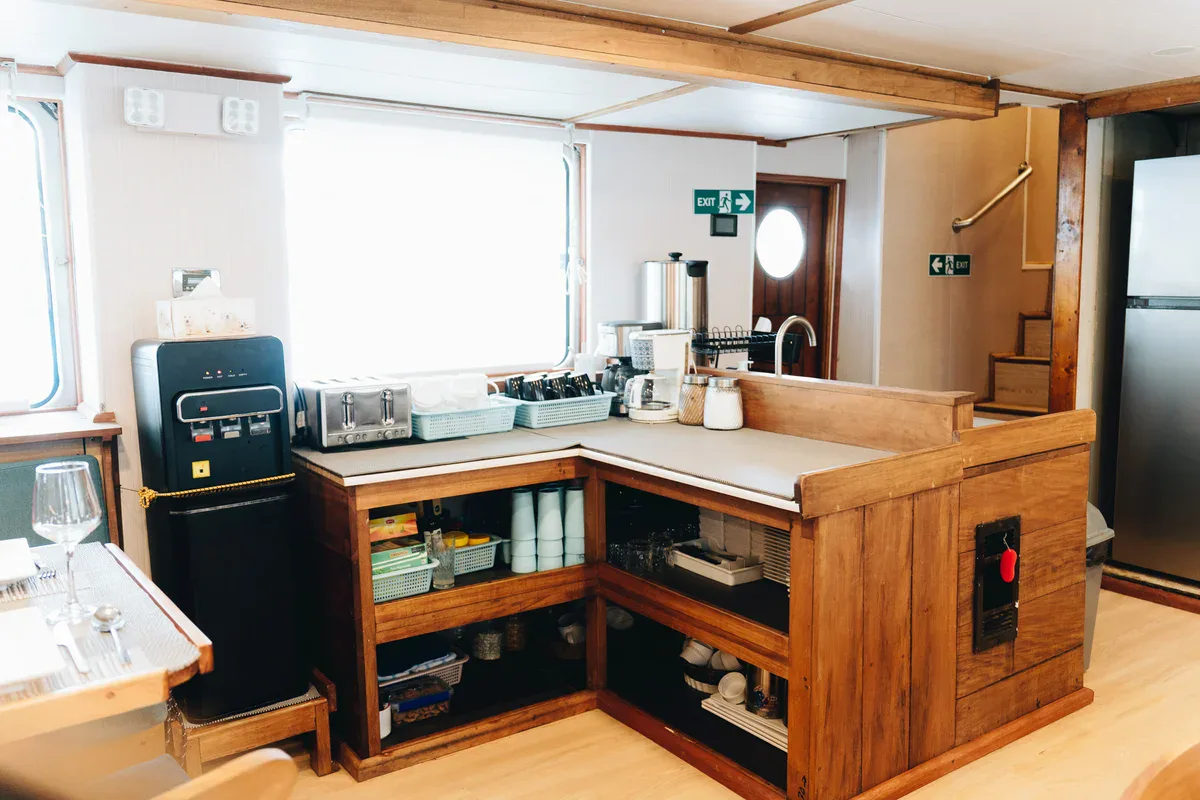
The sockets on board are US, 110 V and 60 Hz; a handful of 220 V outlets exist only at the camera table in the dining room, so do not plug European gear in without a converter. International SIM cards do not work anywhere in the Solomon Islands, and a local SIM has signal for roughly a third of the trip. There is Starlink, but it is paid: 60 USD for seven nights and 90 USD for ten. There are no 13 L or 15 L cylinders on board, only 11 L AL80s. You may bring your own alcohol, but no more than one bottle of spirits, wine or champagne per person, and no beer. Gluten-free flour and bread are not available on board, and low-fat, low-sugar and soya products are hard to source in the country. Malaria is present in the Solomons, and some anti-malarial drugs — mefloquine among them — have side effects that mimic the symptoms of decompression illness. EU citizens need no visa for up to 90 days; UK, US, Canadian, Australian, New Zealand and most other Commonwealth nationals get a free visitor’s permit of 45 days on arrival.
No mark-up
You pay the rate the operator publishes. The only thing added on top is the actual payment processing cost — no fee of ours.
We run the booking
Correspondence with the operator, holding your places, the contract, confirmation and all paperwork sit on our side. Nothing for you to arrange yourself.
Pay by card
We send you a Stripe invoice — pay by card, in your own currency, from anywhere in the world. The transfer to the operator is handled on our side.
Support in your language
We help you pick the cabin and dates, answer questions on the route and gear, and stay reachable until you are home — in English, in your time zone.
We quote the exact amount when confirming the booking: it covers the operator's rate plus the actual payment processing cost. No hidden charges.
Yacht Specifications
Length
37 m
Beam
7 m
Material
Steel
Year Built
1974
Capacity
16 guests
Cabins
8
Crew
three dive guides; the operator does not publish the total crew number members
Speed
10 knots cruising
Engine
2 × Cummins 520 HP
Refit
2016
Bathrooms
8
Tender
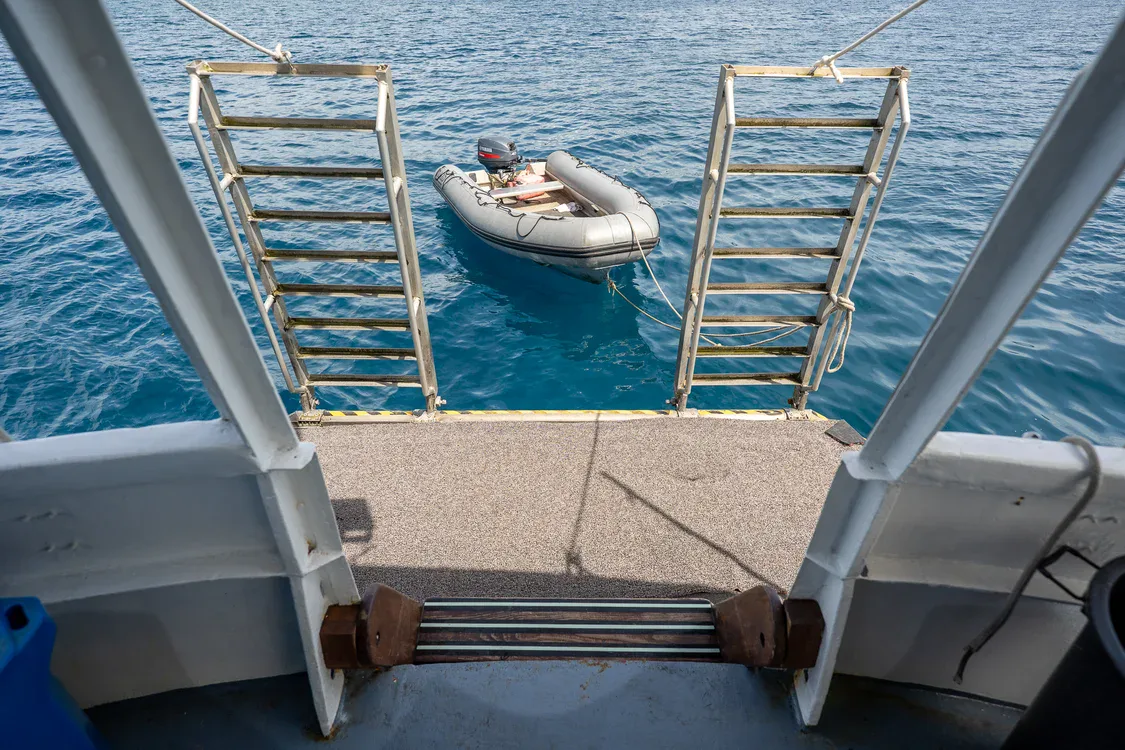
2 tenders
Freshwater maker
watermaker, 20 tonnes a day
On Board
Diving
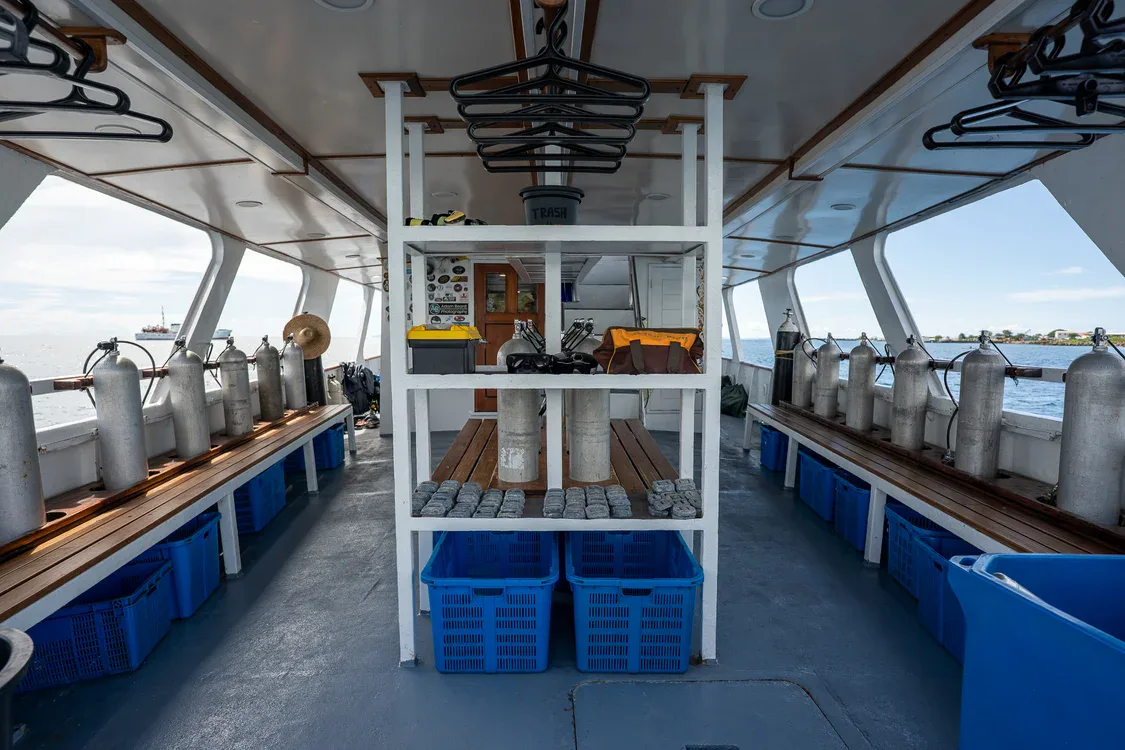
Entry requirements: on most routes Advanced Open Water is recommended and 40 logged dives are mandatory; on WWII Wreck Week Advanced Open Water is mandatory plus a minimum of 75 logged dives. Some sites carry strong currents and are not suitable for beginners. The wartime sites in the programme lie within recreational limits, 30–40 m maximum. Nitrox is not included: 180 USD for seven nights and 270 USD for ten. Equipment and gases must be pre-booked, technical requirements at least six months ahead.
Food and drink
Gluten-free flour and bread are not available on board, and low-fat, low-sugar and soya products are hard to find in the country — flag any dietary need in advance and without illusions. You may bring your own alcohol, but no more than one bottle of spirits, wine or champagne per person, and no beer. The local staple is fish with coconut, sweet potato, taro, yam, cassava and breadfruit.
Navigation and safety
Cabins
· 3 cabins
Two single beds
Beds: 2 single beds
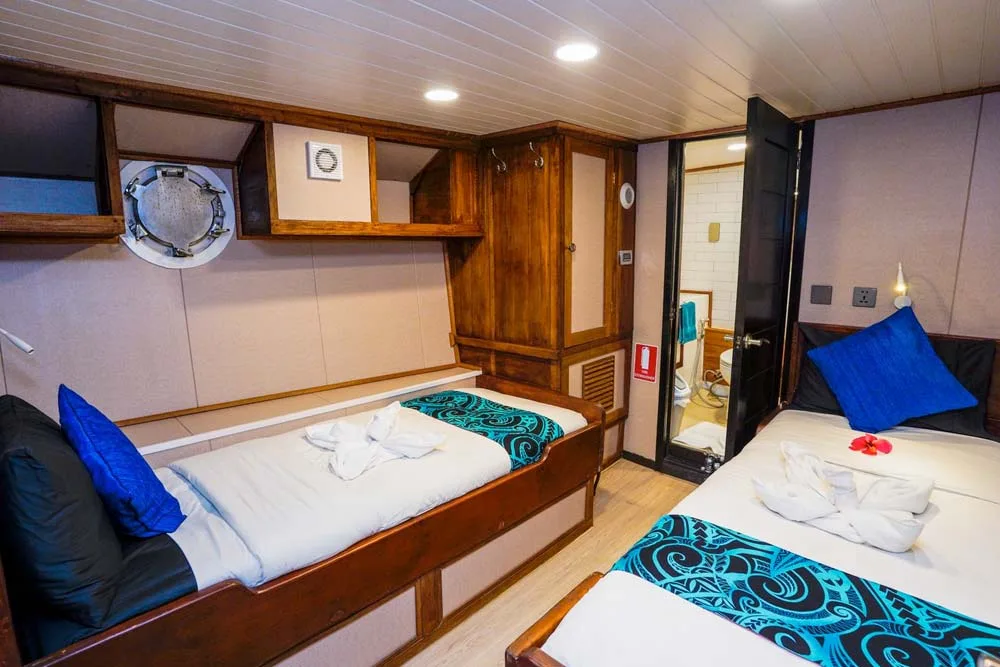
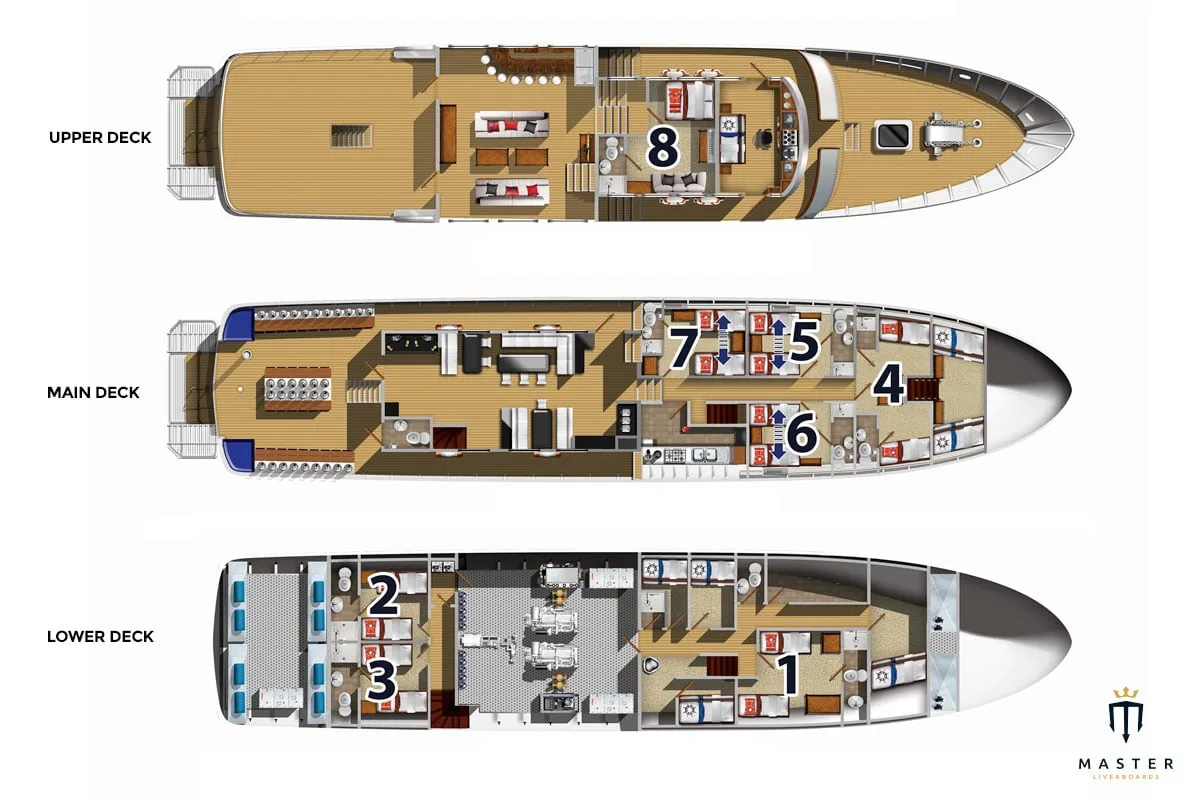
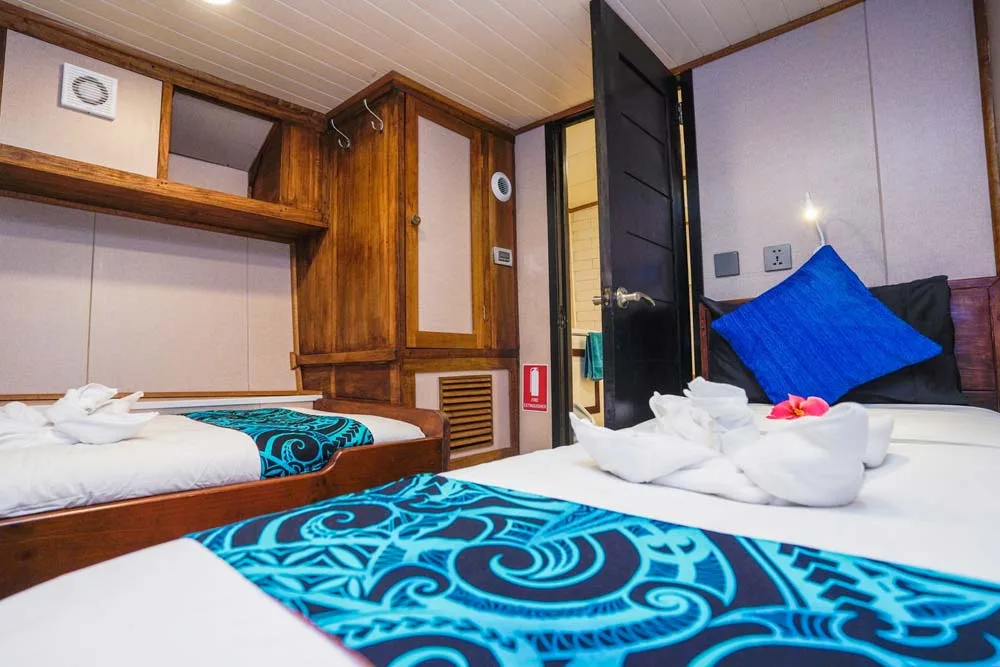
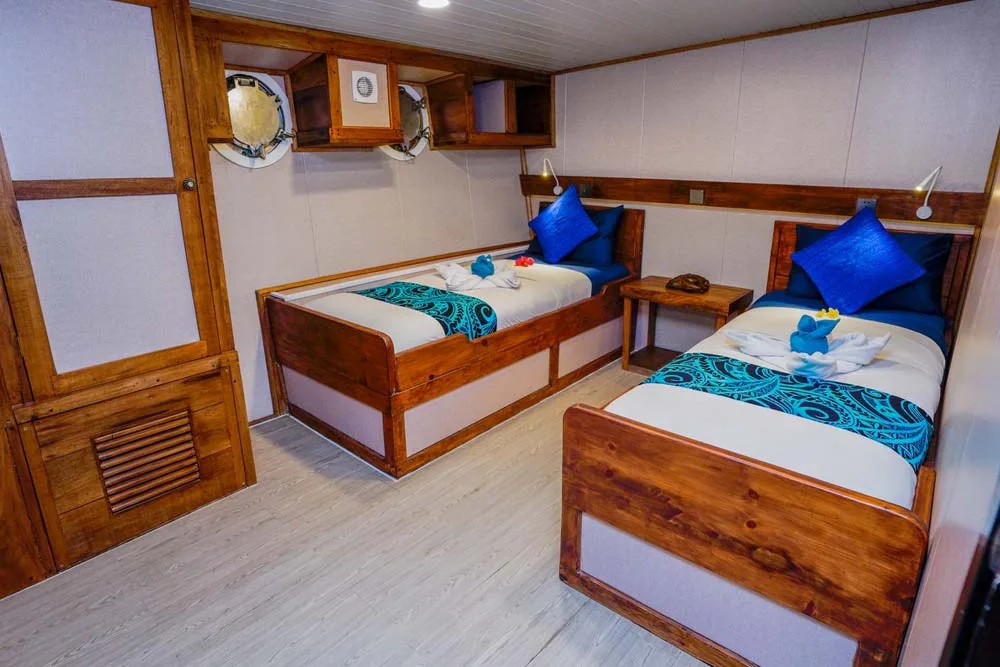
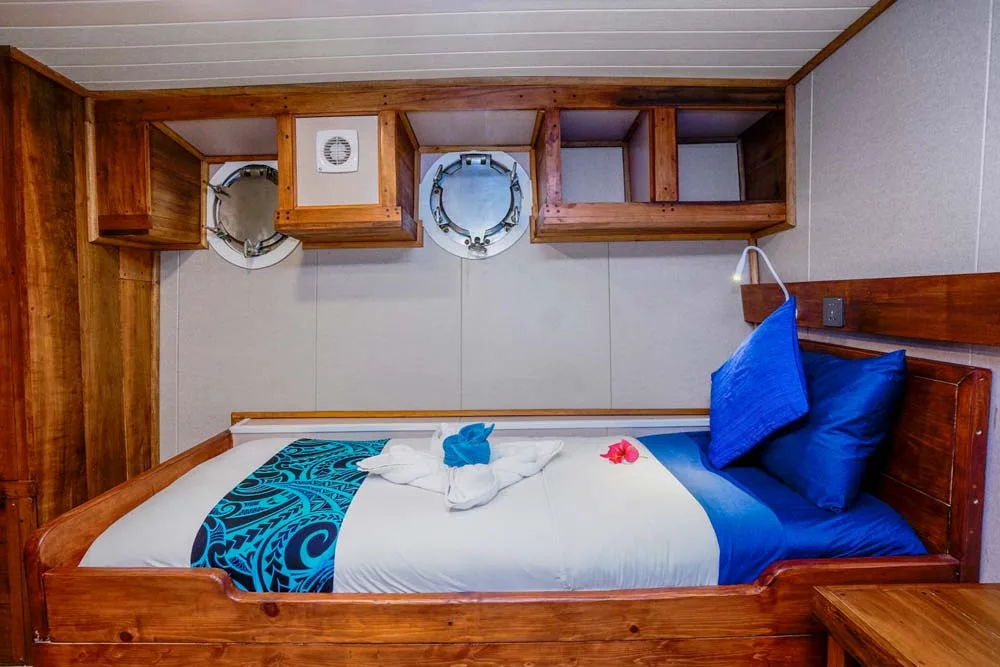
Three lower-deck cabins — the simplest category on board and the only one where the beds do not convert into a double. The finish is the same as everywhere else after the refit: honey teak on the wardrobes and headboards, white bulkheads, a pale floor and blue Pacific-print runners on the beds. Light comes through portholes, there is a shelf and a reading lamp above the bed, a private bathroom with a shower and individually controlled air-conditioning. Since the operator sells every berth at one price regardless of category, the difference between Classic and Premium is deck, window and floor area, not money.
· 1 cabin
Two single beds
Beds: 2 single beds
The only main-deck cabin where the beds stay separate and do not convert. Two singles along the sides with the deck door between them, reading lamps above each bed and full-height wardrobes with louvred vents outboard. Private bathroom with a shower behind a curtain, individually controlled air-conditioning. Which of cabins 4–7 this category occupies is not published — on the deck plan all four main-deck cabins are simply numbered.
· 3 cabins
Twin or double configuration
Beds: 2 single beds or one double
Three main-deck cabins where the beds are pushed together into a double or split into two singles on request — the operator calls them amendable, and the configuration has to be asked for at booking. Inside there is teak, a pale floor, shelves above the headboard, a pair of portholes, a private bathroom with a shower and individually controlled air-conditioning. In size and outlook they sit in the middle of the boat: higher and brighter than the lower deck, without the big windows of the upper one.
· 1 cabin
One double and one single bed
Beds: 1 double and 1 single bed
The only upper-deck cabin and the roomiest on board: a double bed plus a separate single, large windows instead of portholes, a tall teak cabinet with open shelves and a ship's clock, and noticeably more storage than anywhere else. Private bathroom, individually controlled air-conditioning. On the deck plan this is cabin 8, up in the superstructure beside the wheelhouse. The price is still the same as a Classic on the lower deck — the operator charges no category supplement.
Schedule & Pricing
Florida and Russell Islands
The vessel's most frequent and cheapest route: seven nights in a loop from Honiara, up to 22 dives. It works the Florida Islands around Tulagi and the Russell Islands — walls, swim-throughs and caverns, among them the famous Leru Cut, where a shaft of light drops through a slot in the limestone, and the freshwater Mirror Pond. Along the way there are several WWII sites: Japanese and American aircraft and battle grounds, plus silty muck bottoms near shore holding mimic octopus and frogfish among the army debris left behind by departing troops. A village visit is part of the programme — the school, carvings, football with the children.
December 2026
1 departureMarch 2027
2 departuresApril 2027
2 departuresJune 2027
1 departureOctober 2027
1 departureNovember 2027
1 departureDecember 2027
1 departureFebruary 2028
1 departureJune 2028
1 departureAugust 2028
1 departureDecember 2028
1 departureJanuary 2029
1 departureMarch 2029
1 departureMay 2029
2 departuresJuly 2029
1 departureAugust 2029
1 departureSeptember 2029
1 departureOctober 2029
1 departureNovember 2029
1 departureDecember 2029
1 departureWWII Wreck Week
Seven nights and up to 22 dives across Iron Bottom Sound between Guadalcanal and the Florida Islands, where the naval battles for Guadalcanal were fought in 1942–43. The dives are on the accessible ships and aircraft within recreational limits, 30–40 m maximum, together with the classic reef sites of the Russell Islands, Leru Cut and Mirror Pond. This is the only route with a hard entry bar: Advanced Open Water is mandatory and a minimum of 75 logged dives. Ashore there is a village visit and the ground once held by Japanese and Allied units.
March 2027
1 departureDecember 2027
1 departureMarch 2028
2 departuresJune 2028
1 departureJuly 2028
1 departureSeptember 2028
1 departureOctober 2028
1 departureDecember 2028
1 departureFebruary 2029
1 departureMay 2029
1 departureJune 2029
2 departuresJuly 2029
1 departureAugust 2029
1 departureOctober 2029
1 departureDecember 2029
1 departureBest of the Solomons
Ten nights and up to 30 dives, night dives included. On top of the Florida and Russell Islands the boat pushes west to Marovo Lagoon and Mbulo Island. The mix of sites is the widest on offer: pinnacles and walls, caverns and sunlit swim-throughs, untouched hard and soft coral, macro, schools of reef and predatory fish, sharks and rays, and with luck pilot whales. The route includes several overnight passages, so weather affects it more than the others.
December 2026
1 departureJune 2027
1 departureJuly 2027
2 departuresSeptember 2027
1 departureDecember 2027
1 departureFebruary 2028
1 departureMarch 2028
1 departureSeptember 2028
1 departureNovember 2028
2 departuresDecember 2028
1 departureJanuary 2029
2 departuresFebruary 2029
1 departureMarch 2029
1 departureApril 2029
1 departureJuly 2029
2 departuresAugust 2029
1 departureSeptember 2029
1 departureOctober 2029
1 departureNovember 2029
1 departureDecember 2029
2 departuresGuadalcanal and Western Province: Honiara to Munda
Ten nights one way: board in Honiara, disembark in Munda, up to 30 dives. Between Guadalcanal and Munda the boat works the Russell Islands, Blanche Channel and Marovo Lagoon, anchors off small islands and calls at villages, where you can shop the market with the crew or look over the local carving. The wartime leg is White Beach, where American equipment was pushed straight into the sea. Important for your tickets: you fly home from Munda, Solomon Airlines runs daily between Munda and Honiara, and that flight is not part of the trip price.
May 2027
1 departureNovember 2027
1 departureOctober 2028
1 departureApril 2029
1 departureGuadalcanal and Western Province: Munda to Honiara
The same ten-night route in the opposite direction: board in Munda, disembark in Honiara. The operator schedules these back to back with the outbound run, so they always follow one another in the calendar. When you plan tickets, allow for the Solomon Airlines domestic hop from Honiara to Munda on boarding day; it is not included in the trip price.
May 2027
1 departureNovember 2027
1 departureMay 2028
1 departureAugust 2028
1 departureOctober 2028
1 departureApril 2029
1 departurePrices and availability can change. Get in touch and we'll confirm current dates and pricing.
Included in Price
Not Included
Required extras
Optional extras
Extras are shown per person and are paid on board.
from 4445 USD / 7 nights
Estimated wait time — 24 hours
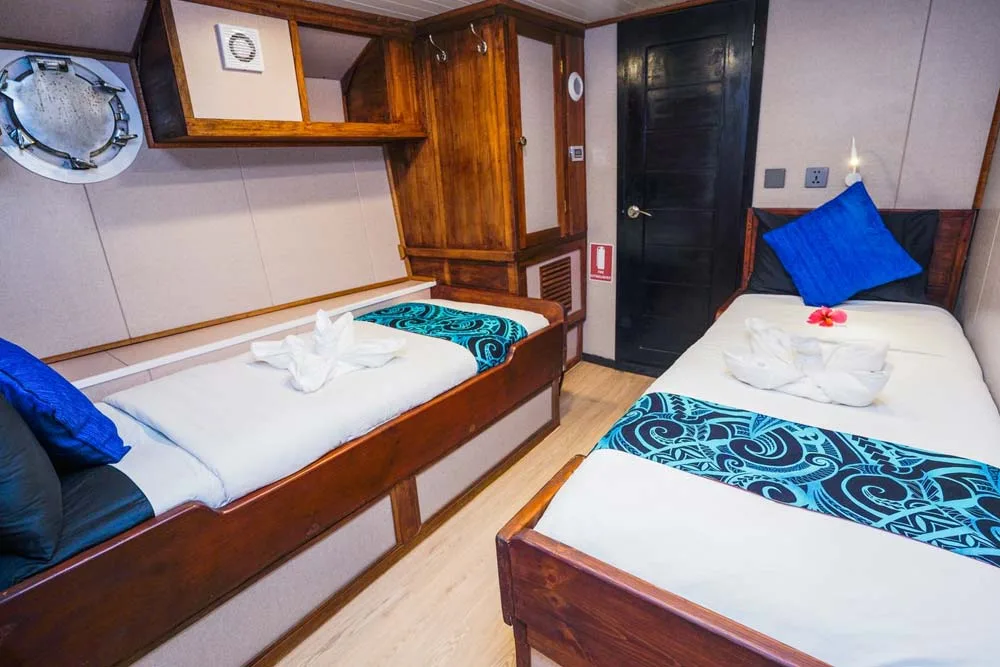
Two single beds
Three lower-deck cabins — the simplest category on board and the only one where the beds do not convert into a double. The finish is the same as everywhere else after the refit: honey teak on the wardrobes and headboards, white bulkheads, a pale floor and blue Pacific-print runners on the beds. Light comes through portholes, there is a shelf and a reading lamp above the bed, a private bathroom with a shower and individually controlled air-conditioning. Since the operator sells every berth at one price regardless of category, the difference between Classic and Premium is deck, window and floor area, not money.
- Deck
- lower deck
- Beds
- 2 single beds
- Windows
- Porthole
- Cabin numbers
- 1, 2, 3
- cabins of this type
- 3
- from
- the same price as every other category
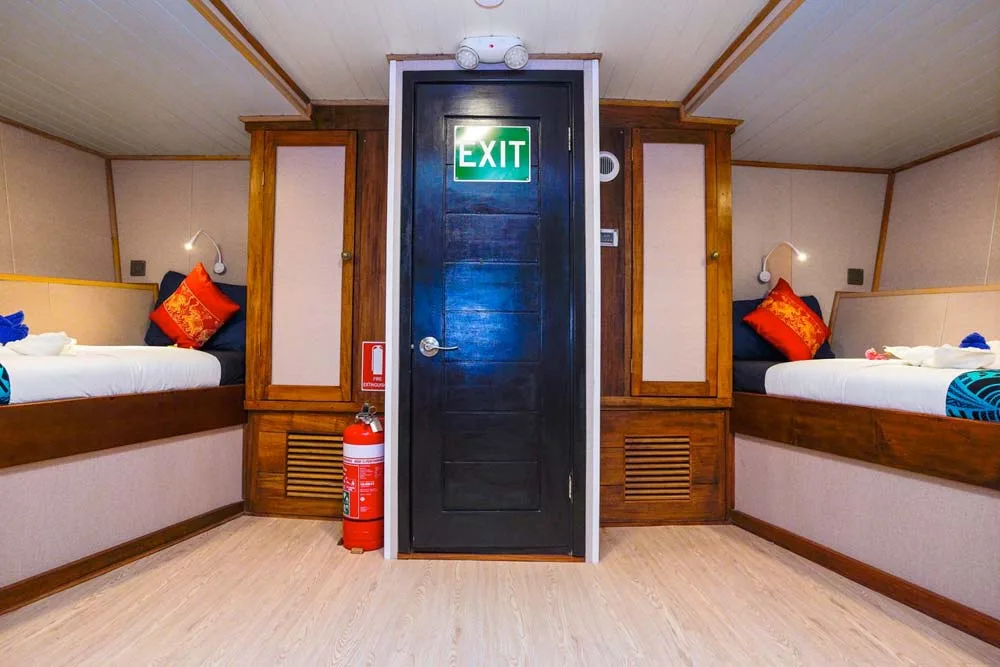
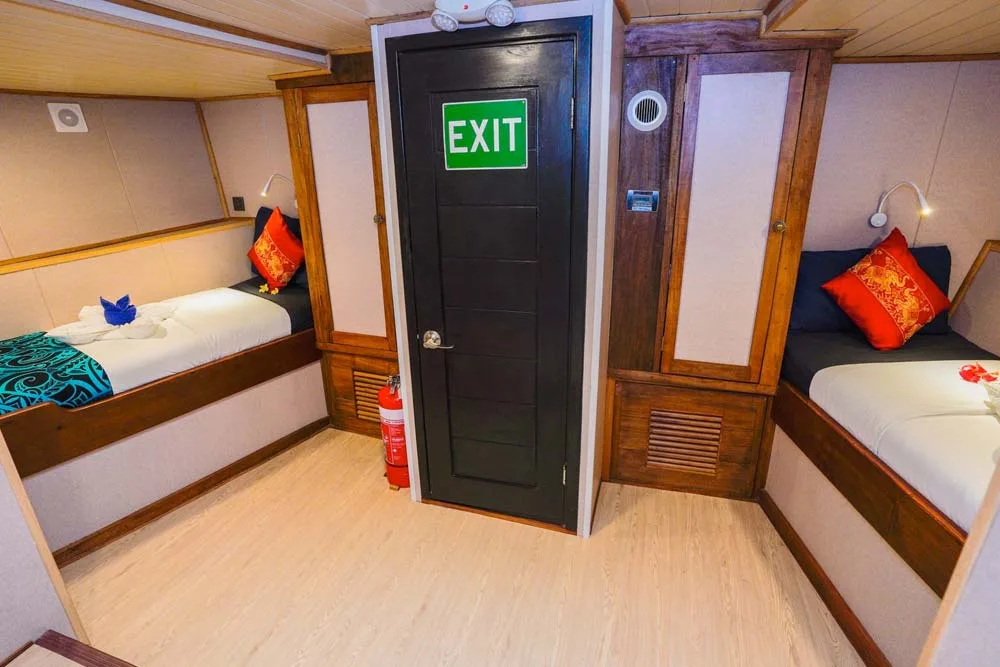
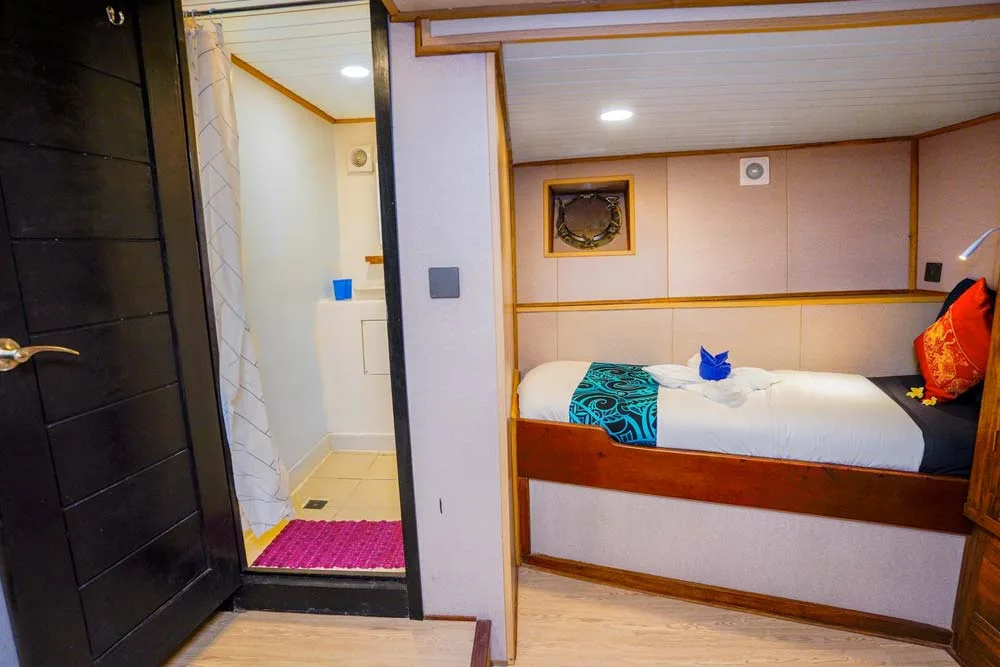
Two single beds
The only main-deck cabin where the beds stay separate and do not convert. Two singles along the sides with the deck door between them, reading lamps above each bed and full-height wardrobes with louvred vents outboard. Private bathroom with a shower behind a curtain, individually controlled air-conditioning. Which of cabins 4–7 this category occupies is not published — on the deck plan all four main-deck cabins are simply numbered.
- Deck
- main deck
- Beds
- 2 single beds
- Windows
- Window
- Cabin numbers
- one of cabins 4–7
- cabins of this type
- 1
- from
- the same price as every other category
Twin or double configuration
Three main-deck cabins where the beds are pushed together into a double or split into two singles on request — the operator calls them amendable, and the configuration has to be asked for at booking. Inside there is teak, a pale floor, shelves above the headboard, a pair of portholes, a private bathroom with a shower and individually controlled air-conditioning. In size and outlook they sit in the middle of the boat: higher and brighter than the lower deck, without the big windows of the upper one.
- Deck
- main deck
- Beds
- 2 single beds or one double
- Windows
- Portholes
- Cabin numbers
- three of cabins 4–7
- cabins of this type
- 3
- from
- the same price as every other category
One double and one single bed
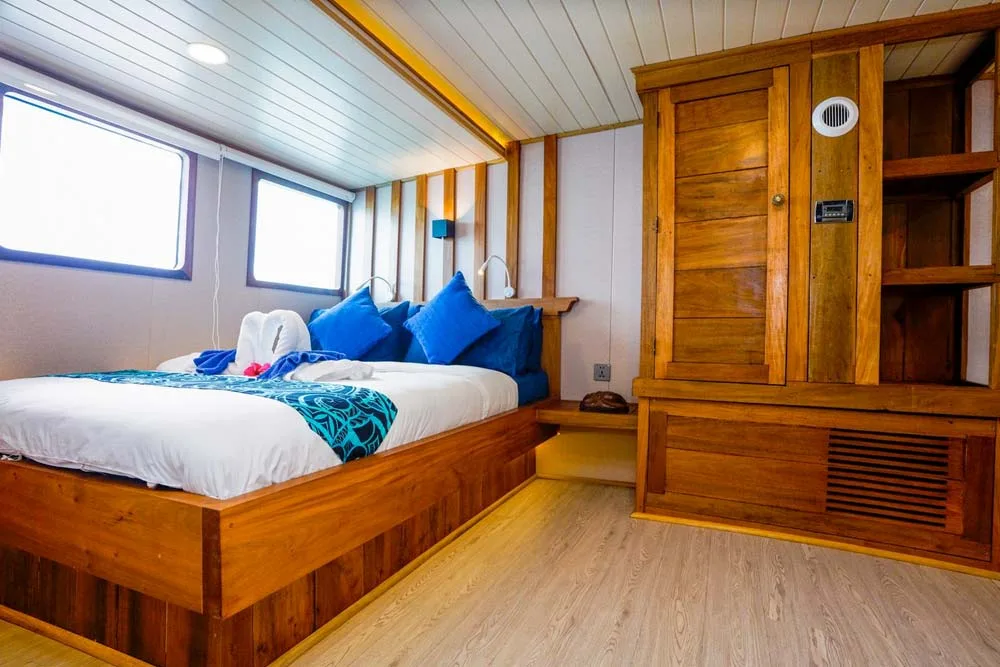
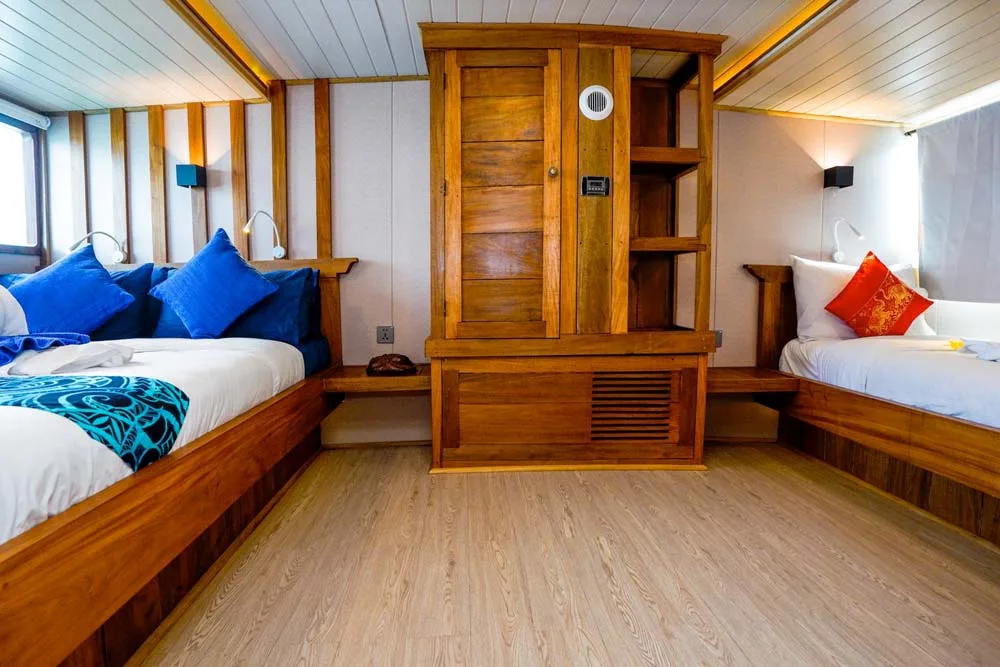
The only upper-deck cabin and the roomiest on board: a double bed plus a separate single, large windows instead of portholes, a tall teak cabinet with open shelves and a ship's clock, and noticeably more storage than anywhere else. Private bathroom, individually controlled air-conditioning. On the deck plan this is cabin 8, up in the superstructure beside the wheelhouse. The price is still the same as a Classic on the lower deck — the operator charges no category supplement.
- Deck
- upper deck
- Beds
- 1 double and 1 single bed
- Windows
- Large window
- Cabin numbers
- 8
- cabins of this type
- 1
- from
- the same price as every other category
Solomons Master
from 4445 USD