32 people rated this journey 4.9 out of 5. One tenth of a point short of perfect. Perhaps because perfection is when you don’t want to leave. And from here, you don’t.
There are journeys you recount to friends over dinner. And there are journeys you can’t recount — because words don’t do them justice.
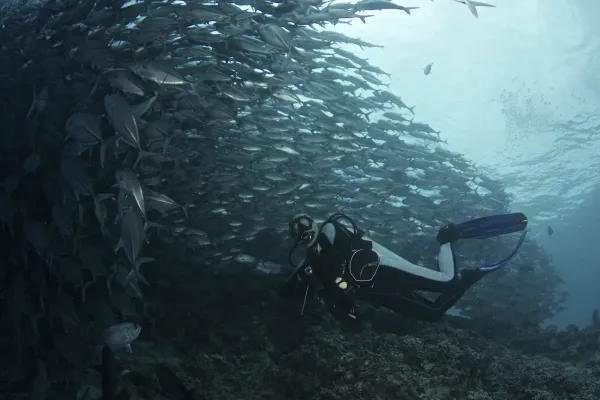
How do you explain what it’s like to hang suspended above a six-hundred-metre abyss, weightless, in silence, watching a silver tornado of a thousand barracuda spiral around you while the sun disappears behind a wall of fish? How do you convey the feeling when a green sea turtle — ancient, wise, weighing a hundred and fifty kilograms, her shell carpeted in algae like moss — glides to within arm’s reach and looks you in the eye? Eyes that hold two hundred million years. Eyes that saw this reef before you were born. And will still see it long after you’re gone.
How do you describe a creature two centimetres long that you spent twenty minutes searching for, motionless over the sand, scrutinising every tiny bump — and when you finally found it, when the pink pygmy seahorse turned its tiny face toward you — you forgot to breathe? Not from fear. From the sheer fact that such a thing exists.
11 days. An itinerary that begins among skyscrapers and ends on stilts above the ocean.
Three days in Kuala Lumpur. Caves that are 400 million years old — formed when life had not yet left the ocean. Towers that are twenty years old — and have already become the symbol of an entire nation. Silver langurs that settle on your shoulders — warm, light, with russet babies. Fireflies that flash in unison — thousands of tiny lights pulsing like the heartbeat of the forest. A bird park with 3,000 birds under open sky. An aquarium — a rehearsal before the real ocean.
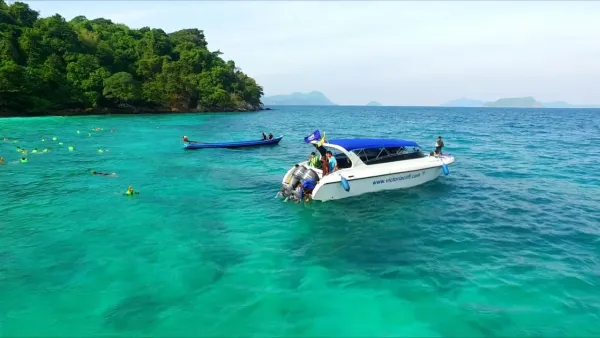
The flight to Tawau — a small airport on the east coast of Borneo, a short distance from the sea. A bus to Semporna — a fishing town where boats are moored more tightly than cars. A boat across turquoise shallows — 45 minutes, past palm-covered islets, past houses on stilts where the Bajau sea nomads live — a people who spend their entire lives on the water.
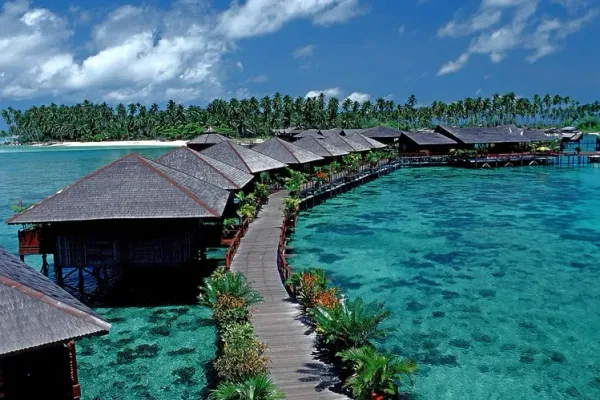
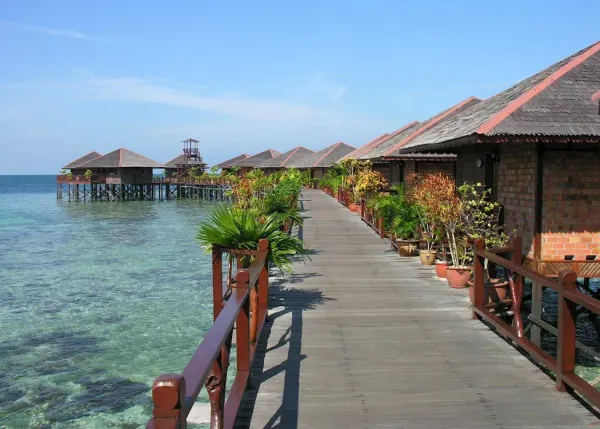
And then — Mabul. Sipadan & Mabul Resort 4★. Private chalets set among coconut palms. A pool. A restaurant with a sunset view. White sand — the kind ground by parrotfish. And a house reef right beneath the bungalows — step out of your room, climb down the wooden ladder into the warm water, pull on your mask — and you’re already among the fish. No boat, no transfer, no schedule. Feel like diving at three in the morning? Dive. The reef doesn’t close.
Six days of diving. Three or four dives a day — from a boat. Plus unlimited shore dives at any time, including night dives — Mabul’s house reef runs on its own schedule, and at night it transforms: creatures that hid by day come out to hunt, while mandarin fish begin their courtship dance.
The islands of Sipadan, Mabul, Kapalai, Siamil, Mataking — each with its own character. The Malaysian government issues Sipadan permits in limited numbers — on average one visit every two to three days. Quotas fill up fast — which is exactly why Tourleader Club books places well in advance. The rest of the time is spent at Mabul and the neighbouring islands. But that “rest” is not second-best — it’s a different universe entirely.
Sipadan is the grand scale. Walls that drop into the abyss. Currents that carry you along the reef as if on a conveyor. Schools that blot out the sun. Sharks that glide past without turning their heads. A sense of scale that makes your heart stop.
Mabul is the fine detail. Sand, silt, the remnants of old pilings. Creatures that need a magnifying glass to find — and which, once found, astonish you more than any shark. A sense of discovery that takes your breath away.
Together — the full picture. Opera house and jeweller’s workshop. Telescope and microscope. Scale and detail.
In a single expedition you see both ends of the spectrum — from a one-hundred-and-forty-kilogram turtle to a two-centimetre seahorse. From a school of a thousand barracuda to a single mandarin fish dancing at dusk. From a six-hundred-metre drop to a square metre of sand hiding three creatures you can’t see at first. This is what makes Sipadan unique among all dive destinations in the world: you don’t get one journey — you get two. In one.
Ten to twelve divers in the group. Not fifty. Not a hundred. Ten to twelve people who will have become friends within a week — because it’s impossible not to make friends with people you share a Zodiac, a dinner table, and the wonder of what you’ve seen every single day.
A professional diving instructor from Tourleader Club — someone who knows every dive site, who will show you the pygmy seahorse on the exact gorgonian fan, who knows what time the mandarin fish start their courtship dance, and who will brief you before every dive so thoroughly that you’ll know exactly what to look for and where.
Help with flights — a routing via Doha on Qatar Airways with carefully matched connections. Transfers — from Tawau airport to the boat for Mabul. Gear — recommendations, rentals, checks. 24⁄7 manager support at every stage, from booking to your return home.
You don’t think about logistics. You think about what you’ll see on the next dive. Whether a school of hammerheads will appear on the horizon today. Whether the guide has found a new seahorse on the third piling on the left. Whether you’ll catch the mandarin fish mid-dance this evening.
The logistics — that’s our job. Flights sorted. Transfers arranged. Permits booked. Gear checked. All you need to do is one thing — be ready to see something you will never forget.
Cousteau sailed to Sipadan on the Calypso — a research vessel packed with equipment, crewed by twenty people. He spent weeks here. Shot a film. Found a cave full of skeletons. Witnessed the barracuda tornado. Filmed turtles that swam up to the camera as though greeting an old friend.
And said: “An untouched work of art.”
That was nearly forty years ago. The resorts were removed. Quotas were introduced. The corals recovered. The turtles are protected. Sipadan today is no worse than it was in Cousteau’s day. Perhaps even better — because now people understand: this place must be cherished.
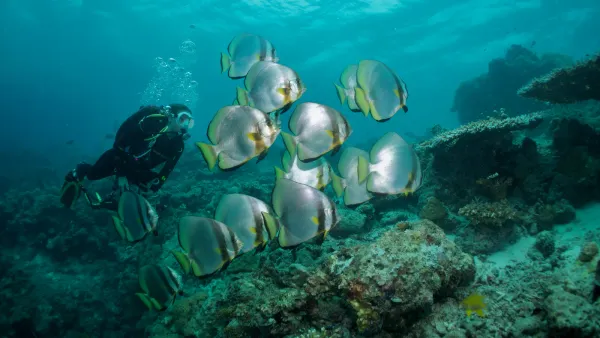
You don’t need the Calypso. You need 11 days, starting 1 May. A flight to Kuala Lumpur. An instructor who knows where the pygmy seahorse hides. And the readiness to see what Cousteau called untouched.
Since 2002 there has not been a single resort on Sipadan. A maximum of 120 divers per day. Permits sell out months in advance. The island doesn’t wait. It simply exists — with its 600-metre wall, 600 species of coral, a cave of ghosts, and a tornado of silver.
A few days after you return home — when you’re back in traffic, or in a meeting, or standing in a coffee queue — you’ll suddenly remember. Not a specific frame. Not a photograph. A feeling. Weightlessness. The silence in which the only sound is your own breathing. A silver wall of a thousand barracuda blocking the sun. A turtle’s eyes — ancient, calm, asking for nothing. A pink seahorse that would fit on your fingernail.
And you’ll understand: you want to go back.
32 people before you felt exactly the same. 4.9 out of 5.
The question isn’t whether it’s worth going. The question is whether you’ll make it in time. 120 permits per day. 10–12 places in the group. Date — 1 May.