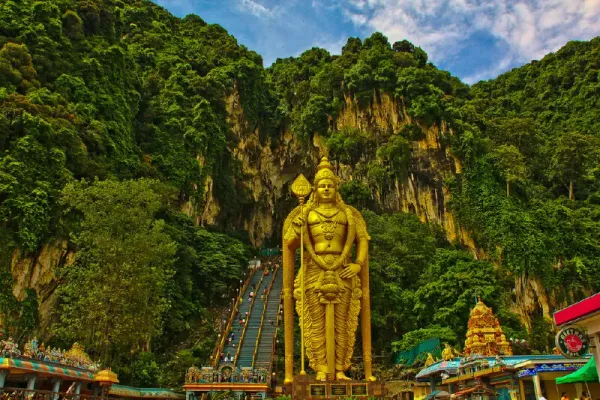
42.7 metres of gold. The statue of the god Murugan at the entrance to the Batu Caves is one of the tallest Hindu statues in the world. It has stood here since 2006, but the caves it gazes into are 400 million years old.
Kuala Lumpur is not the city you expect to find yourself in before a dive trip. Usually the route — airport, boat, reef — flies by in a single day: a quick transfer, a change of clothes, and you’re already underwater. Divers are impatient people: every hour on land is an hour that could have been spent beneath the surface.
But Sipadan is a different matter. The flight from Moscow via Doha is 15 hours. From Kuala Lumpur to Mabul island, there’s another flight to Tawau plus two hours by bus and boat. Jet lag adds five hours to Moscow time. Your body needs to adjust, and diving with jet lag is a bad idea: fatigue underwater dulls your attention, and an inattentive diver is a dangerous diver.
Three days in Malaysia’s capital are not a pause or a way to kill time. They are a full and proper part of the journey. And, honestly, a part that many participants later recall just as vividly as the diving itself.
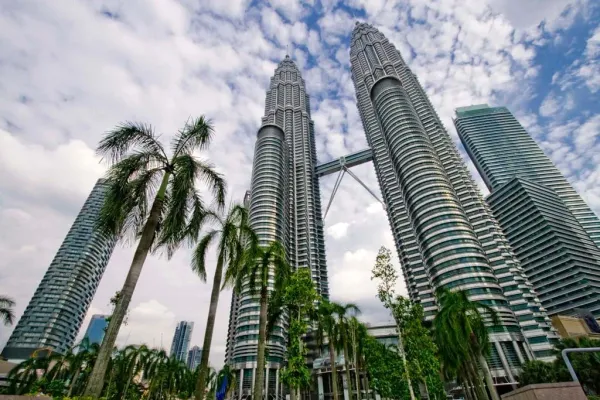
Kuala Lumpur is a city that cannot be summed up in a single word. Because one word is not enough.
This is a city of three cultures, three cuisines, three architectures. The Malay quarter — mosques with golden domes, the muezzin’s call at dawn, the aroma of nasi lemak — rice cooked in coconut milk with anchovies and chilli. The Chinese quarter — red lanterns, temples with dragons on the rooftops, the smell of fried noodles from street wok stalls, grandmothers selling herbal brews. The Indian quarter — garlands of marigolds, saris in every colour of the rainbow, the scent of cardamom and turmeric, music from loudspeakers.
And all of this — in one neighbourhood. Literally. The border between worlds is a street. You cross the road and step from India into China. One more intersection and you are in Malaysia. Nowhere else in the world are three civilisations woven together so closely, so peacefully, and so deliciously.
The Batu Caves — a network of limestone caverns 13 kilometres from the city centre. They are 400 million years old, formed when dinosaurs had not yet appeared on Earth. Two hundred and seventy-two steps upward, past the golden Murugan, past wild macaques — long-tailed, brazen, professional thieves. They snatch water bottles from your hands, pull sunglasses from your head, and one of them once made off with a phone and spent a long time studying the screen before losing interest.
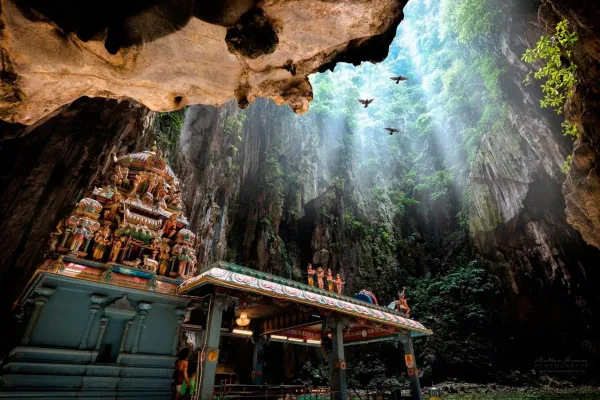
Inside — another world. Darkness, dripping water, resonant echoes. Stalactites hang from the ceiling like organ pipes. And among these stone columns, in niches and on ledges — Hindu temples, built directly into the rock. Vivid and colourful, with golden statues of gods. Light enters through openings in the ceiling — like spotlights in a Gothic cathedral, except that instead of stained glass there are the canopies of tropical trees, and instead of incense there is the smell of wet stone and jungle.
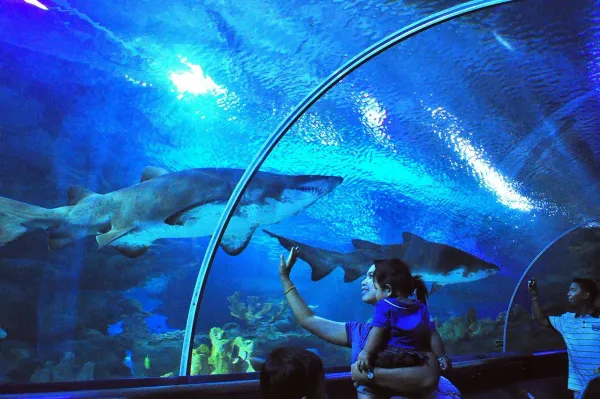
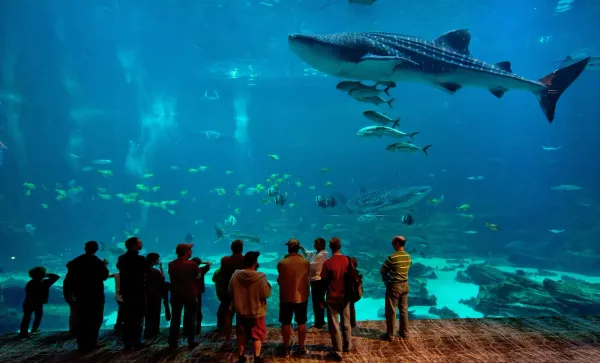
The KLCC Aquarium — Aquaria. One of the largest in Southeast Asia: 20,000 marine creatures, from tiny jellyfish to tiger sharks. The main attraction is a 90-metre underwater tunnel. You walk through a glass tube while rays, sharks, and giant groupers glide overhead. This is the rehearsal. In two days there will be no glass. Only water, a mask, and a regulator.
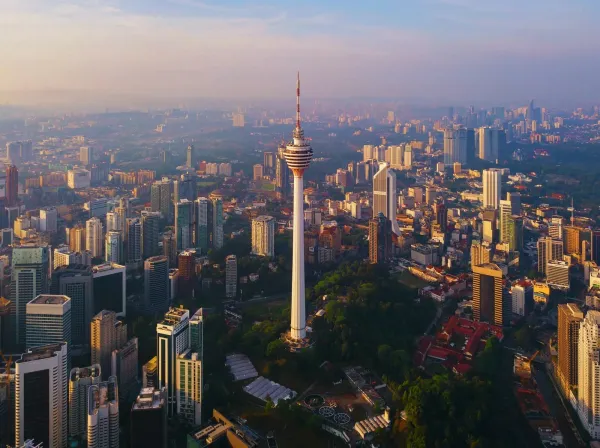
The Petronas Twin Towers. 452 metres of steel, glass, and concrete. 88 storeys. Until 2004, the tallest buildings in the world — until Taiwan’s Taipei 101 took the record. Two silver spires, designed by Argentine architect César Pelli, connected by a bridge on the 41st floor — the highest two-level sky bridge between buildings on the planet. At the heart of the design is an eight-pointed star, a traditional Islamic geometric motif.
From the observation deck, all of Kuala Lumpur lies beneath your feet: skyscrapers, minarets, palm trees, highways, and somewhere on the horizon — green mountains beyond which Borneo begins. The city was built at the confluence of two rivers — the Gombak and the Klang. The name “Kuala Lumpur” translates as “muddy confluence.” A muddy confluence that has become one of Asia’s most photogenic capitals.
Lunch at the Menara television tower — at a height of 276 metres, on a rotating platform with a 360-degree panorama. Below — the city’s rooftops. All around — clouds. A strange feeling: in two days you will be at sea level, and then below it. From 452 metres above ground to 30 metres underwater. From a world of skyscrapers to a world of coral.
But the best thing about Kuala Lumpur is not the heights. It is the first evening.
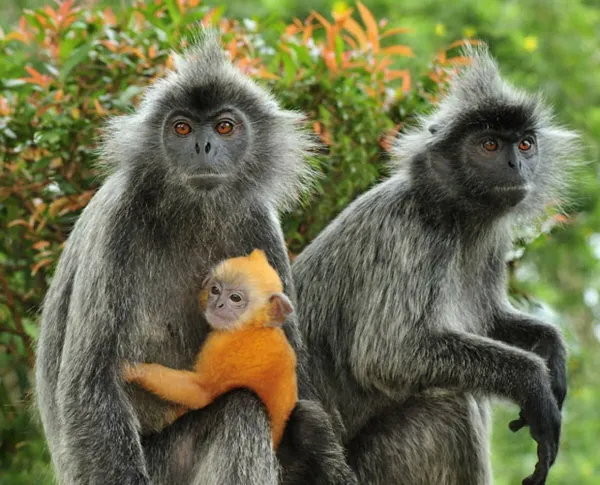
An excursion to the former capital of Selangor state. An old Portuguese fort on the riverbank. And silvered leaf monkeys — Trachypithecus cristatus. Monkeys with black faces, silver fur, and a crest on their heads that resembles a mohawk. In most parts of the world, primates either fear humans or are aggressive toward them. The silvered leaf monkeys at the old fort are neither. They are as friendly as domestic cats. They sit on your shoulders — warm, light, with dexterous fingers. They take food from your hands — gently, without snatching. They let you stroke them.
But the most remarkable thing of all is their young. Adult langurs are silver-grey. But the infants are bright orange. Fiery orange, like young foxes. Nobody knows exactly why: one theory is that the orange colouring stimulates caring behaviour in other females in the group (allo-mothering); another is that it helps the mother keep track of her infant in the canopy. An orange infant clings to its silver mother’s fur and looks at you with saucer-sized eyes — enormous, liquid, utterly trusting.
These monkeys are a prelude to Sipadan. They teach you the most important lesson: some creatures are not afraid of people. Not because they are naive. But because they have decided not to be afraid.
And then — the river. Night. The engine is off. The boat glides over black water between mangrove thickets, and the only sound is the dip of a paddle.
And then — light.
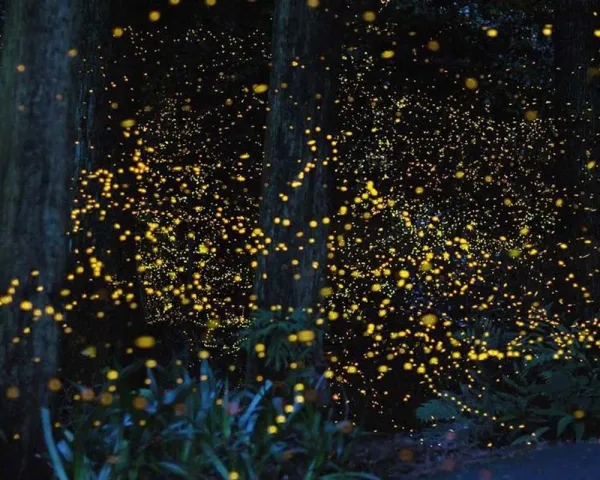
Thousands, tens of thousands of tiny lights. Entire trees covered in light. Fireflies — Pteroptyx tener — the largest colony of synchronously flashing fireflies in the world. They perch on the leaves of mangrove trees and flash. All at once. Not randomly — synchronously, in a single rhythm, like a living string of lights. On — off — on — off. One tree, thousands of lights. Ten trees — a wall of shimmering light reflected in the black water.
How do they synchronise? Scientists have been studying this phenomenon for decades. Each firefly flashes at its own natural frequency, but when surrounded by others it gradually adjusts — the way pendulum clocks on the same wall begin to swing in unison. Mathematicians call this “coupled oscillators.” Poets call it a miracle. And you sit in the boat, in the dark, on the black river, and the trees around you pulse with light like the heartbeat of the forest.
The next day — the Bird Park. The largest covered bird park in the world: 20 acres, more than 3,000 birds of 200 species. Parrots, peacocks, flamingos, ibises, hornbills with enormous beaks. The birds are not in cages — they fly freely beneath a giant net strung between the trees. You walk along a path through tropical forest while flamingos pass overhead.
Then — the aquarium. One of the longest underwater tunnels in the world. You stand in a glass tube while sharks, rays, and thousands of tropical fish surround you. A rehearsal for what awaits at Sipadan. Except that at Sipadan there will be no glass between you and the sharks.
Two days after the fireflies, the towers, and the birds, you board a plane to Tawau — a small airport on the eastern coast of Borneo. Then two hours: a bus to Semporna, a boat across turquoise shallows. And on the horizon — a small green island you can walk around in thirty minutes. Nearby — another island, larger, with wooden chalets on stilts and a white beach. Mabul. Your home for the coming week.
And fifteen minutes away by boat — Sipadan. And 600 metres of wall covered in life.