A pygmy seahorse. Two centimeters. Pink, covered in bumps, perfectly camouflaged against the gorgonian coral it lives on. To see one, you need to know where to look. Then — where to look more carefully. And then — hold still and stop breathing, because a single exhale from your regulator is enough to make it turn away and vanish.
Welcome to the macro world. Welcome to Mabul.
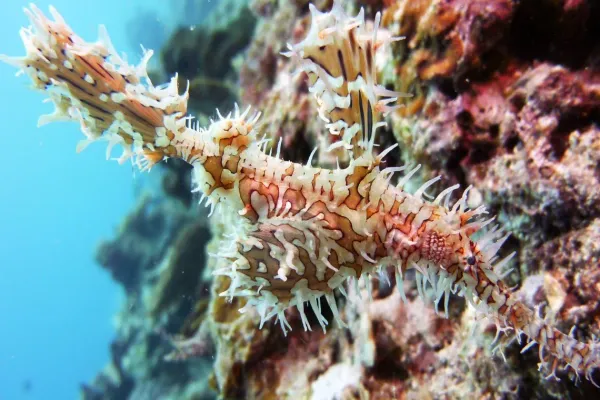
Mabul Island is 15 minutes by boat from Sipadan. If Sipadan is an opera house with a full orchestra, Mabul is an intimate jazz club where every note is worth its weight in gold. There are no six-hundred-meter walls here. No barracuda tornadoes. No sharks. Depths run 5–15 meters. Visibility is 7–10 meters, sometimes less. Murky, sandy, scattered with the remnants of old pier pilings.
And that is precisely why it is one of the best diving destinations in the world.
Mabul is the muck diving capital of the world. “Muck” — as in mud. Muck diving means descending not onto beautiful coral reefs but into shallow water, sand, and silt, among broken pilings and rusted canisters. Sounds unappealing? That’s because you haven’t yet seen what lives in that muck.
Here dwell creatures you won’t encounter on any coral reef in the world. Creatures so small they fit on a fingernail. So strange they look like the work of a mad artist. And so masterfully camouflaged that without an experienced guide — someone who knows every stone, every sponge, every piling — you can swim within a centimeter and not notice a single one.
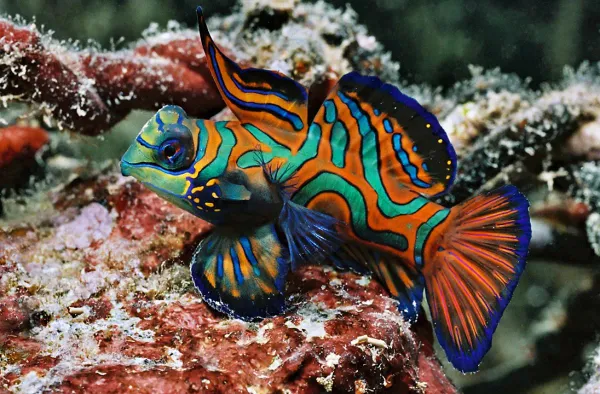
The mandarinfish is one of the most beautiful fish on the planet. The size of a thumb, painted like a psychedelic carpet: blue, orange, green, in swirls and dots. It emerges from hiding only at dusk, for 10–15 minutes, for its mating ritual. Male and female rise above the coral, entwine in a dance, and release eggs — a tiny cloud caught in a torchbeam. If you blinked, you missed it.
The flamboyant cuttlefish — Metasepia pfefferi. Ten centimeters of fury and beauty. It doesn’t swim — its cuttlebone (the internal structure that gives ordinary cuttlefish their buoyancy) is so dense that it sinks. So it walks. Along the bottom. On two lower tentacles, stepping them forward like a tiny alien that just landed and is surveying the terrain.
Its skin is a feat of technology humanity has not yet approached. Chromatophores — pigment cells — change color every second. Not just change — waves of color ripple across its body: purple, yellow, red, white, black, purple again. Like a neon sign. Like psychedelic animation. Like nothing you have ever seen in your life.
It is venomous — the only venomous cuttlefish in the world. Its flesh contains a toxin lethal to most predators. And it knows this. It is utterly unafraid of you — it doesn’t flee, doesn’t hide, doesn’t camouflage itself. Why would it? It walks along the bottom at full height, flashing every color as if to say: “Go ahead. Eat me. Let’s see who comes off worse.”
The blue-ringed octopus is one of the most venomous creatures in the ocean. And one of the smallest — the size of a golf ball, tentacles and all. At rest it is unremarkable: sandy brown, nearly invisible against a piece of coral rubble. But the moment it senses a threat, vivid blue rings ignite across its body. Dozens of rings, flickering like neon lights. This is not decoration — it is a warning in a language all of nature understands: “Don’t touch.”
Its saliva contains tetrodotoxin. The same neurotoxin found in puffer fish, only ten times more concentrated. A single bite is enough to paralyze 26 adults. There is no antidote. The only treatment is mechanical ventilation and hope that the body pulls through on its own.
Divers on Mabul photograph it from arm’s reach. It poses — flaring its tentacles, displaying its rings, allowing shots from any angle. It knows it is invulnerable. It has nothing to fear.
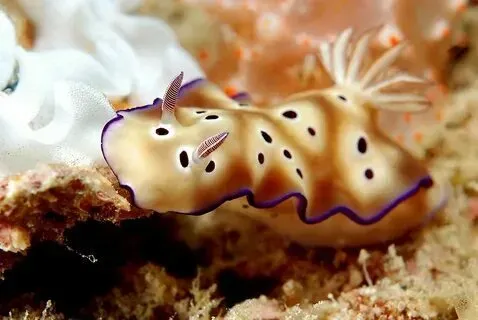
Nudibranchs — shell-less mollusks. On Mabul there are dozens of species, from tiny translucent ones to specimens as vivid as hard candy. Each is a work of art: patterns, spirals, feathers, horns. They are venomous — which is why they can afford to be beautiful. In nature, bright coloration means “don’t eat me.” Nudibranchs have taken this principle to an extreme: they look like designer jewelry.
The frogfish sits motionless on a sponge, covered in bumps and growths, blending perfectly with its background. It can be yellow, red, black, or white — matching whichever sponge it calls home. It has a “fishing rod” — a projection on its head that it waves in front of itself like bait. A small fish swims over to investigate — and disappears. The frogfish’s mouth opens in 6 milliseconds — one of the fastest reflexes in the animal kingdom. Faster than a blink. You won’t even see the moment of the strike — only the before and the after.
The mimic octopus is the only creature on Earth capable of imitating other animals. Not just changing color the way ordinary octopuses do, but changing the shape of its body. It folds its tentacles in a specific configuration and becomes a flounder — flat, moving across the bottom in undulating waves. Or a lionfish — spreading its tentacles like venomous fins. Or a sea snake — extending two tentacles and hiding the rest. The choice of disguise depends on the predator: a different “role” for each one.
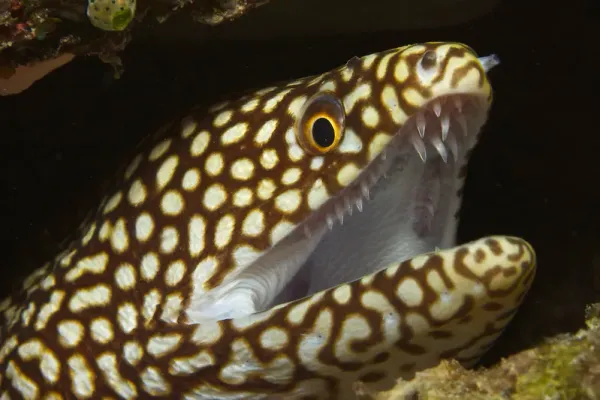
Garden eels poke only their heads out of the sand. Dozens, sometimes hundreds of slender bodies protruding from the seabed, swaying in the current like a field of strange grass. They live in individual burrows and never — literally never — leave them entirely. The lower half of the body always remains in the burrow. They feed on plankton carried past by the current, catching it with their mouths without moving from the spot. If you swim too close, all the heads retract into the sand simultaneously, as if someone pressed a single button. Wait a minute — and they begin reappearing. One, then another, then a third. Cautiously, centimeter by centimeter. Like underwater prairie dogs.
Every dive on Mabul is a quest. The guide knows where to look. He points a finger at what seems like an empty sponge — you stare for a second, two, three — and suddenly you see it: eyes. Two tiny eyes looking at you from inside the sponge. A frogfish. It was there the whole time. You simply didn’t see it.
That feeling — seeing something that was invisible — is one of the most powerful in diving. More powerful than a shark. More powerful than a school of barracudas. Because everyone sees the shark. But the pygmy seahorse on a gorgonian fan — only those who know how to look.
On Mabul you can spend an hour at 8 meters depth, covering an area of 10 square meters — and see more remarkable things than in ten dives on an ordinary reef. This is diving for the patient. For those who know how to slow down. For those who understand that size doesn’t matter when a creature the size of a fingernail makes you forget to breathe.
Six days. Three or four dives a day. Sipadan — for scale: walls, schools, sharks, an abyss beneath your feet. Mabul — for detail: sand, silt, creatures you must hunt like treasure. Together — a complete picture of the underwater world. The opera house and the electron microscope. The telescope and the magnifying glass.
But the journey begins not underwater. It begins at an altitude of 452 meters — in a city that smells of spices and stands at the confluence of three civilizations.