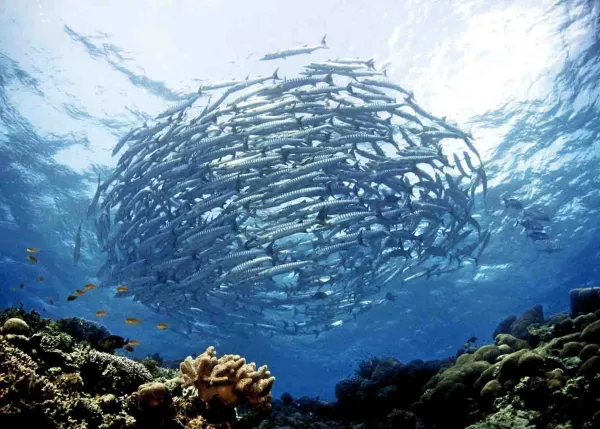
A thousand barracuda. Each one a meter to a meter and a half long, with teeth like razors. They gather into a school and begin to rotate. Slowly at first, then faster. Silver bodies merge into a spiral — and before you stands a tornado. A living, breathing, spinning tornado of a thousand predators.
Barracuda Point is the number one dive site on Sipadan. And possibly one of the most photographed underwater spectacles on the planet.
Barracuda are solitary predators. In open water, a great barracuda hunts alone: it accelerates to 45 kilometers per hour — faster than most motorboats — and strikes its prey in a single blow. Its teeth are triangular, like saw blades, arranged in two rows. The jaws snap shut with enough force to bite a fish clean in half. A barracuda is a torpedo with blades.
But at Sipadan, something inexplicable happens. Chevron and blackfin barracuda — thousands, sometimes tens of thousands — gather together and begin to circle. Not chaotically — geometrically, with mathematical precision, as if someone had written an algorithm. The fish align in perfect rows, each at a fixed distance from its neighbors. The spiral tightens. Their silver flanks reflect sunlight like a thousand tiny mirrors — flashes race through the school like a wave through a stadium crowd.
The school becomes so dense it blots out the sun. You hang on the edge of the drop-off — six hundred meters of nothing beneath you — and the light above goes out. The barracuda have spun into a funnel directly overhead. A silver ceiling of thousands of bodies. And you are inside.
Why do they do this? Scientists offer several theories. Collective defense: in a tornado formation, it is difficult for a predator to single out one target — the eye is “smeared” across thousands of identical bodies. Hydrodynamics: the rotation creates a current that draws in plankton. Communication: the school is “discussing” its direction of travel. Or — and this is the theory divers like best — nobody knows. Barracuda do this because they do.
A dive at Barracuda Point begins with a classic wall dive: you descend along a vertical face covered in giant sea fans, sponges, and soft corals of every color. The wall is sheer — coral to your right, blue abyss to your left. At 18–22 meters there is a channel where the current picks up. This is where the barracuda gather most often, riding the flow.
You emerge from behind a ledge — and there it is. Thousands of bodies. A silver mass rotating in the water like a living cyclone. The nearest barracuda are centimeters from your mask. You can see every eye, every tooth, every scale. They pay you absolutely no attention — you are part of the scenery to them, nothing more.
Sunlight penetrates the water and ignites every scale. Flashes tear through the school like lightning — first from the bottom up, then in a spiral. Sound? Only your own breath in the regulator, the distant crackling of the reef, and the soft rustle of a thousand fins.
Experienced divers say: if you are lucky enough to end up inside the tornado — don’t move. Just hang there. The barracuda will rotate around you like planets around a star. This is one of those moments that cannot be photographed — because no camera conveys what it feels like to have a thousand predators circling around you, with you at the center.
But barracuda are not the only ones putting on a show at Sipadan’s drop-off.
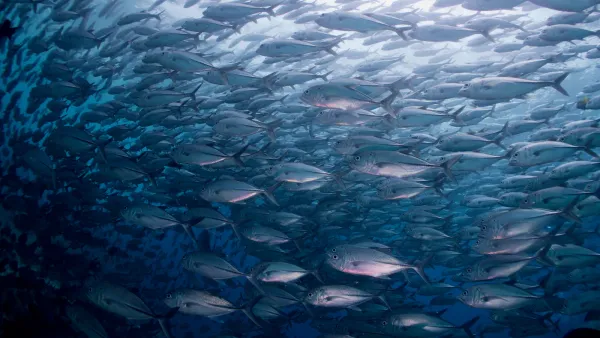
Bigeye trevally gather in schools of several hundred and sweep along the wall like a squadron of fighter jets. Silver, muscular, with enormous round eyes — they move in synchrony like a single organism, changing direction in an instant, the entire school at once, with no visible signal. Divers caught in the path of a trevally school describe the sensation as “a silver train passing centimeters from your face.”
Grey reef sharks patrol the drop-off with the unhurried authority of owners. A meter and a half to two meters — not enormous, but substantial enough to command attention. They pay the divers no mind whatsoever — you are neither food nor threat to them, just a noisy, bubbling object that will leave soon. Whitetip reef sharks lie on the ledges like cats on windowsills — lazily, indifferently, with half-closed eyes. Sometimes five or six on a single ledge, side by side.
And below, in the depths, at the very edge of visibility — shadows. Manta rays — giant creatures with wingspans of up to four meters — glide through the current, barely moving, like living magic carpets. They filter plankton with their vast mouths agape, moving with a grace that seems impossible for something so large. When a manta passes above you, you fall into its shadow, and the world darkens for a moment.
Deeper still, at the limit of visibility where the blue thickens to indigo — hammerhead sharks. They move in groups of ten to twenty, at depths of 30–40 meters, parallel to the wall. They are unmistakable — flat heads spread wide like antennae, eyes at the tips. The shape of the head gives them 360-degree vision — a hammerhead sees everything around it simultaneously. Getting close to them is difficult; they keep their distance. But even the silhouette of a hammerhead school against the blue is a sight for which divers fly to the other side of the planet.
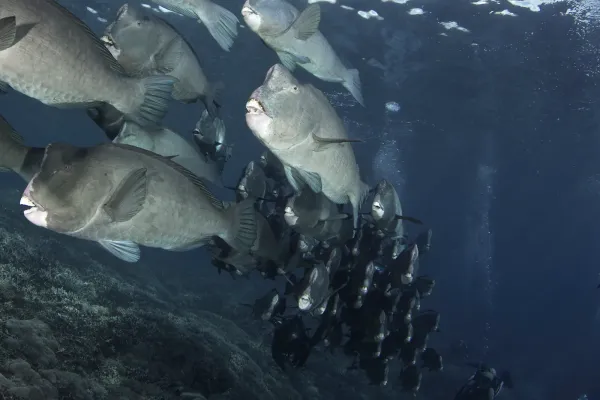
Bumphead parrotfish are the size of a small sofa, weighing up to 75 kilograms, with a bony protrusion on their forehead that makes them look like prehistoric creatures. They move in schools of thirty to fifty along the reef and chew on coral. Literally — they bite off chunks of coral with their powerful, beak-like teeth. The sound underwater is a crunch, as if someone were chewing walnuts. Divers hear the bumpheads before they see them.
These fish eat rock. They bite off a piece of coral skeleton, grind it down with their pharyngeal teeth, extract the algae living inside, and spit out the rest. The rest is fine white powder. A single bumphead produces up to five tons of sand per year. The white sand on the beaches of Sipadan — and on the beaches of thousands of tropical islands around the world — is coral that has passed through parrotfish. Every time you lie on a white-sand beach in the Maldives, the Seychelles, or the Caribbean, you are lying on fish excrement. This is not usually mentioned in the brochures. But underwater photographers know it — and every time they photograph a bumphead crunching through coral with that walnut sound, they smile quietly behind their masks.
There is one more detail that few people think about. The reefs of Sipadan are alive. They grow. Slowly — a few millimeters a year — but they grow. Corals are colonies of tiny animals (polyps) that build a limestone skeleton around themselves. Generation after generation, millimeter by millimeter, over thousands of years, they have created this wall — 600 meters of living architecture. When a bumphead bites off a chunk of coral, it is biting into something that took decades to build. But new polyps will grow in place of the old ones. The reef recovers. If given time.
A dive at Barracuda Point lasts 45–60 minutes. You finish in the shallows, in the “Coral Garden” — one of the most beautiful shallow reefs on the island. After the walls, the depths, and the schools — calm: soft corals, clownfish in anemones, cleaner shrimp climbing into moray eel mouths to clean their teeth. The moray opens wide — not to bite. It is waiting for the tiny shrimp to finish its work.
Every dive on Sipadan is a journey: from depth to shallows, from blue water to corals, from the grand to the intricate. The wall is the main character. The current is the director. You are a spectator who has been allowed backstage.
But Sipadan is a world of large forms. Walls, currents, big fish, big schools, big sharks. Every dive is like an IMAX with full immersion. Beautiful, vast, breathtaking.
And fifteen minutes away by boat, there is another world. A world where everything is reversed. Where every grain of sand matters. Where creatures the size of a fingernail astonish you more than a school of a thousand barracuda. Where you do not swim along the wall — you hover over a single square meter of sand and watch. For a long time. Carefully. Until the sand begins to move.
That world is called Mabul.