At 18 metres depth, in the wall of the drop-off, there is an entrance. Narrow. Dark. Beyond it lies a labyrinth of tunnels stretching deep into the island. The floor is white sand. And bones.
When Cousteau first entered this cave in 1988, his camera captured a sight that shook even a seasoned explorer — a man who, over sixty years, had spent more time underwater than most fish. The cave floor was covered in skeletons. Dozens of turtle shells, bleached white by time, lay on the fine white sand like headstones in an abandoned cemetery. Ribs, vertebrae, skulls — scattered, mixed together, half-buried in sand. Among the turtle remains — a dolphin skeleton. Whole. As if it had simply rolled onto its side and gone to sleep.
The torchlight swept across the walls, pulling niche after niche from the darkness. More skeletons. More shells. The cave was full of the dead.
Cousteau proposed a beautiful, romantic theory. Like elephants that supposedly journey to an “elephant graveyard” to die in peace — turtles swim to this cave deliberately. They sense death approaching and seek a quiet, dark place for their final rest. An underwater cemetery, where those whose time has run out come to rest.
A beautiful story. Not true.
The reality is simpler — and more terrible.
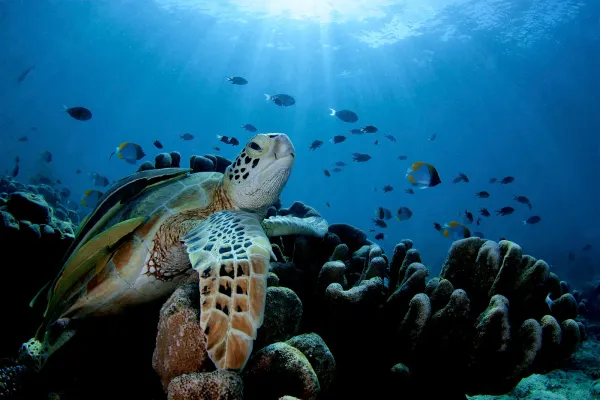
Green turtles are reptiles. Despite spending their entire lives in the ocean, they need to breathe air. They dive, feed on algae along the reef, then look for shelter to rest. In open water they sleep drifting near the surface. But at Sipadan, where the wall drops 600 metres straight down, there is nowhere at the surface to hide from waves and currents. The cave is an ideal refuge: quiet, dark, no current. A turtle swims in through the entrance at 18 metres, settles into a rocky niche, and falls asleep.
And wakes up in the dark.
The cave is not a room with a single door. It is a labyrinth: corridors, dead ends, forks, narrow passages, chambers of all sizes. The total length of the tunnels exceeds 200 metres. In complete darkness, without landmarks, without any sense of up or down, the turtle cannot find the exit. It swims blindly, hits walls, turns, swims into a dead end, doubles back, hits walls again. It breathes faster and faster — the air in its lungs is running out. The turtle cannot return to the surface because it does not know where the surface is. It drowns.
A sea turtle that lives up to 90 years, that crosses entire oceans — 2,600 kilometres from its feeding grounds to the beach where it was born — drowns inside a cave on an island it has known since birth. A creature whose ancestors outlived the dinosaurs — they appeared 200 million years ago, long before the tyrannosaurs — that navigates by the Earth’s magnetic field and returns to the same beach to within a metre, dies because it took the wrong corridor.
This is the cruel irony of Sipadan. An island that gives turtles everything — food, shelter, a nesting beach, protection from predators — also contains a trap from which there is no escape. Beauty and danger. Life and death. On the same wall, metres apart.
How many turtles have died in this cave over thousands of years? No one knows. The skeletons on the bottom are only those that survived intact. How many shells have crumbled to sand, how many bones have dissolved in the water — it is impossible to count. The cave collects its toll quietly, unhurriedly, the way the sea collects shells.
Turtle Tomb is closed to recreational divers. Technical dives only, with a cave certification only, with two tanks, a reel and a guideline, only with an experienced guide who knows every turn of the labyrinth. The rules are absolute. The cave does not forgive mistakes: it did not forgive the turtles, and it will not forgive people.
But even without going inside — even just hovering at the grate at 18 metres, shining your torch into the darkness — you will see it. White sand. Bleached shells. Shadows. And you will understand why Cousteau dedicated an entire film to this place.
Turtle Tomb is a reminder. That Sipadan is not a water park. It is a wild place where beauty and danger are two sides of the same wall. On one side — 600 species of coral and turtles that swim up to greet you. On the other — a dark labyrinth from which there is no return.
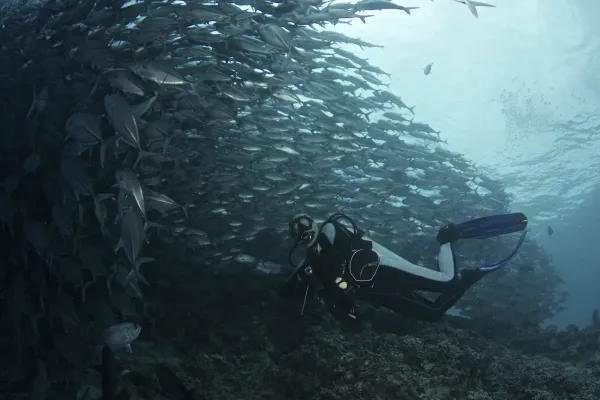
But Sipadan is not a place of death. The paradox of this island is that its deadest place — a cave full of skeletons — is surrounded by the most exuberant life you have ever seen. Turtle Tomb is a shadow, a tiny dark spot at the edge of a dazzling picture. A shadow that makes the light brighter.
Swim out from beneath the overhang where the cave begins, look up — and there it is, the wall. Six hundred metres of vertical reef, covered in life from the waterline down to depths where light no longer reaches. Every metre of this wall is an ecosystem. Every ledge is a small city, populated by creatures that have no idea there is a cave below.
Above the cave, on the walls of the drop-off, on every metre of the 600-metre vertical — life. And what life.
These walls are home to 600 species of coral — more than in the entire Caribbean. Soft corals in every colour, from lemon yellow to deep violet. Giant gorgonian fans stretched across the current like fishing nets. Black corals — not actually black but greenish, with a black skeleton that jewellers have prized for centuries. Sponges shaped like pipes, vases, barrels. Every square metre of wall is an ecosystem.
3,000 species of fish — from tiny mandarinfish the size of a coin to two-metre humphead wrasse with their bony foreheads. And turtles. Those very green turtles and hawksbills — with their pointed beaks — that nest on Sipadan’s beaches at night, that feed on algae along the reef by day, that approach divers without the slightest fear, regard you with ancient amber eyes, and then slowly, as if in a dream, drift off into the blue.
Up to fifty in a single dive. That is not a misprint — fifty green turtles in one hour underwater. In most parts of the world, a diver considers themselves lucky to see a single turtle during an entire journey. At Sipadan — fifty. Per dive.
After three days you stop counting them. After five, you stop photographing them. After six, you simply hang beside one in neutral buoyancy and watch as a 150-kilogram creature glides through the water with effortless grace, barely moving its flippers, as if gravity were something that applied to other beings. The turtle feeds on algae along the wall, biting slowly, chewing, moving along the reef with the unhurried ease of a creature that has nowhere to be. It may be 80 years old. It has seen this reef since before your parents were born. And it will see it long after you are gone.
At Sipadan, green turtles still nest today. At night they haul themselves onto the sandy shore, dig nests with their rear flippers, and lay 100 to 120 eggs. Two months later, tiny hatchlings the size of a palm will emerge from the sand and race to the ocean. Those that survive will return to this same beach in 30 to 40 years.
Two species of turtle live at Sipadan: green turtles and hawksbills. Green turtles are larger — up to 150 kilograms, with a smooth olive-brown shell. Hawksbills are smaller, 60 to 80 kilograms, but with a beautiful shell of translucent amber-coloured scales. It was hawksbill shell that was used for centuries to make combs, jewellery boxes, and spectacle frames — which is why the species was nearly driven to extinction. Both species are now under international protection.
At Sipadan they live side by side — feeding on the same walls, sleeping on the same ledges, nesting on the same beaches. Divers quickly learn to tell them apart: the green turtle is massive, unhurried, moves like an airship. The hawksbill is more compact, more agile, with a pointed beak it uses like a pair of tweezers to prise sponges from crevices in the coral.
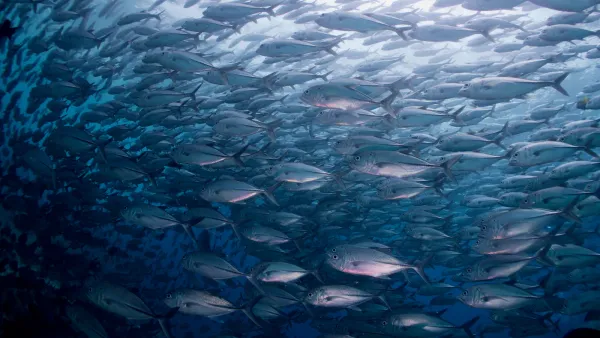
But the most astonishing sight at Sipadan is neither the turtles nor the cave. It is a silver tornado that can be found in only one place on earth.