In 1988, the research vessel Calypso dropped anchor near a tiny island in the Sulawesi Sea. On board was Jacques-Yves Cousteau, a 78-year-old man who had spent more time underwater than anyone else on the planet. He was searching for a mythical creature — a scarlet octopus that local fishermen had talked about. He never found the octopus.
He found something better.
The island can be walked in thirty minutes. Twelve hectares — smaller than an average city park. Sand, palms, scrub, a few trees. A tiny dot in the Celebes Sea, 35 kilometres off the coast of Borneo, in Sabah, Malaysia. On a satellite image it is barely visible — a green smudge on blue. Nothing special, looking from above.
Until the late 1980s, Sipadan was known only to local fishermen from the village of Semporna and the residents of the tiny neighbouring island of Danavan. They came here for fish and turtle eggs — a tradition stretching back to the 19th century, when the Sultan of Sulu granted them fishing rights. Turtle eggs — large, soft, the size of ping-pong balls — were considered a delicacy and sold at markets across Borneo. For the fishermen, Sipadan was a larder. For the rest of the world, the island did not exist.
And then Cousteau arrived.
By 1988, Jacques-Yves Cousteau was not merely famous — he was an icon. His red cap, his Calypso, his narrating voice were familiar to hundreds of millions of viewers around the world. His films aired on television in every country. When Cousteau called a place “the best,” that place became legend. When he said “an untouched work of art,” people started looking for tickets.
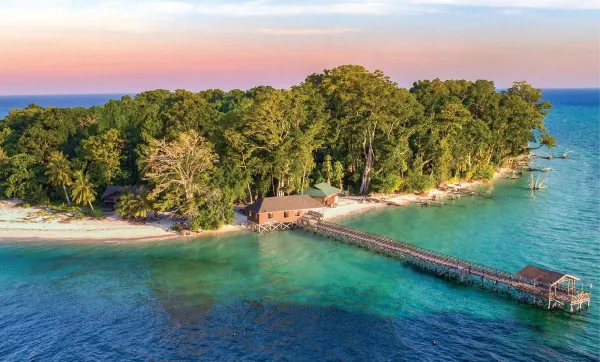
But Sipadan is not what lies above the water. Sipadan is what lies beneath it.
The island is the summit of an extinct volcano — the only volcanic island in all of Malaysia. Millions of years ago there was an underwater mountain here, and corals made it their home. Generation after generation, layer upon layer, living organisms built a reef on top of the dead volcano until it rose above the surface of the ocean. Sipadan is not rock. It is a living creature that spent millions of years building itself.
And that is why its walls drop vertically downward — 600 metres. Six hundred metres of sheer cliff covered in living coral, from the surface to the ocean floor. No shelf, no gradual slope, no “shallows.” You stand on the beach, take three steps into the water — and beneath you is an abyss twice the height of the Eiffel Tower. A wall descending into blue, until the blue becomes black.
Divers call this a “drop-off.” On most reefs in the world a drop-off is a slope. At Sipadan it is a cliff edge. As if you were standing on the roof of a skyscraper, except instead of air there is water, and instead of asphalt below there is darkness.
Cousteau dived. And fell silent.
This man was 78 years old. He had invented the aqualung — literally, he and engineer Emile Gagnan created the first self-contained breathing apparatus in 1943. He had made more than 120 documentary films. He had dived in the Red Sea when no other diver had yet visited it. He had explored sunken ships, underwater caves, coral reefs from the Caribbean to Antarctica. He had seen everything a human being can see underwater.
And he fell silent.
Then he said the words that would change the fate of this island forever:
“We have found an untouched work of art.”
That phrase was both a sentence and a salvation. A sentence, because after it divers from around the world flooded Sipadan by the thousands — all wanting to see what Cousteau had seen. A salvation, because it was precisely that fame — and the anxiety for the island’s future — that eventually led to its protection.
But protection was a decade and a half away. Fifteen years during which resorts sprung up on twelve hectares, boat anchors scratched the corals, and turtle populations began to decline. There were years when 300 to 400 divers were on the island at once — three times the current quota. The reefs began to suffer.
Then, in 2000, something happened that changed everything. A group of armed militants from the Philippines took hostages at one of Sipadan’s resorts — 21 people, including tourists and staff. The hostages were taken to the Philippines; negotiations lasted months. Everyone was eventually freed, but the incident shook Malaysia.
Two years later the government made its decision: all resorts on the island were to be removed. The territorial waters of Sipadan were declared a marine sanctuary. A maximum of 120 divers per day. Hours restricted to 8:00 until 15:00. No overnight stays on the island. No anchoring — mooring buoys only. Permits issued by quota.
Tragedy led to salvation. Sipadan, stripped of its resorts and governed by strict quotas, began to recover. The corals grew back. The turtles returned. The fish returned too. Today’s Sipadan, in the view of many divers, is better than it was in Cousteau’s time. Because now it is protected.
What did Cousteau see on these walls? 600 species of coral — for comparison, the entire Caribbean has around 65. 3,000 species of fish — more than the entire Mediterranean. Giant gorgonian sea fans the size of a car. Sponges, soft corals, black corals — the wall was covered in life from the surface down to the depth where light still reaches, and beyond, into the place where eternal darkness begins.
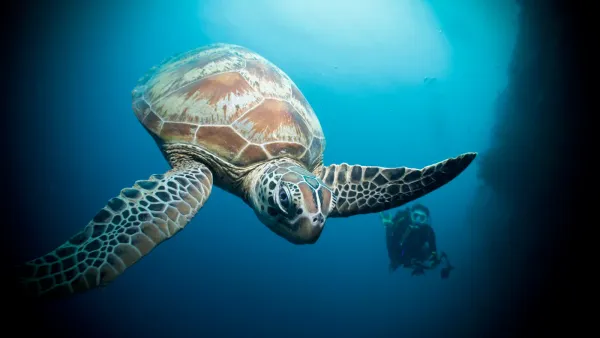
And the turtles. Green sea turtles — the largest of the hard-shelled species, up to 150 kilograms, up to a metre in length. A species under threat of extinction, having lost 90% of its population over the past half-century. In most places in the world, seeing one turtle on a dive is a piece of luck you tell your friends about. At Sipadan — up to fifty in a single dive. They are everywhere: gliding along the wall, grazing on algae across the ledges, sleeping in niches, swimming up to within arm’s reach of divers and looking — attentively, calmly, without fear.
Green turtles live up to 90 years. They are the only herbivores among sea turtles: they eat algae and seagrass, which gives their fat a greenish tint (hence the name). They navigate by the Earth’s magnetic field and are capable of crossing an ocean — 2,600 kilometres from feeding ground to the beach where they were born — to lay their eggs on the same shore where they hatched decades before. Their navigational accuracy is within a few metres.
At Sipadan, turtles still nest today. At night, while divers sleep in their chalets on Mabul, green turtles come ashore on the sandy beach, dig nests, and lay their eggs — 100 to 120 at a time. Then they cover the nest and return to the ocean. Two months later, tiny hatchlings the size of a palm will scramble out of the sand and race toward the water. Most will not survive their first year. But those that do will return to this same beach 30 to 40 years from now. To continue a cycle 200 million years old.
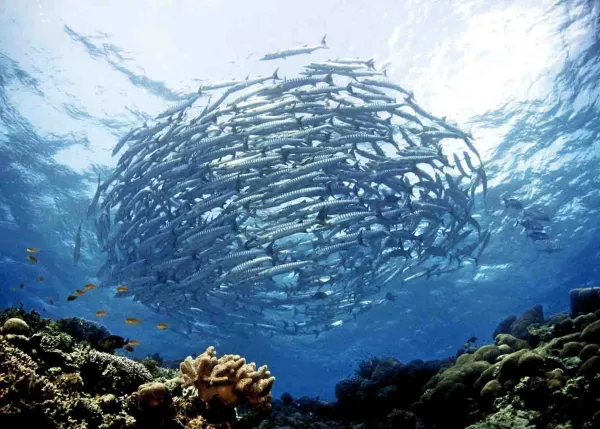
Schools of barracuda spiralling into a tornado of thousands of silver bodies. Reef sharks patrolling the drop-off with the indifference of landlords. Schools of trevally sweeping past like squadrons. And — the cave. A cave inside the island, its floor covered in white sand and the skeletons of turtles.
Cousteau made a film about it — “Borneo: The Ghost of the Sea Turtle.” After the film was released in 1989, Sipadan transformed from an unnamed dot into a legend. Divers from around the world poured onto the island. By the late 1990s several resorts occupied the twelve hectares, boats shuttled back and forth, and anchors smashed the corals.
In 2002 the Malaysian government made a decision that the diving world still speaks of with respect: every resort on Sipadan was removed. Every single one. The island became a marine sanctuary. A maximum of 120 divers per day. Hours only from 8:00 to 15:00. Permits are issued in limited numbers and sell out months in advance.
Sipadan is not for sale. It permits you to visit — briefly. And to leave — with something you will remember for the rest of your life.
Divers who have been to Sipadan fall into two categories. Those who have been once — and are planning to return. And those who have already returned. A third category — “been there, done that” — does not exist. Sipadan is not a tick on a list. It is a place that pulls you back. Every dive on these walls is different: different current, different light, different fish, different mood of the reef. Divers who have been here twenty times say they have seen only a small part of it.
32 people rated the Sipadan journey 4.9 out of 5. Not because the hotel is good (though it is). Not because the food is delicious (though it is). But because underwater there are 600 metres of wall inhabited by 3,000 species of fish, 600 species of coral, and turtles you will stop counting by the third day.
But before you descend those walls, before you see the barracuda tornado and turtles the size of a coffee table — you need to understand what lies inside this island. In its darkness. In the labyrinth of tunnels where the floor is covered in white sand and bones.