63 people. 4.8 out of 5. This is the most reviewed journey in our catalog — and one of the most affordable. €1,760 for a week that will change how you think about what lies beneath the surface.
The Red Sea is where many people dive for the first time. And the last place they dive anywhere else. Because after the Red Sea, you only want to come back here.
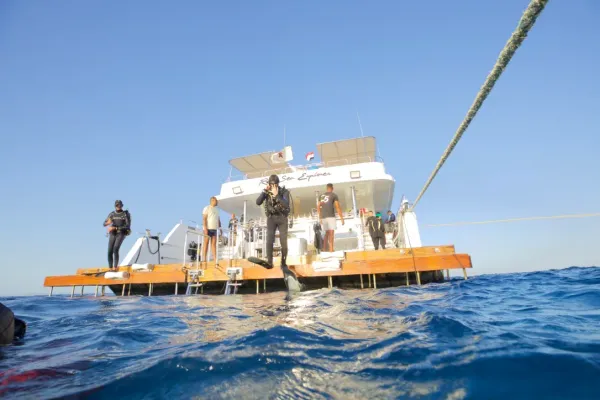
8 days. A direct Aeroflot flight from Moscow to Hurghada — 4.5 hours. Transfer to Port Ghalib — further south, closer to the reefs. Check in aboard the My Red Sea Explorer. And six days underwater.
The route is a southern Red Sea classic. Three legendary dive sites that regularly make the world’s top-10 lists.
Zabargad — an island made of gemstones. Peridotite from the Earth’s mantle, pushed to the surface by tectonic forces. Green peridot crystals in the rocks — the very ones Cleopatra wore as “emeralds.” A lagoon. Sunken ships. Corals undisturbed by day-trip boats — too far from shore.
Daedalus — a reef with a lighthouse. 100 kilometers offshore, in the middle of the open sea. A lighthouse from 1931, two Egyptian Navy soldiers, gulls. And schools of hammerhead sharks — 20, 50, sometimes 100 individuals — circling the southern plateau in the June blue. Silkies. Whitetips. Threshers. Daedalus is the shark capital of the Red Sea.
Rocky Island — Daedalus’s younger sibling. Vertical walls, a jagged profile, the same sharks, the same currents, the same silence.
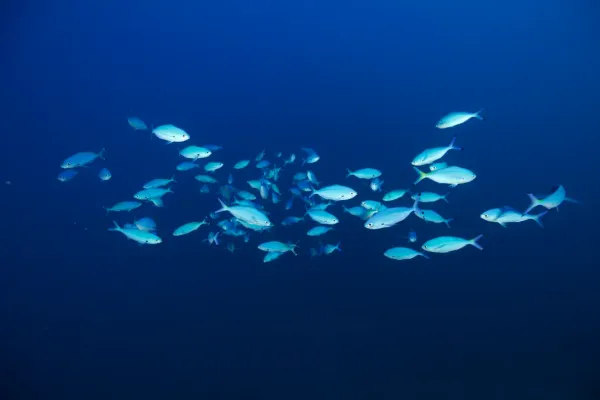
Three to four dives per day. Daytime, afternoon, night. Nitrox 28 — included. Weights, tanks, dive guides — included. You kit up on the dive deck, step off the platform — and in an instant you’re in another world. A world where visibility is 50 meters, water temperature is 27°C, and a school of hammerheads passes you close enough to see every eye.
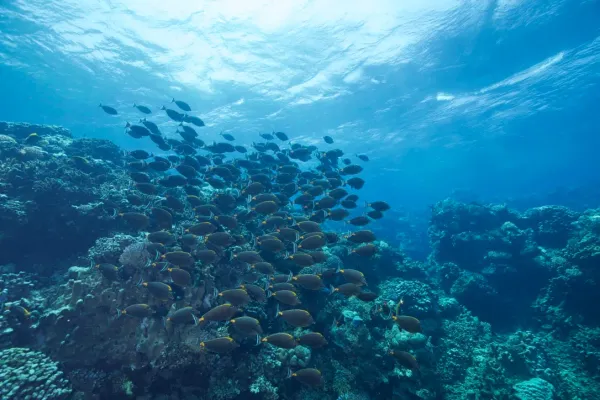
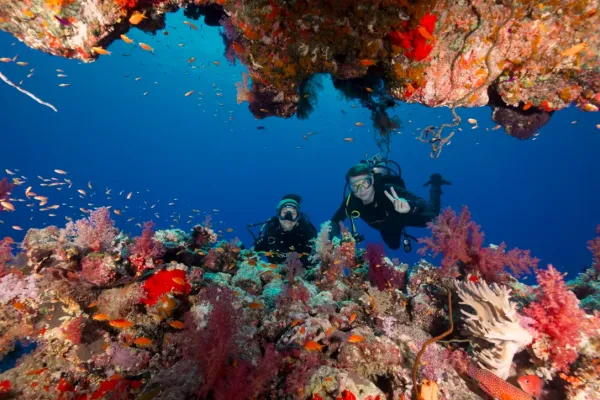
Between dives — life on the yacht. Breakfast on deck with a view of open water. Lunch after the second dive, when appetite is fierce (diving burns calories like nothing else — cold + pressure + exertion = hunger). Dinner under the stars. A hundred kilometers from shore, the sky is different: no light pollution, no clouds, with the Milky Way stretching from horizon to horizon. You lie on the sun deck counting satellites — they drift across the sky in thin lines, fast and silent.
16 people in the group. A trip leader from Tourlider Club. Dive guides who know every rock at Daedalus and every moray at Zabargad. A briefing before every dive — not a formality, but a map: where to enter, where the current runs, where the sharks are, where to exit, where to hang for your safety stop.
Logistics — the simplest of all our journeys. Egypt — visa on arrival, €30, a stamp in your passport in 30 seconds. Direct Aeroflot flight Moscow–Hurghada — 4.5 hours, no connections, no overnight stays in transit airports, no jet lag (just +1 hour time difference). You fly out in the morning and you’re on the yacht by evening. Equipment — your own or hire on board (regulators, BCDs, wetsuits — everything is available). Certification — Advanced Open Water or above: the southern reefs are for experienced divers, depths are serious, currents are strong. If you hold an Open Water Diver certification, there’s an October itinerary covering the northern Red Sea — gentler and no less beautiful.
June is the ideal time. Water 28–30°C — a 3mm wetsuit or even a shorty. Visibility at its peak: 40–50 meters. Hammerheads at Daedalus — peak season. Wind — moderate (winter can bring storms, summer is calmer). Daylight — 14 hours: late sunsets, early sunrises, more than enough time for dives.
This is the most affordable world-class diving safari on the planet. €1,760 for a lower-deck cabin. €1,840 for main deck. €1,920 for upper deck. €2,340 for the Royal Suite. Plus flights (Moscow–Hurghada charters are among the cheapest tickets on the market) and local fees (€280).
63 people before you have already been. 4.8 out of 5 — the highest rating of all our diving journeys (63 reviews — and the largest sample size). They came back with thousands of photos (the average diver brings home 500–800 shots per week), with wind-and-sun tans (on a liveaboard you burn in a day — sunscreen is essential), and with eyes holding the blue of the Red Sea that doesn’t fade.
And with one question: when can we go back?
Many do return. The Red Sea is the kind of diving you get used to like good coffee: after it, everything else seems a little paler. Some of our 63 participants have been to the Red Sea twice, three times, five times. They know Daedalus by heart — every ledge, every turn in the wall, every spot where the hammerheads emerge from the blue. And they keep coming back. Because Daedalus is different every time. Different light, different current, different sharks, different mood in the reef. The same wall — and never the same experience.
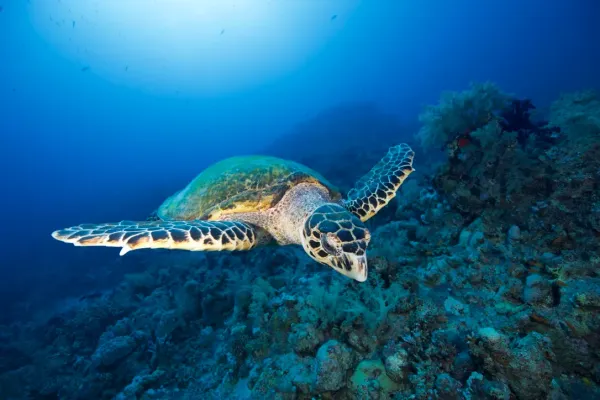
The Red Sea is the most accessible world-class dive destination on earth. A 4.5-hour flight from Moscow. Visa on arrival. No jet lag. Prices far lower than Sipadan, the Galapagos, or Mauritius. And diving quality that holds up to all of them. Because underwater there is no “budget” and no “premium.” There is water. There is a reef. There are fish. Either they are there — or they aren’t. In the Red Sea — they are.
The Red Sea doesn’t tire. It doesn’t age. It doesn’t degrade. It is 20 million years old — and it is young. Expanding by 1.5 centimeters a year — in millions of years it will become an ocean. But right now — narrow, deep, warm, clear, alive. Reefs grow. Corals bloom. Clownfish hide in anemones. Moray eels open their mouths for shrimp. Sharks circle Daedalus every June, like clockwork, faithful to their rhythm. The gemstones of Zabargad lie in the rocks — green as young grass — waiting for those who look down.
All it takes is 8 days. A direct flight. A yacht. A regulator. And the desire to see what lies beneath the surface of the sea that fed Cleopatra’s jewelry, inspired Cousteau to shoot an Oscar-winning film, and is inviting you — right now.