A clownfish lives inside an anemone — a venomous sea creature whose tentacles paralyse anything that touches them. Anything — except the clownfish. It is coated in a mucus that makes it invisible to the poison. It lives inside a lethal trap — and feels perfectly at home.
The Red Sea is not just sharks and reef walls. It is an endless catalogue of relationships. Alliances, deals, betrayals and mutual aid, playing out across every square metre of the reef. Each dive is an episode of Game of Thrones — just without the dialogue. And with better costumes.
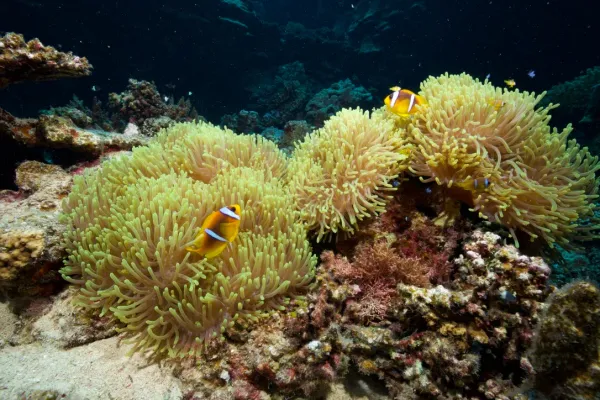
The clownfish and the anemone are a classic example of symbiosis that every child knows after Finding Nemo. But in reality it is more complicated than the film suggests. The clownfish does not simply “live” in the anemone — it feeds it. It brings scraps of food that the anemone, having neither eyes nor a brain, could never find on its own. In return — protection: no predator will venture into the venomous tentacles. Clown and anemone are one whole. Remove one and the other dies.
Cleaner shrimp are another alliance, another wordless deal. Tiny, translucent, with long white antennae like aerials, they sit on a particular coral — always the same one, like a doctor in a consulting room — and wait. Their “consulting room” is called a cleaning station, and the fish know exactly where to find it. They swim in from far away — specifically to be “cleaned.”
Up swims a moray eel — a metre and a half of teeth and muscle, with a jaw that could bite through fingers. It opens its mouth. Wide. And waits. The shrimp — a creature the size of a little finger — climbs inside. Into the mouth of a predator that swallows fish whole. It walks across the teeth. Cleans. Picks out parasites, food remnants, dead tissue. The moray holds its mouth open patiently — a minute, two, three — while the shrimp works. Then it slowly closes its mouth — carefully, giving the shrimp time to get out. And swims away. Clean.
No contract. No coercion. Pure (in every sense) barter that has been working for millions of years.
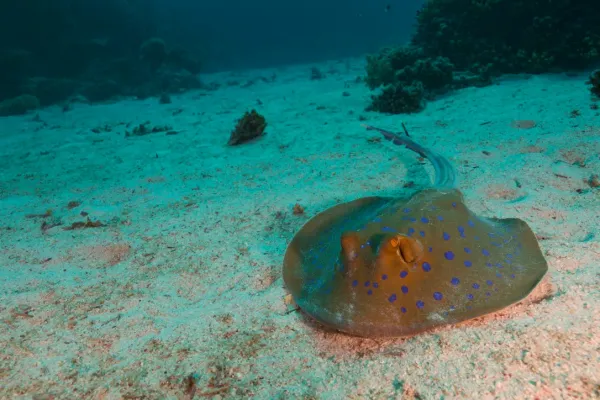
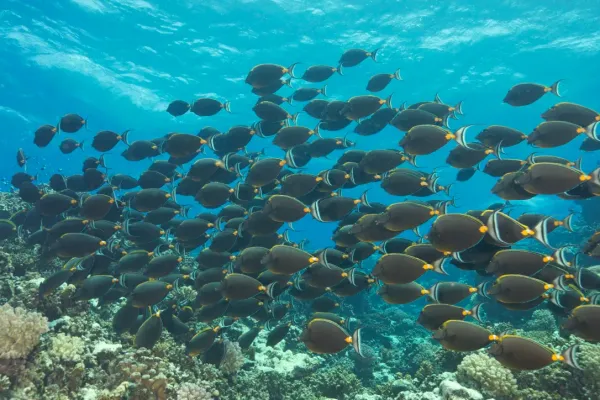
The reefs of the Red Sea are home to 1,200 species of fish. Each with its own survival strategy, its own role, its own place. Surgeonfish — with blades on their tails, sharp as a scalpel (hence the name). One sharp flick of the tail and the skin of a rival or predator is left with a deep gash. Lionfish — venomous, with fan-like fins spread wide as a peacock’s tail — beautiful and lethal. Their venom will not kill a person, but the pain of a sting is described as “a red-hot nail driven into the body.” Parrotfish — they gnaw on corals with beak-like teeth and make sand (one parrotfish produces up to 100 kg of sand per year). Groupers — massive as bulldogs, lurking in their “apartments” — small caves in the reef — and letting no one in. They live in the same spot for years; the large ones for decades. Butterflyfish — always in pairs, because they are monogamous. If one butterflyfish dies, the other stays alone for the rest of its life. It does not look for a new partner. Like swans — only fish.
At night — different rules. Completely different. As if the reef had closed for renovation and reopened with a new staff, a new menu, a different mood.
The daytime fish go to sleep. Literally. Parrotfish secrete a mucous cocoon — a transparent bubble that wraps around them like a sleeping bag. Why? The cocoon masks the scent of a sleeping fish — nocturnal predators (morays, sharks) hunt by smell, and the cocoon makes the parrotfish “invisible.” It hangs in its bubble, eyes closed, motionless — and if you shine a torch on it, it will not even stir. It is asleep.
And all around — those who are not sleeping. Octopuses emerge from their dens. By day they are masters of camouflage, hiding in crevices. By night — hunters. Their skin changes colour and texture so fast that you feel you are watching a special effect, not a living creature. Red, white, brown, striped, bumpy, smooth — in a single second. An octopus moves across the reef and every part of its body takes on the colour and texture of whatever it is sitting on. Left half — brown (rock), right half — red (coral). The boundary between the colours — perfect.
Spanish dancers — vivid red nudibranchs the size of a hand — “dance” in the water, undulating their entire body. The edges of their mantle rise and fall in waves — like the skirt of a flamenco dancer. They do not do this for beauty’s sake — it is simply how they swim. But it looks like a performance.
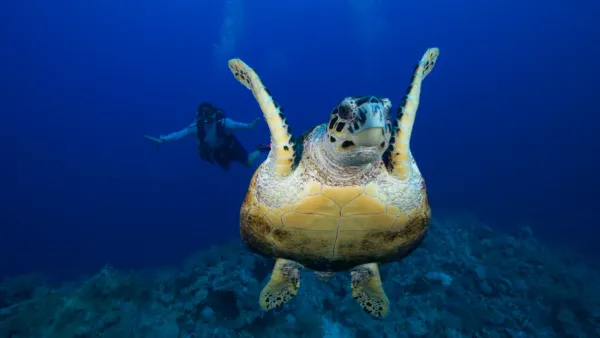
Every dive on a reef — forty minutes, an hour — and you witness dozens of stories. Dozens of plots playing out simultaneously: here a shrimp is cleaning a moray, there a clownfish is chasing a butterflyfish away from its anemone, an octopus is changing colour trying to blend into a rock, a turtle is lazily chewing a sponge without paying anyone the slightest attention.
And all of this — in water with visibility of 40–50 metres. You see far. Clearly. Every detail. Every eye of a moray. Every scale of a barracuda. Every coral polyp.
250 species of coral on the reefs of the Red Sea — and each species grows in its own way. Brain corals — massive, rounded, with winding grooves — grow 1–2 centimetres a year and live for centuries. Branching corals — faster, but more fragile: one careless kick of a fin and ten years of growth are broken. Soft corals — without a skeleton, pulsing in the current like underwater flowers: red, yellow, violet. Gorgonian fans — flat, perpendicular to the current, like living antennae catching plankton.
Every metre of the reef is architecture. Not chaos — architecture. With floors, apartments, corridors and residents, each of whom knows their place. And each of whom is ready to defend it.
But the most important thing is not to see. The most important thing is to be there. Inside. Not behind aquarium glass. Not on a screen. Inside the reef, among the fish, in weightlessness, in silence, where the only sound is your breathing and the crackling of the corals. The sound like distant rain — that is the parrotfish gnawing on rock. The sound like a snap — that is the pistol shrimp, whose click is louder than a gunshot. The sound like nothing — that is you. Breathing. Floating. Living.