Imagine a hotel that moves to a new location every night. You wake up in the morning and outside your window is a different reef, a different island, a different underwater world. And you never have to pack your bags.
A liveaboard — literally a “living board” — is a yacht where you live for the entire trip. You sleep, eat, dive, and relax without ever going ashore. Sounds cramped? Only until you’ve seen My Red Sea Explorer.
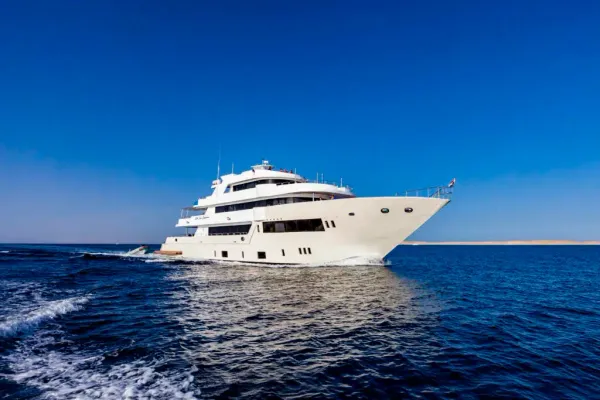
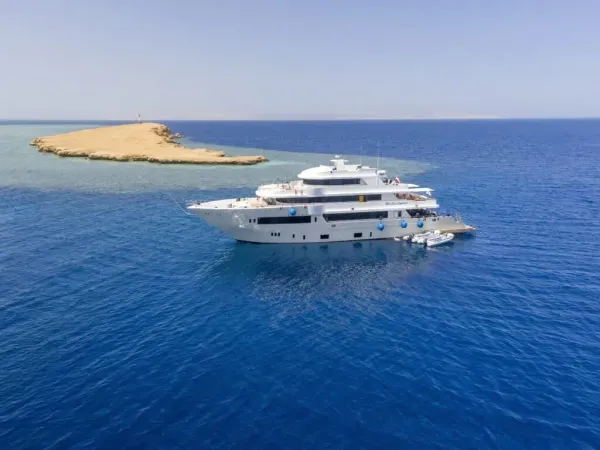
My Red Sea Explorer was built in 2019. Steel hull — not wood, not fiberglass, but steel. That matters: steel yachts are more stable in open water, handle swells better, and last longer. In the Red Sea, where passages between dive sites take 10–12 hours and the yacht crosses open water overnight, a reliable hull isn’t a luxury — it’s a necessity.
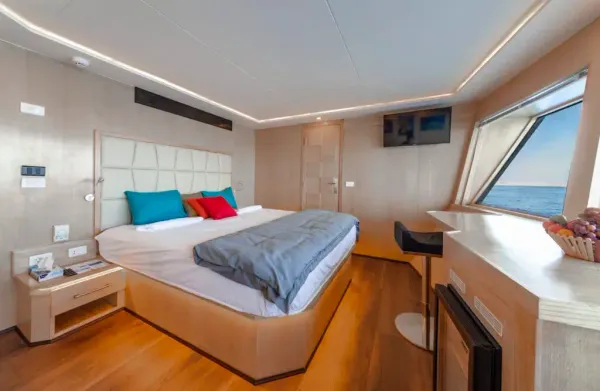
24 guests maximum. This is no three-thousand-passenger cruise ship — it’s a small floating hotel where everyone knows each other by name. Cabins on three levels: lower deck (the most affordable, €1,760), main deck (€1,840), upper deck (€1,920). All feature beds on a single level (no bunks), a private en-suite bathroom with hot shower, adjustable air conditioning, a TV (for reviewing photos between dives), a safe, and a mini-fridge.
The upper deck has Suite-class cabins: more spacious, with a panoramic half-wall window and a sea view right from the bed. Wake up to a sunrise over Daedalus reef. The Royal Suite (€2,340) is for those who want the ultimate: a double cabin with a separate lounge area and its own private terrace.
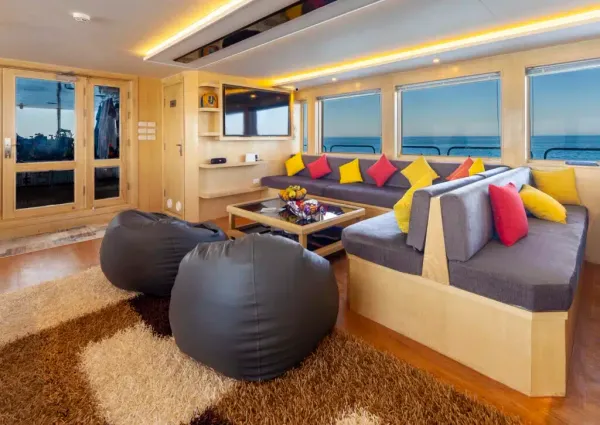
The main deck holds the dining room and salon with a bar. This is where guests have breakfast, lunch, and dinner — full board, from a buffet with dozens of dishes (Egyptian, European, and Asian cuisine) to snacks between dives. Tea, coffee, water, and juices are unlimited. Alcohol is available for an additional charge (beer, wine), but most divers skip it on a dive trip anyway: alcohol plus depth is a bad idea.
The upper deck features a sun deck with loungers, half-shaded from the Egyptian sun by an awning (in June, no joke: SPF 50, a hat, and a rash guard are non-negotiable, or by day three you’ll resemble a tomato). This is where you spend time between dives. You lie back, dry off, scroll through photos on your camera and groan because the hammerhead came out blurry — current, adrenaline, hands trembling with excitement — the classic hazard of underwater photography. You compare notes with your cabin neighbor, who swears the oceanic whitetip was “this big” and spreads their arms wider than the laws of physics allow. Or you simply stare at the sea — endless, blue, without a single vessel to the horizon. On a liveaboard in open water, the horizon is yours. All of it. Three hundred and sixty degrees of water, and not another ship in sight. As if the entire ocean exists only for you.
The dive platform is at the stern: wide, comfortable, with individual gear boxes. Tanks are filled, weights laid out. Nitrox 28 — an oxygen-enriched mix that lets you stay deeper longer and off-gas faster — is included in the price. Three to four dives a day: an early dive (at sunrise or after breakfast), a daytime dive, an afternoon dive, and a night dive. In between: breakfast, lunch, snacks, and a nap on the sun deck.
The rhythm of a day on a liveaboard is something else entirely. And that, perhaps, is the most important thing to understand before your first safari. There’s no schedule in the usual sense — no “breakfast at 8:00, excursion at 9:00, lunch at 12:00.” There are dives, there is food, there is rest. Everything flows into everything else, like waves — with no hard edges.
A typical day looks something like this:
6:00 — Sunrise. The yacht is already anchored at a new reef — while you slept, the captain covered 20–30 miles. You step on deck in just your shorts; the water is pink in the dawn light, and you can see the reef wall twenty meters away.
6:30 — Dawn dive. For those who love silence. The reef is waking up: nocturnal creatures retreat, daytime ones emerge. The light is low-angle, golden, theatrical.
8:00 — Breakfast. The buffet. Eggs, bread, fruit, yogurt, coffee — strong, the real thing. The conversation: who saw what, who photographed the hammerhead, who found the frogfish.
10:00 — Second dive. The main one, the deep one. The wall. Sharks. Current.
12:00 — Lunch. Generous. After two dives, you’re as hungry as after a marathon.
14:00 — A nap on the sun deck. Or sorting through photos. Or just staring at the sea.
16:00 — Third dive. Shallow reef, macro, corals.
19:00 — Dinner.
20:30 — Night dive. Torches. Darkness. Octopuses. Spanish dancers.
22:00 — Stars. Tea. Sleep. Repeat.
Six days in this rhythm.
Six days in this rhythm and you forget what day of the week it is. You forget about email, about messengers (there is Wi-Fi, but it depends on the signal — and 100 kilometers from shore, the signal is, to put it mildly, unreliable). You forget about the news. The world shrinks down to the yacht, the reef, the water, and the people around you.
Six days in this rhythm and you forget what day of the week it is. You forget about email, about messengers. There is Wi-Fi on board — but 100 kilometers from shore, the signal is, to put it mildly, unreliable. And that is a blessing, not a problem. For the first time in a long while, nobody is pulling at your sleeve. Your phone becomes a useless piece of glass. The world has narrowed to the yacht, the reef, the water, and the people around you. And that is enough.
16 guests plus a trip leader. Six days in a confined space — shared dives, shared dinners, shared wonder when someone shouts “hammerhead! hammerhead!” from the platform — and you will become friends. Not just acquaintances — genuine friends. It’s inevitable. A liveaboard forges friendships the way pressure forges diamonds: fast, strong, and lasting. Divers who meet on a safari go on to dive together for years. They visit each other. They stay in touch in group chats. Many of our 63 participants have made friends they found on board.
But the yacht is just the means. The goal is underwater. 1,200 species of fish, 250 species of coral, sharks, turtles, rays. And one of the most extraordinary sensations in diving — a night dive in the middle of the open ocean, with 450 meters of darkness beneath you.