Not a single river flows into the Red Sea. Not one. Zero. It is the only major sea on the planet fed solely by the ocean and rain — and rain here is almost nonexistent.
That sounds like a limitation. In reality, it’s a superpower.
Rivers carry dirt into the sea. Silt. Sand. Agricultural runoff. Urban discharge. Everything washed off the land ends up in the water and turns it murky. The Mediterranean — visibility 15–20 metres. The Black Sea — 5–8 metres. The Baltic — 3–5 metres.
The Red Sea — 40–50 metres. Sometimes more. The water is so transparent that from the deck of a yacht you can see the bottom at 30 metres depth — every coral, every fish, every shadow. Underwater, it feels like flying: no murk, no suspended particles, no “wall” of sediment that light has to fight through. Just water. Clear, blue, endless.
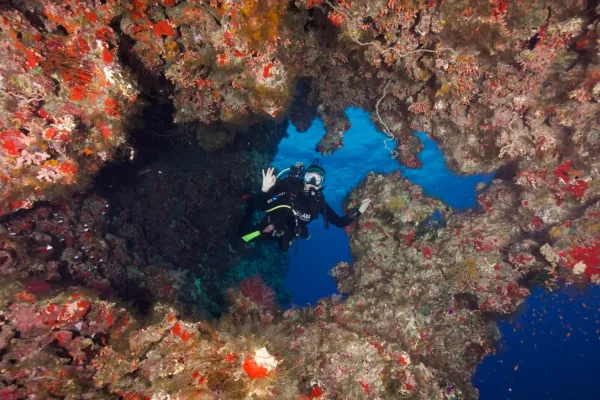
But clarity is not the only remarkable feature. The Red Sea is one of the saltiest seas in the world: 41 parts per thousand, compared to the global ocean average of 35. And one of the warmest: the surface heats up to 32°C in summer, while at 10–20 metres depth it sits at a comfortable 26–28°C.
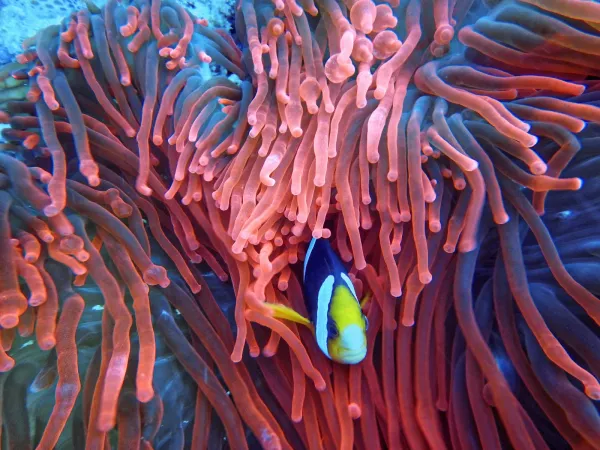
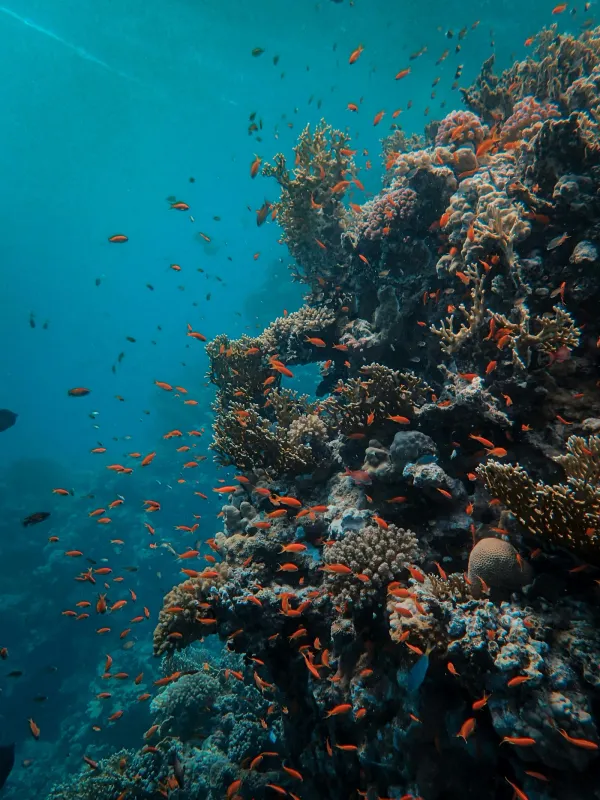
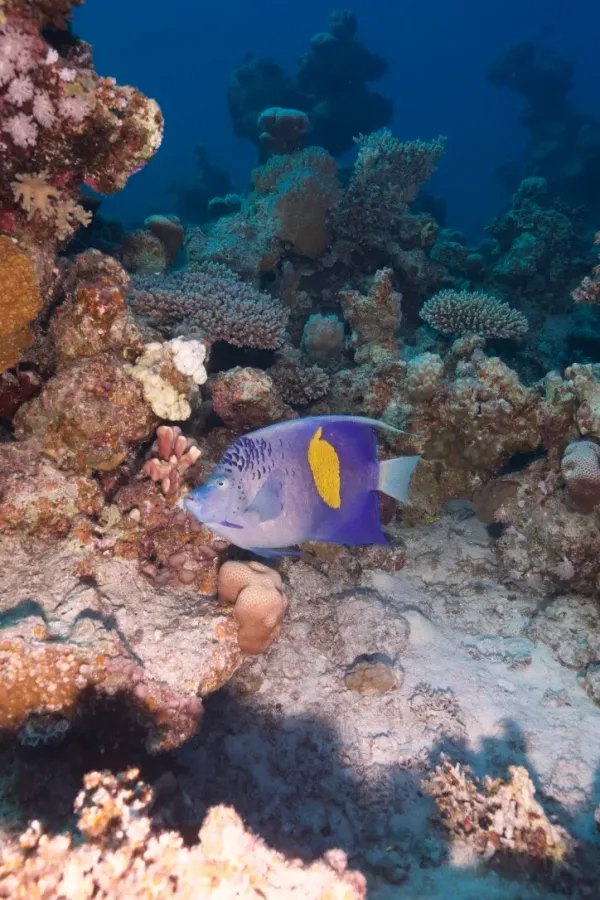
Warm, clear, salty water + constant sunshine = ideal conditions for coral. The Red Sea is one of the four great coral regions of the world (alongside the Great Barrier Reef, the Caribbean, and the Coral Triangle). 250 species of coral. 1,200 species of fish, 10% of which are endemic — found nowhere else on Earth.
And one more fact that few people know: the Red Sea is young. A mere 20–30 million years old. It formed when the Arabian Plate began separating from the African Plate — the same process that pushed Zabargad’s peridotite up to the surface. The Red Sea is a crack in the Earth’s crust, slowly widening at about 1.5 centimetres per year. In 200 million years it will be an ocean. Right now it is narrow, long, deep (down to 2,211 metres) and utterly unique.
Cousteau knew this. The Red Sea was his laboratory — the place where he tested the aqualung, shot his first underwater films, and learned to live beneath the surface.
In the 1950s, when the aqualung was brand new — less than ten years old as an invention — Cousteau brought the Calypso to the Red Sea. Clear water, warm, calm — perfect conditions for the first extended dives with a camera. Here he filmed The Silent World (Le Monde du Silence, 1956) — a feature-length documentary that won the Palme d’Or at Cannes and the Academy Award for Best Documentary. It was the first time millions of people saw what lay beneath the surface of the ocean. The first time the underwater world appeared on a cinema screen.
The Red Sea is the cradle of diving. The place where humanity first truly looked beneath the water. And — unlike many cradles — it is still alive. Still healthy. Still breathtaking.
This sea is still here. It has not degraded the way so many reefs have in other parts of the world (Caribbean reefs have lost up to 80% of their coral cover over the past 30 years; the Great Barrier Reef has survived several mass bleaching events). The Red Sea has proved more resilient: its corals are adapted to high temperatures — they thrive at 28–32°C, whereas tropical corals elsewhere begin to suffer at just 29°C. A paradox: what makes the Red Sea inhospitable (heat, salinity) is precisely what makes its reefs more durable.
The southern Red Sea — the Daedalus–Zabargad–Rocky Island route — is one of the least human-impacted areas in the region. Remoteness equals protection. Day-trip boats carrying hundreds of visitors do not come here. Only liveaboards make the journey — and there are few of them. Marine park status adds another layer of protection: anchoring is prohibited (mooring buoys only), fishing is banned, coral collection is banned.
Night dives on the reefs of the southern Red Sea are a world unto themselves. When the sun goes down, the reef transforms. The daytime fish tuck themselves into crevices and sleep — literally; some change colour and simply switch off. In their place come the night creatures: octopuses, cuttlefish, shrimp with phosphorescent eyes, Spanish dancers — vivid crimson nudibranchs that “dance” through the water, undulating like a flamenco skirt.
Your torch beam is the only light source. You glide along the wall, and the world has narrowed to the cone of your beam. Everything beyond it is darkness. Everything inside it is impossibly vivid. Corals that looked grey-brown by day blaze under the torchlight — red, orange, purple. Colours swallowed by the water column in daylight come flooding back in artificial light.
Another fact that never fails to astonish: the Red Sea is the warmest sea on the planet. Surface temperature in summer reaches 32°C. At 20 metres depth — 26–28°C. For a diver, this means a 3 mm wetsuit, or even a shorty. No drysuits, no gloves, no cold. You drop in and the water wraps around you like a warm blanket. You can spend an hour underwater and never feel chilled. In the Red Sea, diving is not a battle against cold — it is pure pleasure.
And the salinity. At 41 parts per thousand — 17% above the global ocean average — you float more easily. You need less weight on your belt. Neutral buoyancy comes naturally. Your body holds itself in the water. The feeling of weightlessness is stronger here than in any other sea.
Three or four dives a day. Including night dives — with a torch, in the dark, where the reef becomes something else entirely. Including dawn dives — when you descend in darkness and spend forty minutes watching the world around you slowly ignite. You surface, and golden morning light is waiting for you. Six days in a row.
But who will take you there? Which vessel? What are the cabins like? And what happens between dives, when you’re wet, tired, and hungry?