100 kilometres from the nearest shore. In the middle of the open sea — a tiny concrete platform with a lighthouse. Around it: nothing but water to the horizon. And sharks.
Daedalus Reef. Less than a kilometre across. An oval coral platform rising from a depth of 450 metres — like an underwater mountain whose summit nearly reaches the surface. Nearly — but not quite: in several places the reef is exposed at low tide, and on one of those exposures stands the lighthouse. The first was built in the mid-nineteenth century. The current one dates from 1931 and is maintained by the Egyptian Navy. Two or three soldiers, rotating every few weeks, live in a small building beside the lighthouse. Their only company — gulls and sharks.
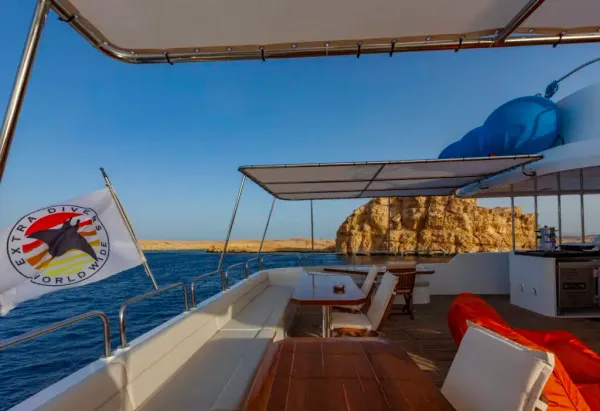
Daedalus is one of the most remote reefs in the Red Sea. You can only reach it on a liveaboard — a vessel that serves simultaneously as hotel and diving platform. No day-trip boats, no speedboats from Hurghada. Ten to twelve hours at sea — and you’re at the reef, far from shore, from civilisation, from mobile signal.
Cousteau knew about Daedalus. When he was filming The Silent World in the 1950s, the southern Red Sea was even less accessible than it is today. But Calypso — his research vessel — sailed here. Cousteau described the reefs of the southern Red Sea as “underwater walls covered in life from the surface to the darkness.” He was right. And 70 years on — nothing has changed. Because remoteness equals protection.
That very remoteness is why Daedalus remains one of the finest dive sites on the planet. Day-trip boats carrying hundreds of tourists don’t make it out here. Only liveaboards come — and there are few of them. Marine park status plus 100 kilometres of open sea equals a reef in near-pristine condition.
The reef walls are sheer. Vertical. Like the walls of a skyscraper, only covered in life. Giant gorgonian fans — the size of a dining table — are stretched across the current, filtering plankton. Soft corals — red, orange, purple — hang from ledges like fringe. Hard corals form terraces and outcroppings where moray eels, scorpionfish and lionfish hide.
But you’re not looking at the wall. You’re looking into the blue.
Because out of the blue they come. Hammerhead sharks. Sphyrna lewini — scalloped hammerheads. In schools. Twenty, fifty, sometimes a hundred individuals. They move along the wall at 25–35 metres depth, parallel to the reef, paying you not the slightest attention. Their heads — flattened sideways, like the letter T — sweep from side to side, scanning the water with electroreceptors. Each turn of the head picks up information: the electric fields of fish buried in the sand, the Earth’s magnetic field used for navigation.
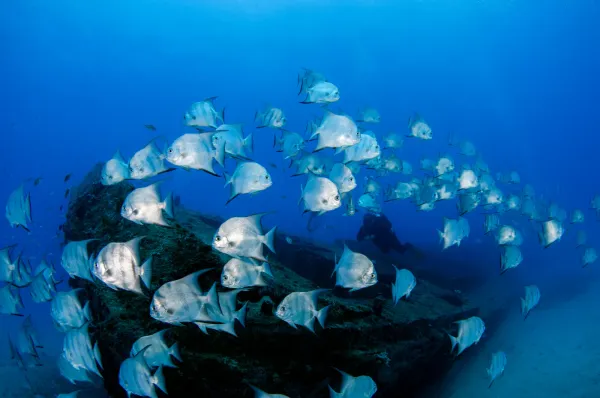
June is the best time for hammerheads at Daedalus. The water warms up, plankton blooms, small fish gather around the reef — and the sharks follow. Schools of hammerheads in June are not a rarity or a stroke of luck. They’re a pattern. They’re here every year, at this time, at this reef. As if they have a schedule.
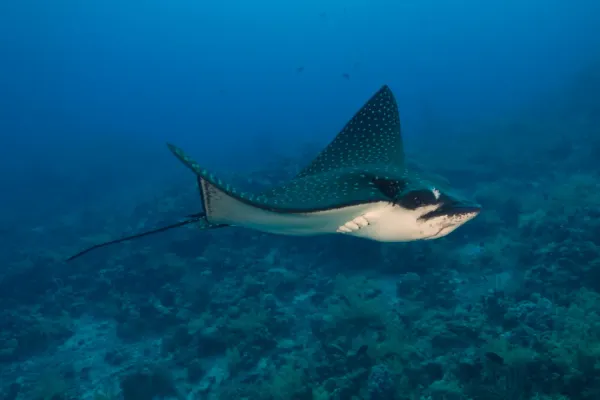
Besides the hammerheads, Daedalus has silky sharks: lean, elegant, named for their smooth skin. They patrol the wall out in the blue, like fighters on watch. Oceanic whitetips — larger, slower, more assured. Their long pectoral fins, white at the tips, are spread wide like wings. They approach divers more closely than other sharks — not from aggression, but from curiosity. Thresher sharks — with tails longer than their bodies — flash at the edge of visibility.
On the southern plateau of Daedalus — at 28–40 metres depth — a flat shelf covered in corals. The current is stronger here, and this is where the hammerheads gather most often. You hang at the edge of the plateau, gripping a rock so the current doesn’t carry you off, and you watch as out of the blue, slowly, unhurriedly, a school emerges. Twenty silhouettes. Thirty. Fifty. They move in a steady formation, like a squadron. Silent. Unhurried. Masters of the place.
A dive at Daedalus is not a “reef dive.” It’s an open-water expedition. Currents — strong, unpredictable: in the morning pulling south, by midday east, by evening who knows where. Depths — serious: the wall drops past 100 metres, and nitrogen narcosis at 40 metres is a real hazard. Visibility — enormous: 40–50 metres of crystal-clear water (the Red Sea has no inflowing rivers, no silt, no suspended matter — the water is as transparent as air). This is diving for those who already know what neutral buoyancy, deco stops and drift diving mean. For those who don’t panic when the current picks up and the reef wall starts sliding past faster than expected.
But you’re not alone. On board the liveaboard there’s a trip leader from Tourleader Club and dive guides who know Daedalus by heart. Who have dived here dozens, hundreds of times. Who know what time the hammerheads come up to the plateau, which side of the reef has the weaker current, where to take shelter if you get swept away. The briefing before each dive is not a formality: dive plan, entry point, direction, depth, time, exit point, emergency scenarios. Your job is to relax, breathe steadily, control your depth and look into the blue. Everything else is the guides’ work.
And next to Daedalus — Rocky Island. Another reef without dry land, another fragment of an underwater mountain jutting from the sea like a tooth. Vertical walls, a jagged profile, ledges and caverns — and the same sharks. The same hammerheads. The same silkies. The same whitetips. Rocky Island is Daedalus’s younger sibling — less famous, but no less impressive.
Between dives at Daedalus — a break on the liveaboard. You sit on the sun deck, drying in the sun, drinking tea. You look at the lighthouse — white, streaked with rust, with a soldier waving from the balcony. He’s here alone — on a tiny concrete patch in the middle of the sea, hundreds of kilometres from shore, from town, from life. His only company — the gulls that screech at dawn and the sharks circling below. A strange job. But the lighthouse must burn — shipping lanes pass through here, and without a light on the reef there would be more wrecks than there already are.
Two reefs in the middle of the sea. Two lighthouses. Two vertical columns of coral rising from a four-hundred-metre abyss. And around them — schools of sharks that come here every summer, as if returning home. Because this is their home.
But to understand why the Red Sea is special, you need to look not only at the sharks. You need to look at the water itself. At its clarity. At its warmth. At its age.