Fifty kilometres off the Egyptian coast, in the stretch of the Red Sea that Arab navigators once called the Bay of Evil Spirits, an island rises from the water. It has no trees. No fresh water. No inhabitants. But its very soil is made of precious stones.
Zabargad. Four and a half square kilometres of scorched rock in the middle of the sea. Unremarkable from a ship: a brown hump jutting from the water, without the faintest sign of life. No greenery. No birds. No beaches.
But bend down and pick up a stone. Any stone. Break it open. Inside — green crystals. Transparent, vivid, the colour of young leaves. Peridot — also known as chrysolite, also known as gem-quality olivine. A precious stone that people have been mining here for three and a half thousand years.
Zabargad is a geological anomaly. The island was formed when the African and Arabian tectonic plates pulled apart, and a piece of Earth’s mantle — the layer that normally lies 30 to 60 kilometres below the surface — was thrust upward. The peridotite that makes up the island is no ordinary rock. It is mantle material. The substance from which the planet’s interior is made. When you stand on Zabargad, you are standing on the innards of the Earth, turned inside out.
And within that peridotite — olivine crystals. Under the right conditions of pressure, temperature, and hydrothermal fluids, olivine grows into large, transparent crystals: peridot. An apple-green stone with an oily lustre that catches the light like a drop of molten gold tinged with green.
The pharaohs knew about this island. Three and a half thousand years ago — fifteen centuries before Cleopatra — the Egyptians were already sending ships here, loaded with slaves. An island with no water, no shade, not a single bush. Air temperatures above 40 degrees. The rock grows so hot you cannot touch it with a bare hand.
Slaves chipped at the stone with bronze tools, then iron ones, breaking off chunks of peridotite and prising out the green crystals. They worked at night — the days were impossible. Water was brought from the mainland, every mouthful rationed. Food: dried fish, dates, flatbread. Lives: short. The stones were loaded onto ships and sent across the Red Sea, then along a canal into the Nile, then upstream to Luxor, to Thebes, to Memphis. To temples, palaces, and the necks of queens.
Cleopatra — the last of the Ptolemies — was famous for her love of green stones. For centuries historians believed she wore emeralds. But in recent decades another theory has emerged: many of Cleopatra’s “emeralds” were in fact peridots from Zabargad. Peridot is brighter, cleaner, and more brilliant than emerald — but in antiquity, few people could tell two green stones apart. Cleopatra, adorning herself with “emeralds,” may well have been wearing stones from this blazing island in the middle of the Red Sea. Stones wrested from rock by slaves in a hell without shade or water. Stones that still lie in the cliffs — green, transparent, vivid. Anyone can prise one from the wall; they do not hide. But mining has been forbidden since 1958, and today Zabargad is a nature reserve, not a mine.
Historians still argue: was it emeralds or peridots that adorned Cleopatra? Both stones are green. Both are transparent. But peridot is warmer, oilier, with a golden shimmer. Emerald is cooler, deeper, with a bluish cast. In antiquity they were constantly confused: Pliny the Elder, in his Natural History, describes the stones of Zabargad and calls them smaragdus — emerald. Was he wrong? Or are we wrong to assume that Pliny meant emerald?
The Greeks called the island Topazios — convinced they had found a topaz deposit. They were mistaken. It was peridot. The Romans mined it for centuries. The Crusaders carried the stones back to Europe. Mining continued until 1958, when the Egyptian government nationalised the quarries — and the island fell silent.
Three and a half millennia. Pharaohs, Ptolemies, Romans, Crusaders, Ottomans — all of them wanted Zabargad’s green stones. And all of them sent slaves, because no one would have survived on this island voluntarily. No shade. No water (the nearest freshwater source is on the mainland, 50 kilometres away). No breeze — only the baking desert air trapped between the cliffs. Slaves worked at night because the rock burned their hands by day. They scraped at peridotite with primitive tools, prising green crystals from the matrix. Many died from heat and dehydration. The stones went to Alexandria, to Rome, to Constantinople — to adorn royal crowns and church altars.
Today, no one mines Zabargad. The quarries have been closed since 1958. The island is empty. And nature has begun to take it back.
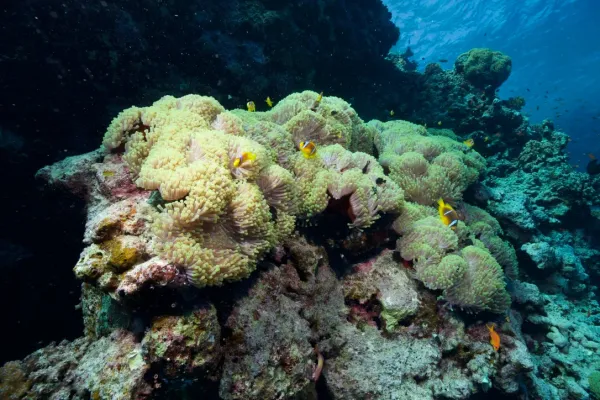
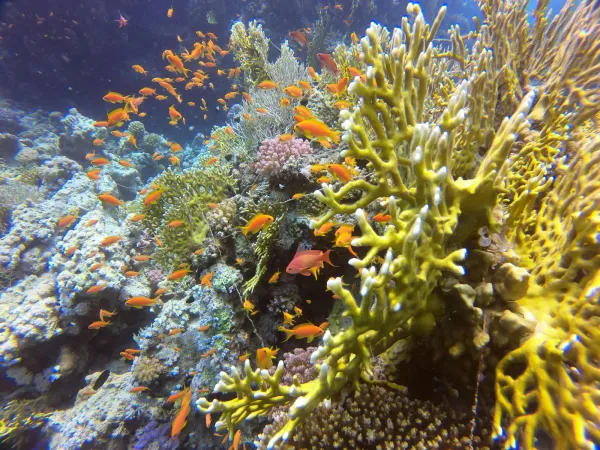
Today, divers come here. Because underwater, Zabargad is no less extraordinary than above. A lagoon of turquoise water and white sand — one of the few places in this part of the Red Sea where you can snorkel in perfect calm, sheltered from swells and currents. The outer walls of the island descend for tens of metres, covered in corals of every colour: from bright-yellow soft corals resembling cauliflower to massive stone pillars centuries old. Gorgonian fans — a metre, a metre and a half across — open broadside to the current like living sails. At the base of the walls lie shipwrecks encrusted with sponges and corals — shadows of the past, sunk into the present. Turtles sleep on ledges. Moray eels peer from crevices. Spotted eagle rays glide through the blue, wings outstretched.
But Zabargad is just one of three gems along this route. Some 130 kilometres to the north, in open water, stands a reef circled by schools of hammerhead sharks. A reef with a lighthouse. A reef you cannot set foot on. A reef that most of the world’s divers consider the finest dive site in the Red Sea.
Zabargad is an island of contrasts. Above — dead rock, scorched by the sun, without a single stream. Below — life. Corals, fish, turtles, morays — an underwater city thriving against the walls of a dead island. As though all the life the land could not hold has gone into the water.
And one more detail. On the seabed off Zabargad’s eastern slope lies the hull of an old sailing vessel — believed to date from the 19th century. The hull has collapsed, but the frames are still legible in the sand. Who was she? A peridot smuggler? A spice trader? Simply a sailor who could not hold against the current? No one knows. The Red Sea keeps its secrets. This ship is one of many lying on the bottom between Egypt and Saudi Arabia. Underwater archaeologists have not yet begun to count them.
In the 1950s, a man arrived in these same waters who would change the world’s relationship with the ocean. Jacques-Yves Cousteau — inventor of the aqualung, filmmaker, oceanographer — chose the Red Sea for his first expeditions. Not by accident: clear water, warm and calm, an ideal laboratory for the new instrument he and engineer Émile Gagnan had created in 1943. Here, in the Red Sea, Cousteau filmed The Silent World — a film that won the Palme d’Or at Cannes and an Academy Award, and for the first time showed millions of people what lay beneath the ocean’s surface. Cleopatra adorned herself with the stones of Zabargad. Cousteau showed the world that beneath those stones lives an entire world.
And further north — Daedalus.