22 people. 5 out of 5. The only journey in our catalogue with a perfect rating. Perhaps because Namibia is the only place where there is not a single unnecessary detail.
Namibia is not a trip. It is a journey to another planet. A planet where everything is different: the colours, the proportions, the silence, the time, the scale. Where the red sand is not a metaphor but a literal fact — it is red because the iron in it has been oxidising for millions of years. Where 55 million years is not a number in a textbook but a sensation underfoot, as you stand on a dune and realise: this desert is older than the Himalayas.
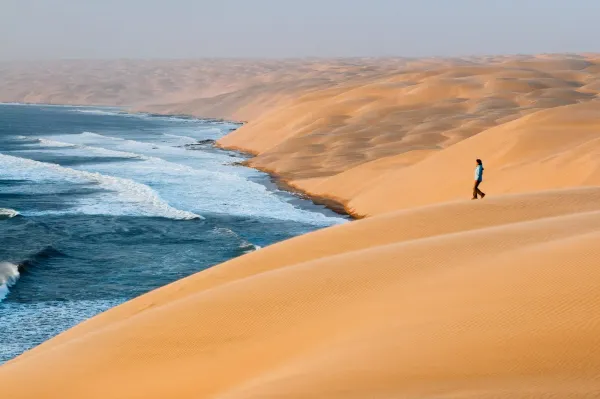
12 days. A route that begins in Windhoek — a small, clean, unhurried capital — and passes through every climate zone and every era.
Erindi Reserve — two days of classic African safari. Lions, leopards, elephants, rhinos, buffalo — the Big Five. Plus zebras, giraffes, cheetahs, hippos. Plus — if you are lucky — a pangolin, the most elusive creature in Africa.
The Erongo Mountains — two days on another planet within another planet. Volcanic rock formations 130 million years old, lunar landscapes, stone arches, caves with San bushmen rock paintings dating back 2,000 to 30,000 years. Spitzkoppe — the “Matterhorn of Namibia”, a granite pyramid rising from the plain. A San village — an encounter with people whose DNA is closest to the root of humanity’s family tree. People who read tracks in the sand the way we read books. People who speak in a language of clicks.
Swakopmund — three days at the intersection of the impossible. A German pastry shop from 1905 — and the Atlantic Ocean outside the window. Bavarian half-timbered buildings — and dunes as tall as houses. Oysters with champagne on a yacht — and pelicans clambering aboard. Flamingos in the lagoon — pink, in their thousands. Fog that feeds beetles every morning as they stand on their heads. And Sandwich Harbour — where the desert falls into the ocean, and a 4x4 picks its way along a narrow strip between a wall of sand and the breaking surf, one wheel in the water.
The Namib Desert — two days in the oldest desert on earth. Dune 45 — 170 metres of red sand, climbed at dawn. Deadvlei — dead trees that have stood for 900 years and still have not fallen. Sunset over the dunes — when the sand burns in every shade of red, orange, and violet.
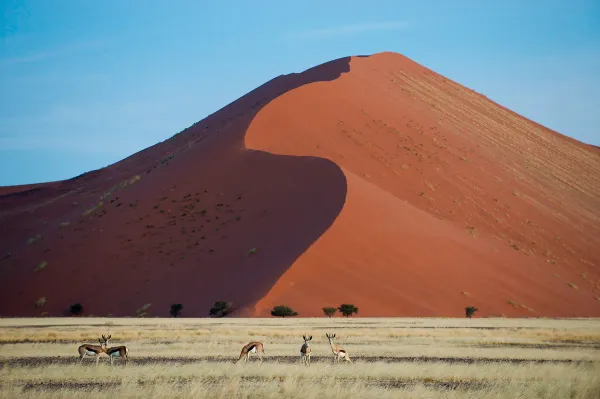
GocheGanas — the final day. A villa in a private reserve. Spa. Swimming pool. Antelope and zebras right in the garden. Rest after adventure.
10 people in the group plus a trip leader. Not a bus of fifty. Ten people who, over twelve days, become a family. Driver-guides — Africans who know every bend, every trail, every lion’s favourite haunt. A trip leader from Tourlider Club — someone who organises, coordinates, and handles every question while you simply look.
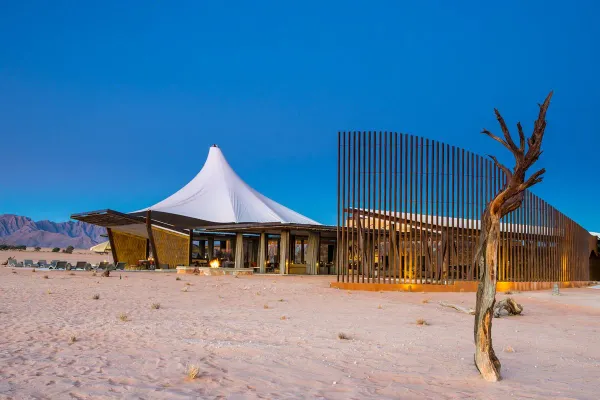
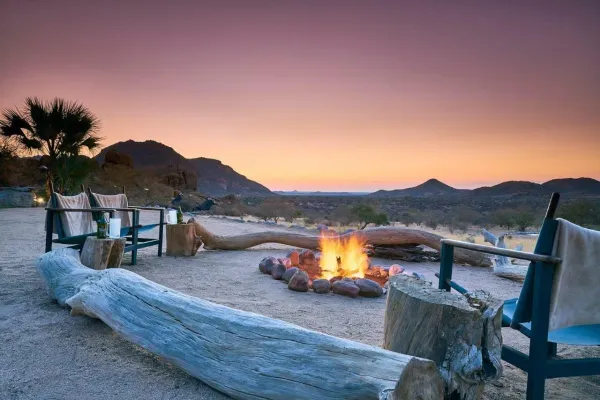
Accommodation — 5-star lodges and hotels. Not tents in the savanna. Not hostels with shared showers. African lodges, with thatched roofs and wooden verandas, but with king-size beds, air conditioning, a shower, and a view of the savanna right from the bed. In the morning you open your eyes — and beyond the window antelope are grazing in the early mist. In the evening — dinner by candlelight, under the stars, to the sounds of the savanna: the distant roar of a lion, the laughter of a hyena, the chirping of cicadas.
Am Weinberg in Windhoek — a boutique hotel with a pool and views over the city. Old Traders Lodge at Erindi — a lodge in the heart of the reserve, where elephants pass by the restaurant. Ai Aiba in the Erongo — a lodge among rocks covered in ancient paintings. The Delight in Swakopmund — a design hotel in colonial style. Hoodia Desert Lodge — tented suites overlooking the Namib dunes. GocheGanas — a villa with a spa and zebras in the garden.
Every lodge is a different world. Every transfer is a change of scenery. As if in 12 days you had visited six different countries — except they all go by the name Namibia.
Flight assistance — Ethiopian Airlines via Addis Ababa, with connections carefully matched to your schedule. Transfers throughout the route — 4x4s, air conditioning, an English-speaking driver who knows every turn of every dirt road. A Russian-speaking trip leader from Tourlider Club — coordinates, solves problems, answers questions, and photographs you in front of the dunes when you forgot to ask.
24⁄7 manager support. No visa required for Namibia for Russian passport holders (up to 90 days). Entry stamp on arrival — free. One of the safest countries in Africa. One of the least corrupt. One of the most welcoming to visitors.
22 people gave this journey 5 out of 5. Five. Out of five. Not a single four. Not a single three. 22 people — every one gave the maximum. That is not a coincidence. That is Namibia.
Perhaps because Namibia is not a place but a state of being. A state in which you are small. And the world is vast. And ancient. And beautiful. And indifferent to your problems — in the best possible sense. In the liberating sense.
Trees that have stood for 900 years — black, scorched by the sun, yet not rotting. A desert 55 million years old — older than any landscape, older than most mountain ranges. Paintings 30,000 years old — rhinos and antelope drawn by people whose descendants still live in these mountains and speak in a language of clicks. A ship lying in the sand 400 metres from the water — because the desert advanced and claimed it from the ocean. A beetle that stands on its head to catch a drop of fog — because there is no other water. Flamingos — pink, in their thousands — in a lagoon among the dunes.
And you — with your forty, fifty, sixty years behind you — stand in the middle of all this. At the top of a red dune, at dawn, as the light crawls down the slope like molten gold. And you feel it: time is not the enemy. Not a ticking clock, not a deadline, not “ran out of time”. Time simply. Is. Like the desert. Like stone. Like trees that have stood nine hundred years and show no sign of falling.
The place where time stood still. The place where you can stop alongside it. Just for a while. For twelve days.