The Eduard Bohlen ran aground in the fog on 5 September 1909. That was 117 years ago. Since then the desert has advanced — and now the ship lies buried in sand, 400 metres from the water.
The Skeleton Coast. Five hundred kilometres of shoreline strewn with whale bones and the wreckage of ships. The Bushmen called it “The Land God Made in Anger.” Portuguese navigators called it “The Gates of Hell.” Modern maps simply call it “Skeleton Coast.”
Why do ships perish here? It all comes down to the fog. The Benguela Current — cold water flowing north from Antarctica — runs along the Namibian coast. The Namib Desert behind it blazes with heat. Cold water plus hot air equals condensation. Every morning a thick, impenetrable fog rolls in and swallows the shore. Visibility: zero. A captain cannot see the coast. Cannot see the rocks. Cannot see the reefs. And only learns of their existence when the hull grinds against stone.
Hundreds of ships have been lost here over five centuries — from the wooden caravels of Portuguese explorers to the steel cargo vessels of the twentieth century. Some wrecks are nothing but rust stains in the sand. Others remain recognisable: masts, hulls, steering wheels. The most famous is the Eduard Bohlen, a German cargo steamer, 1909.
The story of the Eduard Bohlen is the very essence of the Skeleton Coast. 5 September 1909 — fog. Thick and impenetrable, like a wall of milk. The captain steers by compass and chart — no GPS, no radar, no satellites. He judges the distance to shore by eye. His eye failed him: the ship drove its bow into the sand at full speed. The crew were rescued — the shore was close enough to reach on foot. But the hull stayed behind.
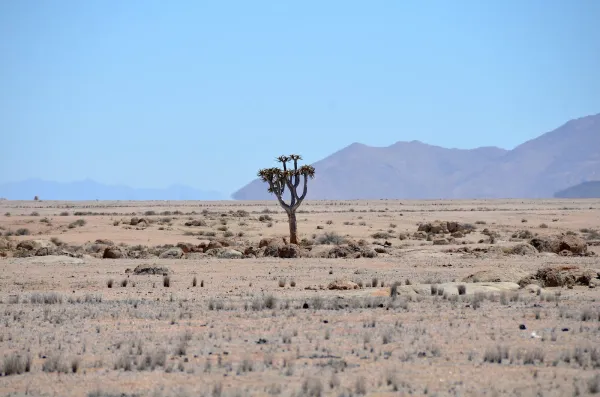
From that day on, the desert went to work. Sand advanced — centimetre by centimetre, metre by metre, year by year. The ocean retreated, or the desert grew toward it — scientists still disagree. Today, 117 years later, the rusted hull of the Eduard Bohlen lies among the dunes. Four hundred metres from the waterline. A ship in the desert. A vessel built for the sea, standing in sand. Like Deadvlei: something that should not exist in this place. Yet it does — because in Namibia, time works differently.
Everything here is like that. Namibia is a country of impossible combinations. Desert and ocean — not across a road from each other, but literally side by side: dunes tumble into the water, sand mingles with the foam of the surf. German strudel and African lions — a hundred kilometres apart. A ship in the sand — 400 metres from the water. Flamingos in a lagoon — surrounded by dunes. Trees dead for 900 years — still standing.
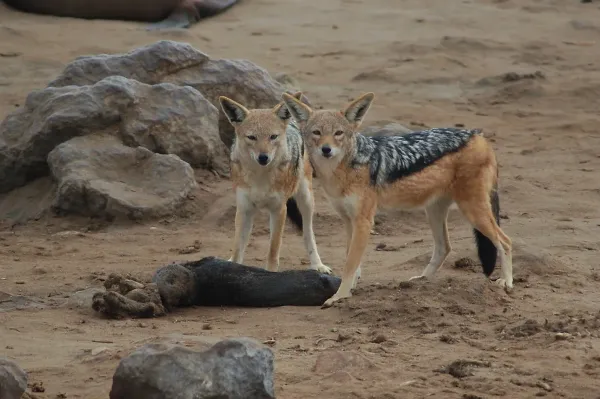
And one more impossible combination: the Skeleton Coast — one of the most dangerous stretches of coastline in the history of seafaring — is today one of the most strictly protected nature reserves in Africa. The place that killed ships now shelters seals, jackals, hyenas, and eagles. The Cape fur seal colony at Cape Cross is one of the largest in the world: up to 200,000 individuals crowded along a few kilometres of shore. The smell is overwhelming — seals are not the tidiest of creatures. The spectacle is extraordinary. Two hundred thousand bodies heaving across the rocks, barking, squabbling, nursing pups, basking in the sun. Chaos — but organised chaos. Like a Namibian market, only with flippers.
And one more contrast, the sharpest of all: Namibia is one of the least densely populated countries on earth. Two and a half million people spread across 824,000 square kilometres. A density of three people per square kilometre — for comparison, Moscow has 5,000. There are roads you can drive for hours without passing a single other vehicle. There are territories the size of a small European country where no one lives at all.
This emptiness is not melancholy. It is freedom. Real, physical freedom — from noise, from crowds, from the hum of city life, from blinking screens, from notifications, from traffic, from neighbours. In Namibia you can step out of the lodge at night, sit down on a rock, and see not a single artificial light source. No street lamp. No lit window. No headlights anywhere on the horizon.
And then — the stars.
Namibia is one of the finest places in the world for stargazing. The International Dark-Sky Association includes several Namibian areas on its lists. No light pollution — there is no one to create any. No clouds — it is a desert. No humidity to scatter the light. The Milky Way stretches from horizon to horizon, bright, detailed, three-dimensional. Not a blurred band, but billions of individual stars arranged into the arms of a spiral. The Southern Cross — a constellation invisible from Europe — hangs directly overhead. The Magellanic Clouds — dwarf galaxies orbiting the Milky Way — are visible to the naked eye as faint misty patches.
In a school textbook the Milky Way is a drawing. Here it is real.
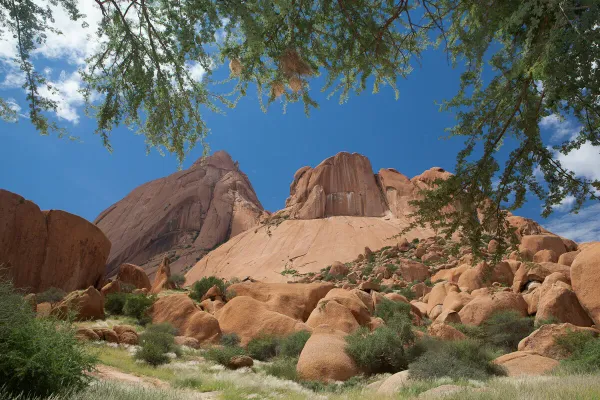
The final day of the journey is spent at the GocheGanas villa, a private reserve outside Windhoek. A proper spa — with massage, hot stones, and treatments that strip away twelve days of dust, sand, sun, and sensation. A pool with a view over the savanna where antelope graze. A different kind of silence — not the silence of the desert, but something softer, more domestic, like a warm blanket.
After twelve days of desert, mountains, ocean, fog, dunes, lions, strudel, oysters, stars, Bushmen, and beetles doing headstands — stillness. Animals wander freely across the grounds: antelope nibble the grass by the veranda, zebras drink from the garden fountain, warthogs — the ugliest and most endearing creatures in Africa — industriously dig up the flowerbeds.
You lie by the pool with a glass of South African Pinotage — a grape variety that grows nowhere else in the world — and watch the sunset. The last African sunset. Pink, orange, violet. Tomorrow: the airport. Addis Ababa. Home. Another life.
And you think: this place is real. It is not a set. It is not a film. This is Namibia. The place where trees stand for 900 years. Where rock paintings are older than the pyramids. Where the desert reddens with age. Where ships lie in the sand.
A place where time does not hurry. Does not push. Does not rush. It simply — is. Like the desert. Like the stars. Like trees standing for nine hundred years.
And somewhere inside this frozen time — you. With a camera, with a bottle of water, with the feeling that the world is larger than it seemed. Much larger. And much older.