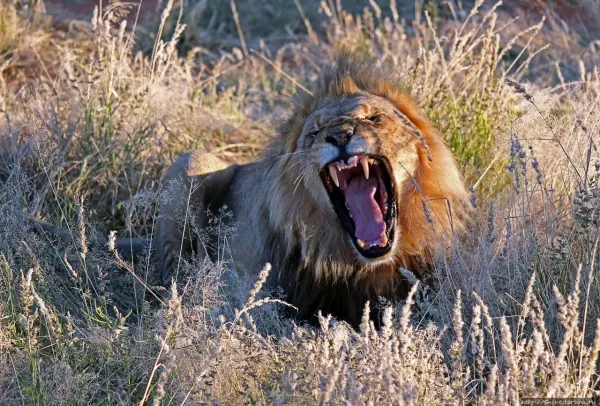
A lion yawns. Wide open — all four canines on display, a pink throat visible right down to the tonsils. He lies in dry grass, ten metres from the open jeep, and your existence is of absolutely no concern to him.
Erindi. A private game reserve 180 kilometres from Windhoek. Not a zoo. Not a circus. Not a petting farm. This is Africa. The real thing. With predators that hunt. With prey that flees. With a balance maintained not by fences but by ecology.
The “Big Five” — a term coined not by zoologists or travel agencies but by hunters: British colonial hunters of the nineteenth century. Lion, leopard, rhino, elephant, buffalo — five animals that were the most difficult to bring down on foot. Not the largest (a hippo is bigger than a leopard) — the most dangerous. The most unpredictable. The most capable of killing the hunter who came to kill them.
The lion — because it stands its ground and does not run. The leopard — because it hides and attacks from ambush. The rhino — because it is short-sighted, ill-tempered and charges anything that moves. The elephant — because it is six tonnes of fury when provoked. The buffalo — because it remembers who wronged it and comes back.
Today the Big Five are hunted with a camera, not a rifle — but the thrill is the same. Every game drive is a quest. And no one can guarantee you will see them all. The leopard may not appear — it is nocturnal, elusive, and spotting one in daylight is genuine luck. The rhino may be in another corner of the reserve. The buffalo — unpredictable.
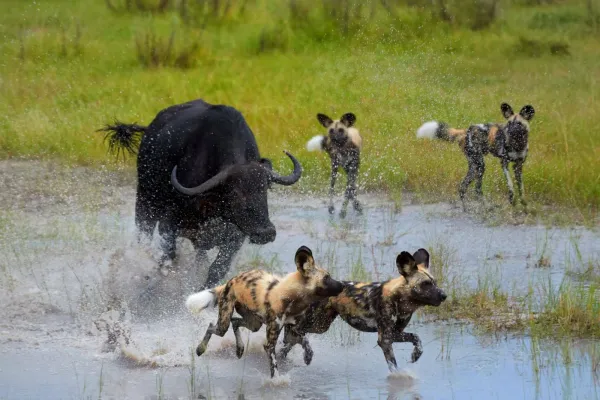
At Erindi — all five. Plus cheetahs, hippos, zebras, giraffes, antelopes of a dozen species (oryx, springbok, kudu, impala, wildebeest), wild dogs, caracals, mongooses, meerkats. And — the pangolin. The most trafficked wild animal on the black market in the world. The most inconspicuous. And the most extraordinary.
The pangolin is a creature that looks like the offspring of a pine cone and an aardvark. Covered in scales from head to tail — the only mammal on Earth with scales. It curls into a ball when threatened — and its scales can withstand a lion’s bite. It eats nothing but ants and termites, using a long sticky tongue that is longer than its own body. Nocturnal, secretive, almost invisible. Spotting a pangolin in the wild is the kind of luck people talk about for years.
Its scales are used in traditional Chinese medicine — without any scientific basis: they are keratin, the same protein as our fingernails. Hundreds of tonnes of pangolin scales are seized every year. Erindi is one of the few places where pangolins have genuine protection.
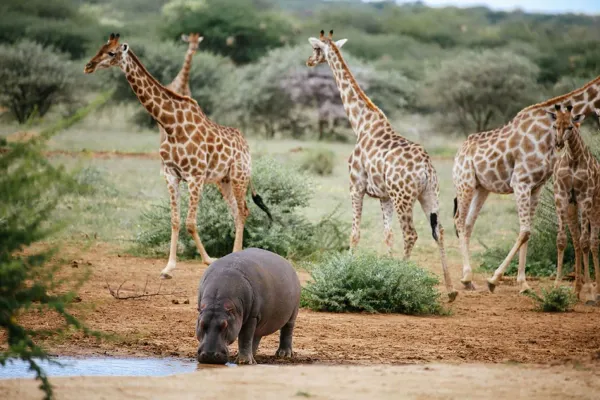
The morning game drive begins at dawn — 5:30, when the savanna is golden and cool. An open jeep, a ranger-driver, binoculars. The first minutes: zebras. Their stripes are not decorative: each zebra has a unique pattern (like a human fingerprint), and the stripes, according to one theory, disorient tsetse flies and other blood-suckers by creating an optical illusion when the animal moves.
Giraffes — the tallest land animals on Earth, up to 5.5 metres. Their necks contain exactly seven vertebrae — the same number as a human being. Each one is simply 25 centimetres long. They move at a languid pace, as though gravity applies to them at half strength.
Elephants — the largest land animals on the planet. An African elephant weighs up to six tonnes — the equivalent of three cars. Its ears are the size of a door, and they are not decorative: the ears are threaded with a network of blood vessels and function as radiators, dispersing heat (critical in Africa). An elephant fans its ears — and cools its blood by several degrees.
Their legs are round as pillars, with a pad of fatty tissue on the sole that muffles the sound of their steps. Six tonnes of living weight move almost silently — you can miss an elephant standing twenty metres away in the bush. Their trunks contain 40,000 muscles (the entire human body has 639). They can lift a log with that trunk — and pick a peanut off the ground.
Elephants are among the few animals that show signs of what we call grief: they return to the skeletons of dead relatives, touch the bones with their trunks, stand in silence. Biologists debate whether this is ritual, memory, mourning. There is no answer. But anyone who has witnessed it does not forget it.
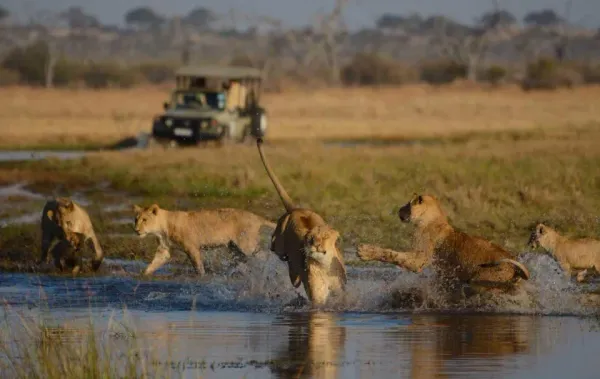
The evening game drive is different. The light is oblique, warm. Predators wake up. Lions stretch, yawn, rise reluctantly. A leopard — if you are lucky — sits on a branch with its tail hanging down, surveying the world from above with an expression of absolute superiority.
And then — the night game drive. A spotlight. Eyes in the darkness — dozens of pairs, green, yellow, red. Caracals — “desert lynxes” with tufted ears. Porcupines — with quills up to 30 centimetres long. Hyenas — with their famous “laugh,” which is in fact a signal of submission. And, with luck — the pangolin. Small, scaly, purposeful, probing a termite mound with its long tongue.
And the meerkats. Small, standing bolt upright, with dark “goggles” around their eyes. They live in family groups of 20 to 30 and post a sentry — one meerkat that stands on its hind legs on a raised spot and scans the horizon. At the first sign of danger — an alarm call, and the entire family vanishes into burrows in a second. When the threat has passed, heads appear from the holes one by one. Like submarines surfacing.
Two days at Erindi. Four game drives — morning and evening, when the light is right, the animals are active, and the heat has not yet taken hold. Between drives — the pool, the lodge, a cold beer. In the evening — dinner on the terrace, under the stars, with the distant laughter of hyenas.
And a feeling that cannot be faked and cannot be forgotten: you are a guest. In a world that is not yours. A world that existed for millions of years without you — and will exist for millions of years after. You are here for a brief while. And that is fine. And that is good.
But twelve days in Namibia are not only dunes, mountains, ocean and safari. This is a journey that brings everything together — from a 55-million-year-old desert to a Bavarian strudel — into one impossible yet entirely real story.