A German pastry shop with apple strudel. Bavarian half-timbered facades. Neat pavements, trimmed lawns, signs in German. All of this — on the edge of a desert 55 million years old, on the shore of an ocean where the water is 14 degrees.
Swakopmund. A city that has no business existing. And yet it does — in defiance of geography, climate, and common sense.
It was founded in 1892 by German commander Curt von François — as a supply port for the colony of German South West Africa. The shore was the only place where fresh water could be found — the Swakop River (though “river” is a generous term: it flows for just a few days a year, after rare rainfall, and the rest of the time is nothing but a dry bed of sand).
The Germans built the way they knew how — thoroughly, methodically, with German seriousness. Stone houses — not barracks, but proper stone houses with mouldings, balconies, and cast-iron railings. A church — Lutheran, with a pointed steeple visible from the sea. A lighthouse. A post office. A courthouse. A brewery (these are Germans, after all — naturally a brewery). They shipped blueprints for half-timbered buildings from Bavaria — a wooden frame filled with brick — and erected them amid the sands. As if a chunk of Hamburg had been teleported to the edge of the world’s oldest desert.
The streets were given German names: Bismarckstraße, Kaiser-Wilhelm-Straße, Moltkestraße. Cafés offered German menus: strudel, schnitzel, bratwurst with sauerkraut. The language of administration was German. The newspaper was German (the Allgemeine Zeitung is still in print — the oldest daily newspaper in Namibia, published in German). To this day, a German-speaking community lives in Swakopmund — descendants of the colonists — and on the streets you are more likely to hear “Guten Tag” than “Hello.”
Absurd? Absolutely. But it is precisely this absurdity — half-timbering among the dunes, strudel on the Atlantic shore, “Guten Tag” in Africa — that makes Swakopmund unforgettable. You sit in Café Anton (founded 1905, still in business), eating apple strudel with vanilla sauce, while outside the window the grey-green Atlantic stretches away, unswimmable: the water is 14–16 degrees. The Benguela Current flows up from Antarctica along Africa’s western coast, chilling the coastal waters to a temperature that cramps your legs within a minute.
But that current is the cause of everything else. Cold water plus a scorching desert equals condensation. Every morning the Namibian coastline is wrapped in fog — thick, milky, like something out of a horror film. Visibility: ten metres. The Swakopmund lighthouse blinks in the white. Cars crawl with their headlights on. By noon the fog burns off — and a boundless blue sky opens up.
But the fog is not just atmosphere. The fog is life. In the world’s driest desert, where it may not rain for years, fog is the only source of moisture. Every morning it “feeds” the desert: droplets settle on stones, on cobwebs, on the shells of beetles. The fog-basking beetle (Stenocara gracilipes) — an engineer of survival. It climbs to the crest of a dune, stands “upside down” — tail in the air, head towards the sand — and waits. Fog droplets condense on the bumps of its shell (hydrophilic — attracting water), run along the channels between the bumps (hydrophobic — repelling water), and fall directly into its mouth. MIT bioengineers studied this shell and modelled a material for harvesting water in arid regions on it. A beetle in the Namib desert inspired a technology that saves lives.
The only source of water in the world’s driest desert — a beetle standing on its head. Namibia.
But Swakopmund is not only cafés and fog. It is the base for one of Namibia’s most spectacular adventures: Sandwich Harbour.
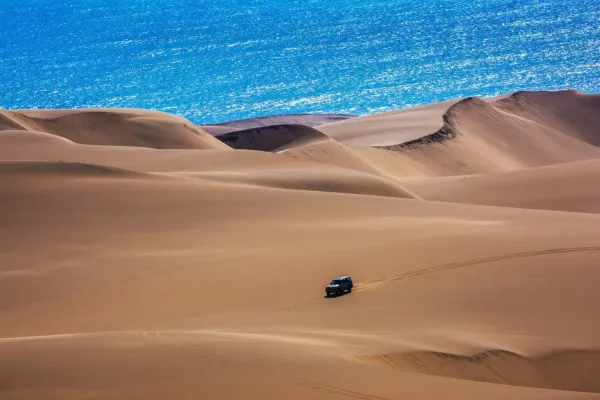
A 4x4. Sand dunes. And — the ocean. The Sandwich Harbour dunes are a place where the Namib desert literally meets the Atlantic. Not separated by a strip of beach — no. The dunes plunge straight into the water. Vertical walls of sand, red and orange, crashing into the grey-green ocean. The 4x4 picks its way along a narrow strip between the dune and the surf, right at the limit — one wheel in the water, the other in the sand. The driver — a professional who has made this run hundreds of times — steers with one hand and points with the other: “Over there — flamingos.”
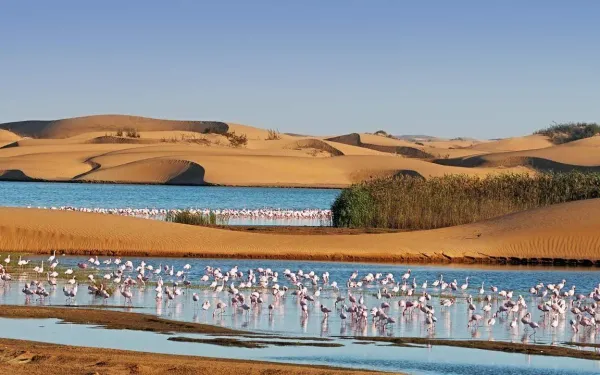
Flamingos. Pink. Thousands of them. In the lagoon between the dunes — shallow salt water warmed by the sun — the perfect environment for brine shrimp, the tiny crustacean that gives flamingos their colour. Without brine shrimp, flamingos are grey. With brine shrimp — pink, peach, sometimes almost red. The more shrimp they eat, the brighter the plumage. Flamingo fashion: you are what you eat.
Desert. Ocean. Flamingos. Three things that have no business being together — and yet together they are. Namibia specialises in impossible combinations.
A boat cruise in Walvis Bay — another item on the itinerary, another impossible combination. The yacht leaves the harbour of the little German colonial town — past warehouses built by the Kaiser’s engineers, past the lighthouse, past the concrete breakwater. The bay is vast, shallow, sheltered from the waves. Pelicans land on board — literally, they hop onto the gunwale and demand fish, opening enormous pouched bills. Cape fur seals swim alongside, poking their whiskered, curious faces out of the water. Dolphins — occasionally — leap in the distance.
A boat cruise in Walvis Bay — another item on the programme. The yacht heads out into the bay. Pelicans land on board — literally, they jump up and demand fish. Seals swim alongside, heads bobbing above the surface. And — oysters. Fresh oysters with lemon and champagne, on the deck of a yacht, in a bay where the desert touches the ocean.
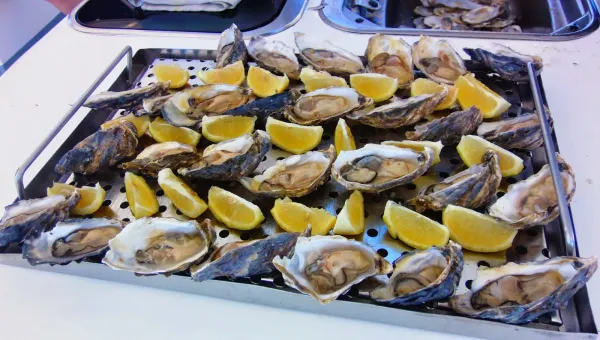
And — oysters. Fresh Namibian oysters — farmed right here, in the cold waters of the Benguela Current (cold, oxygen-rich water = ideal conditions for oyster farming). With lemon. With champagne. On the deck of a yacht rocking on the waves, while the pelican on board waits impatiently for you to drop a shell.
Three days in Swakopmund. Three days between worlds: German and African, desert and ocean, ancient and colonial, freezing and scorching. Morning — fog, 14 degrees, a jacket. By noon — sun, 30 degrees, shorts. By evening — sunset over the Atlantic, wind off the ocean, and seals barking in the bay like hoarse dogs.
After Swakopmund — the road to Erindi. To a reserve where the real Africa begins. Lions. Elephants. Leopards. Safari. Where in a single morning game drive you can witness what BBC wildlife documentaries assemble from months of footage.