On a granite cliff, in the shadow cast by a million-year-old boulder — a drawing. A rhinoceros. Red ochre, a few strokes, with a precision that would make Picasso envious. The artist lived 30,000 years ago. Their name is lost. Their work is alive.
The Erongo Mountains are the volcanic heart of Namibia. 130 million years ago, there was a volcano here — enormous, active, spewing lava and ash. Then it fell silent. Then wind and water began to erode the soft rock, leaving the hard granite untouched. The result: a fantastical lunar landscape of giant boulders, arches, caves, and flat-topped mountains scattered across the plain like a giant’s toys.
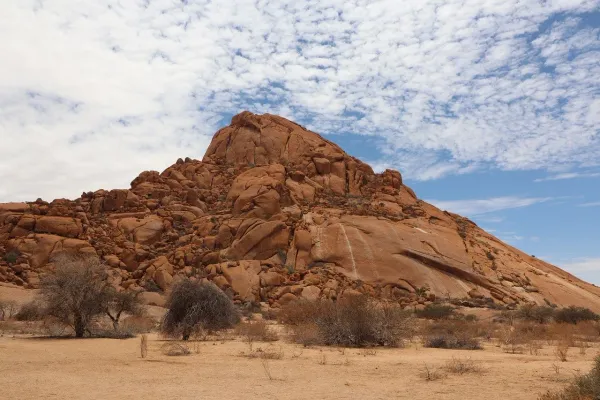
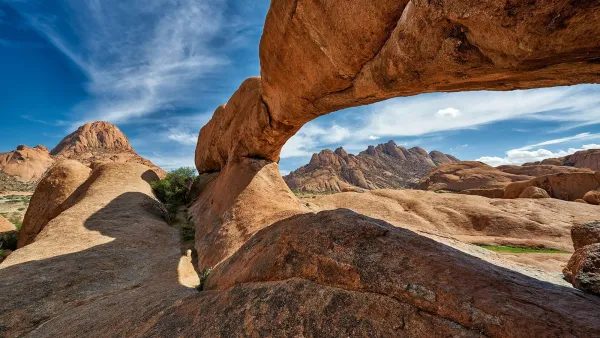
Spitzkoppe — the “Matterhorn of Namibia” — is a granite pyramid rising 1,728 meters above the plain, jutting up like a tooth. Around it: a chaos of boulders, stone arches, and caves. And in those caves — drawings.
About 80 rock art sites in the Erongo Mountains. 37 around Spitzkoppe alone. Paintings and petroglyphs ranging from 2,000 to 4,000 years old, and in other parts of Namibia — up to 30,000 years old. Pigmented slabs from a cave in the Huns Mountains in the south of the country represent the oldest figurative art in Africa.
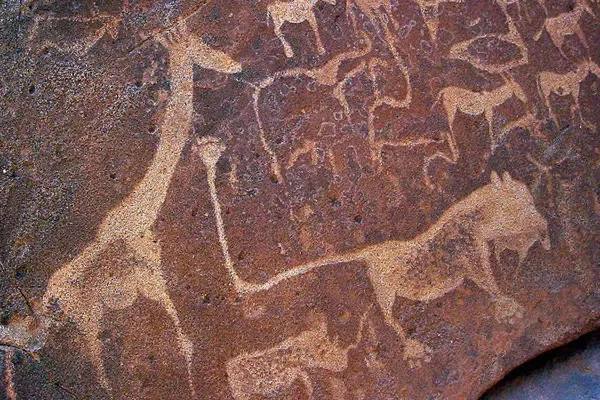
The drawings are not abstract. Rhinoceroses, giraffes, antelopes, elephants — recognizable, anatomically precise, rendered in red, white, and brown ochre. Hunting scenes: people with bows, animals in motion, arrows in flight. Shamanic visions: half-human, half-animal beings, figures in trance. This is not “rock painting for children” — it is art. Complex, deliberate, with composition, perspective, and movement.
They were created by the San — the Bushmen. One of the oldest continuous cultures on Earth. And that is not just a pretty phrase for visitors.
Genetic research over recent decades has upended our understanding of human history. DNA analysis shows that the San are the most ancient branch of humanity: their genetic lineage diverged from the rest of Homo sapiens more than 100,000 years ago. This means: when the ancestors of Europeans, Asians, and all other peoples were still living in East Africa with no thought of migration — the ancestors of the Bushmen were already here. In southern Africa. In these mountains. In this desert.
While all other peoples migrated, mixed, warred, built empires and destroyed them — the San remained. They hunted. They gathered. They painted on rocks. They lived at a rhythm that did not change for tens of thousands of years.
Their language is one of the few in the world that uses click consonants: tongue clicks as part of speech. Sounds that no European language can reproduce. Their hunting skill is legendary: a Bushman can pursue an antelope on foot for dozens of kilometers, for hours, in the heat, until the animal collapses from exhaustion — this is known as “persistence hunting.” Humans are the only creatures capable of this: our thermoregulatory system (sweating) allows us to run longer than any four-legged animal.
Their language is one of the most complex on Earth. Click consonants — tongue clicks that function as full speech sounds, not interjections. In the !Kung language (one of the San dialects) there are five types of clicks: dental, bilabial, palatal, lateral, and alveolar. Each is a distinct phoneme, like our “b” or “d.” Try clicking your tongue — that is one type. Now try doing it five different ways, each of which changes the meaning of a word. No European, Asian, or African language (except certain Bantu languages that borrowed clicks from the San) uses anything like it.
The journey’s itinerary includes a morning walk with a visit to a Bushmen village. Not a “cultural village for visitors” with rehearsed dances and a souvenir shop, but a real encounter with people who live as their ancestors lived thousands of years ago. How they find water — from the roots of shrubs and bulbs that look like stones but hold moisture. How they read tracks in the sand — a Bushman can determine an animal’s species, age, sex, speed, and even mood from a single footprint. How they make arrow poison — from the larvae of Diamphidia beetles: the poison is applied to the arrowhead and works slowly, paralyzing prey over several hours.
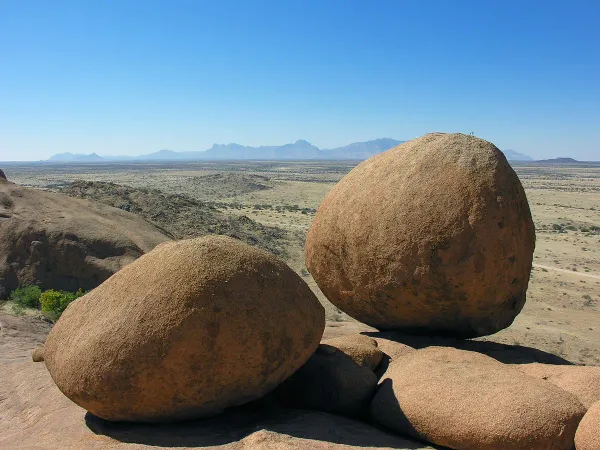
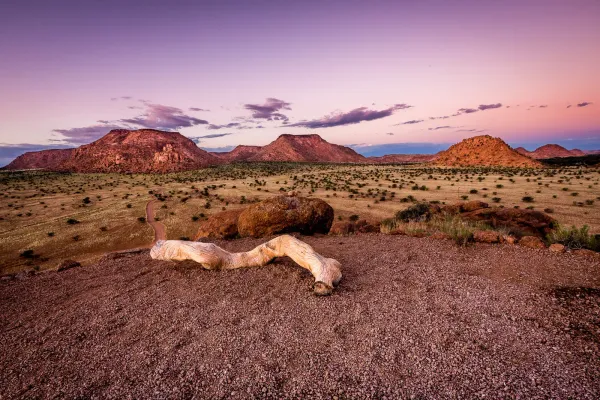
Two days in the Erongo Mountains. Two days that shift your sense of scale. Not the scale of the desert — the scale of time.
Ai Aiba Rockpainting Lodge sits among the rock-art boulders — the name says it all. You have breakfast on the terrace, and fifty meters away is a stone with an image of an antelope that someone painted three thousand years ago. The artist is gone. The antelopes are alive. The painting is intact. Three thousand years — like yesterday.
In the morning — an otherworldly light: the sun breaks through between the boulders, shadows falling in strange patterns on the reddish earth. The rocks — granite, smooth, polished by wind — change color throughout the day: grey at dawn, pink by noon, orange at sunset, black at night. The same landscape in four color palettes over a single day. Photographers lose their minds.
Klipspringer antelopes — small, graceful, with round ears and impossibly long eyelashes — stand on top of the rocks. On the very tips of their hooves — literally on tiptoe, like ballerinas en pointe. Their hooves — cylindrical, rubber-soled like climbing shoes — allow them to stand on ledges just a few centimeters wide. Where a human would fall, the klipspringer stands, chews grass, and looks down at you with an expression of gentle superiority.
Quiver trees — Aloe dichotoma — stand on the horizon like silhouettes from a science fiction film. Thick trunks, branching crowns of spiny leaves. The Bushmen used their branches as quivers for arrows — hence the name. These trees can be 300 years old. In a desert where even dead acacias do not rot.
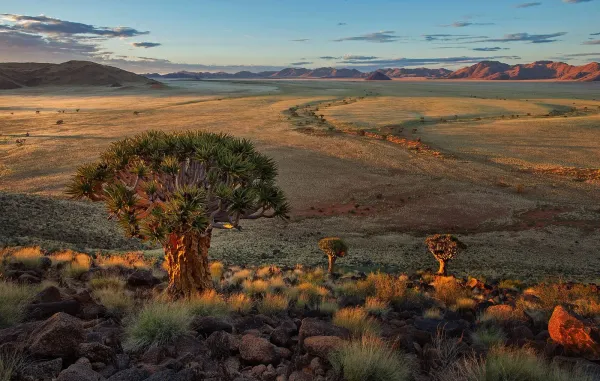
Namibia is an open-air museum. Only the exhibits are not behind glass. They surround you. Rock paintings thousands of years old. Trees hundreds of years old. A desert tens of millions of years old. And people — the Bushmen — who remember how to live among all of this. Without electricity. Without running water. Without maps.
But from the Erongo Mountains — the road leads to the ocean. To the place where the world’s oldest desert meets the coldest current in the Atlantic. Where Bavarian cafes stand on the edge of an infinite sea of sand. Where ships lie buried in the sand — 400 meters from the water.