They stand. Black, scorched by the sun, with branches stretched toward the sky like arms. They are dead. Nine hundred years. And they have not fallen. Have not rotted. Have not crumbled to dust. They stand — in a white clay hollow, among red dunes, beneath a sky that never sends rain.
Deadvlei. The Dead Valley. One of the most photographed places on Earth — and one of the most impossible.
To reach it you must walk a kilometre through sand. Not beach sand — real desert sand, soft and deep, swallowing your foot to the ankle with every step. The dunes around you are red, tall as twenty-storey buildings. The temperature is above forty degrees. No shade. No wind. No sound but the creak of sand underfoot.
And then — white. A flat, level, white clay pan. And on it — trees. Black. Dead. Standing.
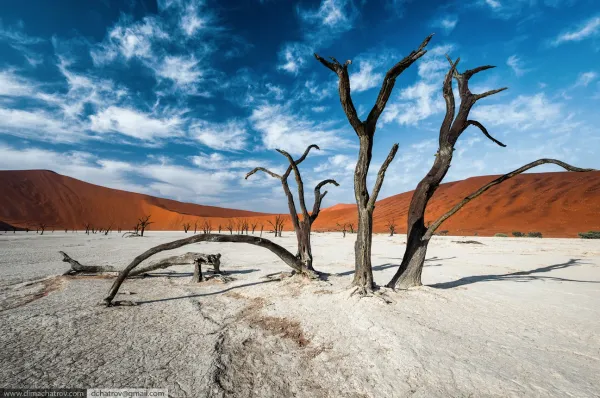
These are camelthorn acacias — Vachellia erioloba. Long ago they grew here beside a lake: the Tsauchab River flowed down from the mountains, spreading out to form shallow pools, and the acacias drank. They grew for decades, reaching toward the sky, throwing out their branches. They were living trees — with leaves, with birds in their canopy, with shade at their roots.
Then the dunes shifted. Sand blocked the riverbed — the water stopped coming. The lake dried up. The trees died.
That happened 600 to 900 years ago — roughly when Notre-Dame was being built in Europe, when the plague was sweeping through cities, and when Marco Polo was writing up his travels. The trees that grew here — camelthorn acacias capable of sending roots sixty metres deep in search of water — were suddenly cut off from their source of life. The river stopped coming. The groundwater retreated. The leaves yellowed and fell. The branches dried out. The trees died.
And since then they have stood. Not fallen. Not rotted. Not decayed. Nine hundred years.
Why? Because there is nothing here to decompose them. Deadvlei is one of the driest places on the planet: average annual rainfall is less than 10 millimetres. For comparison, Moscow receives 700 mm — seventy times as much. The humidity is so low that bacteria and fungi — the very microorganisms that turn a fallen tree to pulp in 10 to 20 years in a normal climate — cannot survive. No water, no microbial life, no decay.
The trees dried out almost instantaneously (in geological terms) and became mummies. They did not petrify — that is important: they are still wood, you can touch them and feel the texture of the bark. But ultraviolet radiation of near-Antarctic intensity (the ozone layer above Namibia is thinner than above Europe) and temperatures above 45 degrees have charred the wood on the outside — which is why they are black. Black as coal. Black as night. Against the white clay they look like ink drawings on a sheet of paper.
White clay. Black trees. Red dunes. Blue sky. Four colours — and nothing else. No Photoshop, no post-processing, no filter — just a place where nature decided to become a surrealist painter. Salvador Dalí, seeing photographs of Deadvlei, would have said: “I painted this — only worse.”
Photographers from all over the world travel here for a single shot at dawn. The sun is still low — it skims along the surface like a searchlight, and the dunes burn orange on one side while remaining black on the other. The shadows of the trees fall across the white clay in long ink-dark lines. The contrast is absolute: light and dark, living and dead, vertical and horizontal.
The film The Cell, with Jennifer Lopez, was shot here — the director was looking for a place that looks like a dream. He found Deadvlei. Nothing needed to be changed: reality was more surreal than any set. National Geographic photographers come here, advertising crews, music-video directors — everyone who needs a landscape that cannot be constructed in a studio.
And here is the paradox: the most photographed place in Namibia is dead. There is no life here. No water. No animals (apart from the occasional lizard or beetle). Only dead trees on dead clay. And it is beautiful. Because beauty does not require life. Sometimes beauty is what remains after life has gone.
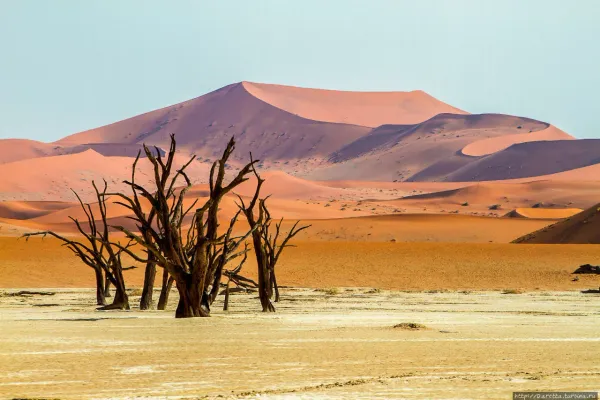
Deadvlei is the calling card of the Namib Desert. And the Namib is the oldest desert on Earth. It is 55 to 80 million years old. When it began to form, dinosaurs still walked the planet. In all that time — not once in 55 million years — has this region had a wet climate. Every other desert in the world — the Sahara, the Gobi, the Atacama — is younger. The Sahara is “only” 2 to 7 million years old. The Namib is ten times older.
The red colour of the dunes is not paint. It is iron. The sand grains of the Namib contain iron oxide — rust. The older the dune, the more the iron has oxidised in the open air, the redder the sand. White dunes are young. Yellow ones are older. Orange ones are old. Red ones are ancient. Dune 45 — the one visitors climb at sunrise — is red. It is thousands of years old.
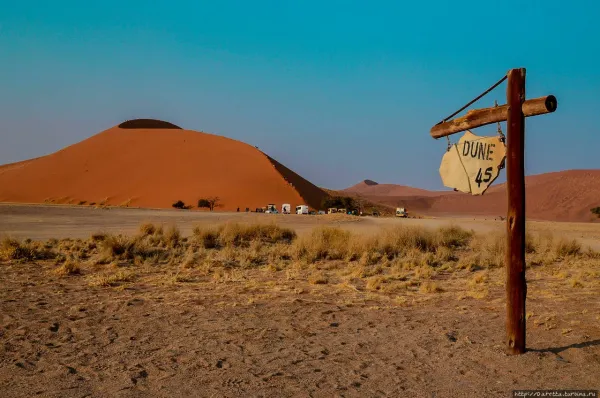
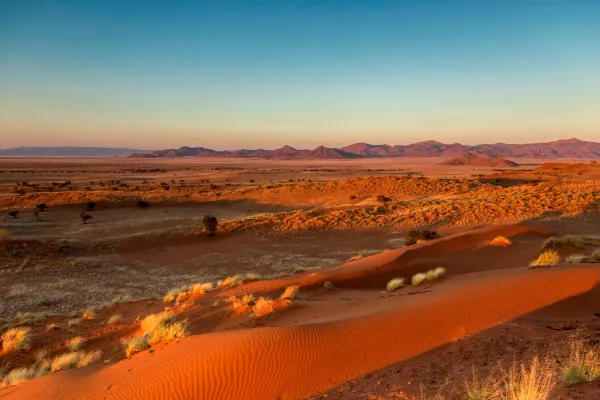
Dune 45 stands 170 metres tall. Its name comes from the kilometre marker on the road from Sesriem where it sits. The climb begins at 5 in the morning, before dawn, while the sand is still cool. The path runs along the dune’s spine — a narrow ridge with slopes dropping away on both sides. The sand is soft; your foot sinks with every step — two steps forward, one step back. Thirty to forty minutes for the fit, an hour for everyone else. At the top: sweat, heavy breathing, and a panorama that makes the suffering worthwhile.
Endless dunes to the horizon. Each one a different shade of red and orange. Each one with a perfect ridge along its crest, carved by the wind like a knife blade. Not a single footprint (the wind erased them all overnight). Not a single person. Not a single sound. Only silence — and the sun rising from behind the dunes, lighting the sand from top to bottom: first the peaks blaze gold, then the light creeps down the slopes and the shadows — long, sharp — shrink before your eyes.
The journey’s itinerary includes two desert outings in the Namib. The first at 5 in the morning — for sunrise, Dune 45, then a kilometre on foot through the sand to Deadvlei. The second at 5 in the afternoon — for sunset, when those same dunes look completely different: golden and orange in the morning, red and violet in the evening. Twice a day — the same landscape. And each time, a different one.
Between the outings — the pool at Hoodia Desert Lodge, with a view of the dunes directly from the water. You lie in the cool water and all around you are 55 million years of red sand. And springboks — small antelopes — bounce across the slopes like rubber balls. They know how to “pronk” — leaping straight-legged, on the spot, a metre into the air. Why? One theory: to show a predator, “I’m healthy and fast, don’t waste your energy.” Another: they simply enjoy jumping.
Namibia is a place where time works differently. Trees do not rot. The desert does not grow younger. Sand turns redder with age. Antelopes leap for joy. And among all of this — 30,000-year-old rock paintings left by people who lived here long before the pharaohs, before Rome, before Athens.
People whose descendants live here still.