“Gladiator.” “Game of Thrones.” “Lawrence of Arabia.” “Asterix and Obelix.” “Kingdom of Heaven.” “Cleopatra.” “The Mummy.” All of these films were shot in the same place. In a small town in the middle of the Moroccan desert.
Ouarzazate. “The Hollywood of Morocco.” A town of 70,000 people that few have heard of — yet whose landscapes everyone has seen.
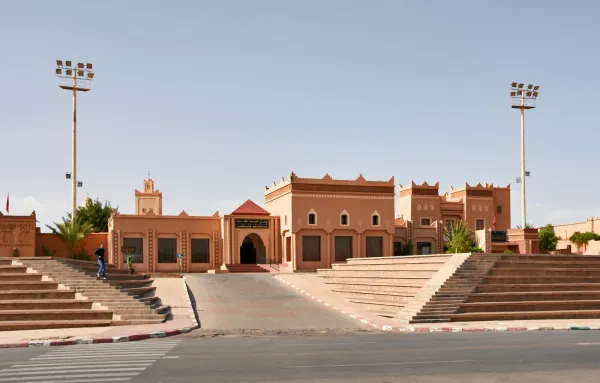
Atlas Studios is the largest film studio in the world. Not in Hollywood. Not in Bollywood. Here. In the middle of the desert, at the foot of the Atlas Mountains. Why? Because everything is here: the desert is ten minutes away. The mountains are half an hour. Kasbahs — real, mud-brick ones — are within walking distance. 350 sunny days a year. And the costs are a fraction of what they’d be in California — local extras, costumes, and sets cost ten times less.
The list of films shot in and around Ouarzazate reads like an encyclopedia of world cinema. “Lawrence of Arabia” (1962) — the film that made Peter O’Toole a star and David Lean a legend; the desert around Ouarzazate “played” Arabia, Jordan, and Sinai all at once. “Jesus of Nazareth” (1977) — Moroccan kasbahs became Jerusalem. “The Last Temptation of Christ” (1988) — Scorsese returned here eleven years later. “Kundun” (1997) — the same Scorsese, only this time Morocco “played” Tibet. Ridley Scott’s “Gladiator” (2000) — the Colosseum was built on-site, from plaster. “The Mummy” (1999) — the Sahara became the Egypt of the pharaohs. “Kingdom of Heaven” (2005) — the Crusades. “Asterix and Obelix: Mission Cleopatra” (2002). “Game of Thrones” — the scenes of Yunkai, Pentos, and Meereen. “World War Z.” “Prince of Persia.” “007: Spectre.” The list is endless. And every year it grows longer.
Why here, of all places? Not Hollywood, not Rome’s Cinecittà, not London’s Pinewood? Because Ouarzazate is a universal backdrop. The perfect set that can “play” any era and any geography.
The desert just around the corner (literally — 20 minutes by car) stands in for the Middle East, Egypt, Palestine, Mesopotamia, and even Mars (yes, Martian scenes are shot here too). The mountains behind you become Tibet, the Hindu Kush, the Andes, the Caucasus. The mud-brick kasbahs become Babylon, Jerusalem, Mecca, any ancient city from India to Spain. 350 sunny days a year means the light is predictable and production schedules don’t get derailed by rain. The dry air keeps equipment from being ruined by humidity. And it’s affordable: extras from the local population (Berbers who play Romans, Arabs, Persians, and Egyptians with equal conviction), sets built from local clay (the same pisé used to build kasbahs for a thousand years), and accommodation for the crew at a fraction of what it would cost in California or London.
On the Atlas Studios lot, sets that were never dismantled after filming simply because it was easier to leave them standing. The Colosseum from “Gladiator” — full scale, made of plaster and wood, but looking like stone a thousand years old. The throne from “Game of Thrones” — small, iron, uncomfortable (it looked larger on screen). The Egyptian temples from “Cleopatra” — columns, sphinxes, hieroglyphics. All of it is props. All of it is strikingly convincing. You walk between the sets and feel a sense of déjà vu — you’ve seen this before. On screen. But up close it’s a different feeling. Up close you can see that the “stone” is plaster, that the “gold” is paint, that the “antiquity” is from last year. And that doesn’t disappoint — it fills you with wonder. Because illusion is also an art.
But the main attraction is not the studio. It is the ksar of Aït Benhaddou.
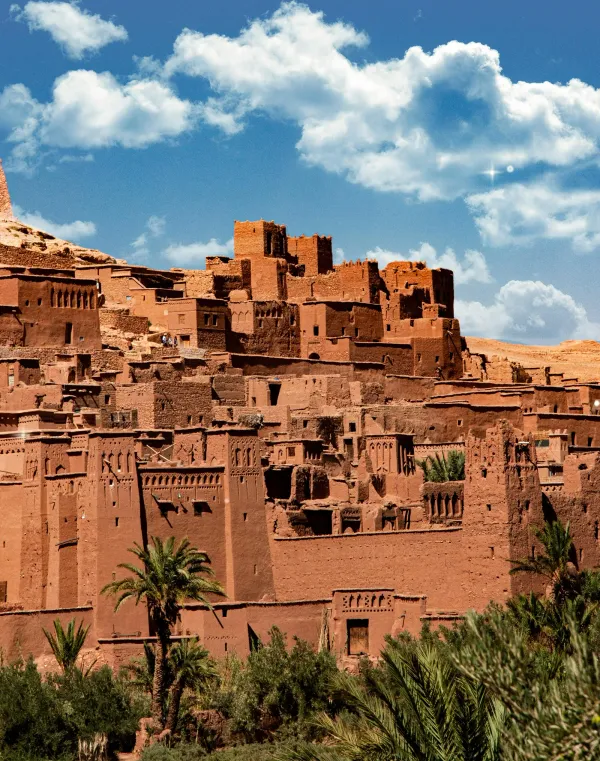
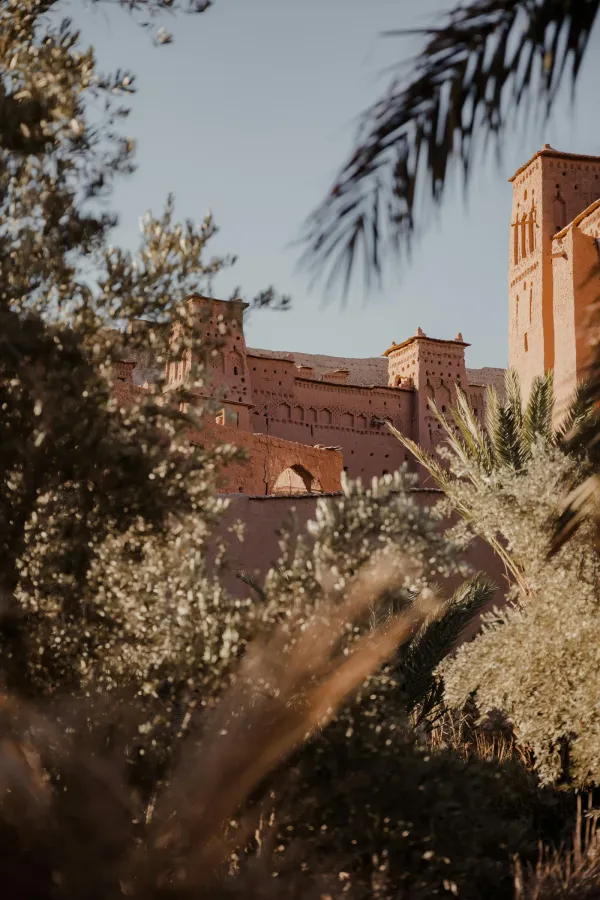
A ksar is a fortified settlement. Multi-storey mud-brick houses, walls a metre thick, towers with arrow slits — all built from compressed clay (pisé) mixed with straw, water, and sometimes lime. Clay is the perfect building material for the desert: during the day it keeps the interior cool, at night it holds in warmth. A natural air conditioner that has worked for thousands of years without electricity.
Aït Benhaddou stands on a hill above the Ounila River, on an ancient caravan route from the Sahara to Marrakech. A thousand years ago, caravans loaded with gold from Timbuktu, salt from the Saharan mines, and enslaved people from the south passed along this road. The ksar protected traders from bandits — and collected a toll for passage. Every caravanserai was a business: safety in exchange for money. A medieval toll road.
A UNESCO World Heritage Site since 1987. But it is alive. Not a museum, not a ruin. Several families still live inside the walls. Children run along the same narrow streets where camels laden with gold were led a thousand years ago. The walls erode in the rare but heavy rains — and the residents patch them again, layer by layer, just as their great-grandparents did. Every year, fresh clay. The ksar renews itself without changing. Like a living creature that sheds its skin.
The Tizi n’Tichka pass — 2,260 metres. The road from the desert to Marrakech through the High Atlas is one of the most scenic mountain roads in the world. 200 kilometres of hairpin bends: a turn, a drop, a turn, a drop. The views change with every kilometre: below — the brown desert, scorched and lifeless. Halfway up — Berber villages among terraced olive groves. At the summit — snow (in winter), grass (in summer), wind (always). Beyond the pass — a green valley, and in the distance — Marrakech, red, hazy, alive.
At the pass — 15°C and wind. You were just at 35°C in the desert. Morocco is a country of extremes. Not only in colour — in temperature, altitude, culture. In a single day you can travel from the Sahara to the Alps.
The Todra Gorge — another stop on the route, another world entirely. A canyon with sheer walls 400 metres high — made of pink-orange limestone, striped like a layered cake (each stripe an era, each colour a different sediment composition). At its narrowest point — 10 metres from wall to wall. The sky above — a narrow strip of blue. The river at the bottom — shallow, clear, cold. Light filters down from above in slanting shafts, like the interior of a Gothic cathedral. Cool — after 40°C in the desert it feels like air conditioning. Quiet — only the water. And walls that have stood here for a hundred million years.
The Dadès Valley — after the gorge. The town of Kelaat M’Gouna — the capital of Moroccan roses. Damask roses are grown here for the production of rose water and rose oil. In May there is a rose festival: the whole town is covered in rose petals and the scent carries for kilometres. In October there are no roses — but shops selling rose water, rose soap, and rose cream are on every corner.
And after the pass, after the gorge, after the roses and the film studio — Marrakech. The Red City. With a square that never sleeps. With a garden saved by a fashion designer. With a souk where you can get lost for an entire day — and never regret it.