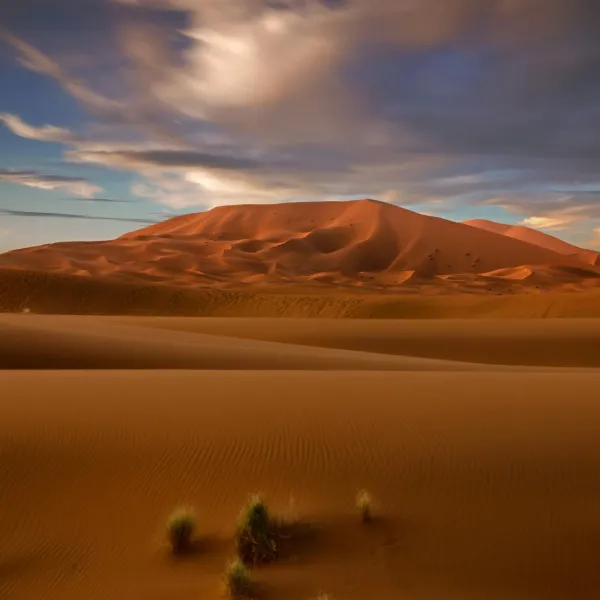
A camel walks across the sand. Slowly, swaying, like a ship. You are on its back. The sun is setting. The dunes burn orange. The shadows are long, black as ink. Ahead — tents. A campfire. And a night with more stars than you have ever seen in your life.
The Sahara. A word every child knows. A word from a geography textbook, from The Little Prince, from a thousand films. And a word that explains nothing until you see it for yourself. Because the Sahara is not a “desert” in the way you picture it. Not an “empty place.” Not “nothing there.” The Sahara is a feeling. The feeling of a scale that takes your breath away. The feeling that the world is empty. That beyond these dunes lie more dunes. And beyond those — more still. And so on, across 9 million square kilometres — an area equal to the entire United States. The largest hot desert on Earth. And you are in the middle of it.
The road to the Sahara is itself a journey. From Fes — through the Middle Atlas. A stop in Ifrane, the “Moroccan Switzerland”: a neat little town of Alpine chalets, parks, and lakes. A ski resort — yes, Morocco has ski resorts, and snow lies here in winter. Atlas cedars, enormous with spreading canopies, and Barbary macaques: tailless monkeys, the only primates in Africa north of the Sahara. They sit along the roadside waiting for nuts. Or simply taking them.
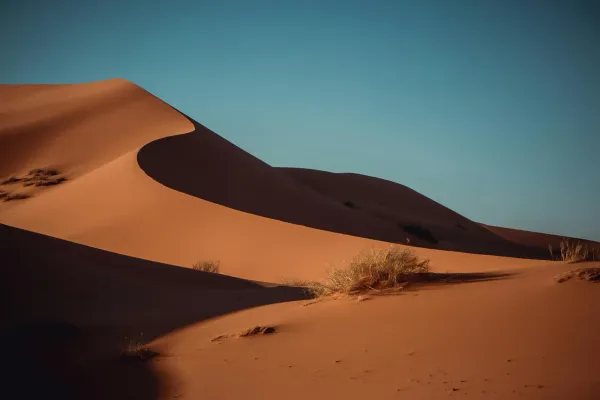
Midelt. Lunch. The Ziz River gorge — a deep canyon with palm oases along its floor. And finally — Merzouga. The gateway to Erg Chebbi. An erg is a sea of sand, a region of dunes. Here the dunes are white and gold, up to 150 metres tall, stretching 22 kilometres from north to south.
At the base — you transfer from the bus to camels. Dromedaries: one-humped, calm, with eyelashes longer than any runway model’s, and an expression on their faces that could be read as wisdom, arrogance, or simply chronic displeasure (probably all three at once).
An hour on camelback. A caravan of 6 to 10 camels, one behind the other, along the crest of a dune. The camel moves slowly, swaying — like a ship on waves. It is no accident they are called “ships of the desert”: the rhythm of movement is oceanic, lulling, meditative. You sit high — higher than on a horse — and see far: dunes to the horizon, orange, gold, pink in the setting light. The shadows of the caravan fall across the sand in a long chain — the classic image you have seen on a thousand postcards. Only now it is your caravan. And your shadow.
The sand is soft, warm (scorching at 60°C by day, pleasant by evening). The silence is absolute. Only the sound of the camel’s footsteps — soft, as if on cushions (dromedaries have wide padded soles that do not sink in). And the creak of sand grains — quiet, constant, like the whisper of the desert.
The camp is not the tents from films about Bedouins. Nor the tents of a campsite. This is glamping in the Sahara. Lavish pavilions with Berber rugs on the floor — thick, soft, handwoven. Beds with real mattresses and linen. Lanterns — wrought iron, patterned, casting lace-like shadows on the walls of the tent. A toilet. Hot water (solar heater — in the desert, there is more than enough sun). In the middle of the Sahara. Ten kilometres from the nearest road.
Moroccan dinner — one of the finest culinary experiences of the journey. Tagine — lamb with vegetables, prunes, and almonds, slow-cooked for hours in a clay pot with a conical lid (the shape of the lid is not design: the cone collects condensation and returns moisture to the dish, like a natural autoclave). Couscous — with vegetables and chickpeas. Moroccan salads — zaatar, takiya, aubergine with turmeric. And mint tea — a ritual. The silver teapot is raised half a metre high, a thin stream pours into a small glass tumbler, building a cap of foam. This is not performance — the foam cools the tea and aerates it. Three glasses — mandatory: “The first is as gentle as life, the second as strong as love, the third as bitter as death” (a Berber saying).
After dinner — Bedouin drums and songs around the fire. Not a “show for tourists” — real rhythms passed down through generations. The fire casts shadows on the walls of the tents. And above your head — the sky.
The sky of the Sahara is the reason people travel to the desert. Not the dunes. Not the camels. The sky. There is no light pollution — the nearest city is hundreds of kilometres away. There are no clouds — in the Sahara, rain falls once every few years. There is no humidity — the air is dry as glass.
And the Milky Way is not a stripe. Not a blurry smear. Individual stars, billions of them, arranged into the arms of a spiral. The Southern Cross — if you know where to look. Constellations you knew only from textbooks — here, real, brilliant, three-dimensional. Shooting stars every few minutes. You lie on a rug outside your tent, head tilted back, and you understand: the sky is not a flat ceiling. The sky is deep. You could fall into it.
Sunrise — at 5 in the morning. You wake in the tent — the silence is so complete you can hear your own heartbeat. You step outside. Sand beneath bare feet — cool (it has dropped to +10°C overnight; in two hours it will be +40°C). The dunes — pink, then orange, then gold. Light crawls down the slopes from above, and the shadows — long, black, sharp — shrink before your eyes. Every ripple in the sand is the imprint of the night wind, which by noon will draw a new one. Nothing remains. Every sunrise in the Sahara is the only one.
The return journey on camels. The “fossil factory” — a stop along the way: polished fossils for sale. Four hundred million years ago this was the seabed — ammonites, trilobites, orthocerases frozen in stone. You can buy a shell from a creature that lived before the dinosaurs for a few dollars. Morocco is one of the best places in the world for palaeontological souvenirs.
The town of Tinghir — a palm oasis, a green ribbon amid brown desert. Todra Gorge — vertical walls 400 metres high, with only 10 metres between them at the narrowest point. A shallow, clear river runs along the bottom. Light enters from above in a narrow band. Cool, quiet, like the inside of a cathedral. The walls — pink-orange limestone, striped: each stripe an era, each colour a different composition of sediment laid down over millions of years.
The Dades Valley, the town of Kelaat M’Gouna — the capital of Moroccan roses. Damask rose, plantations, rosewater, rose oil. In May there is a festival, the whole town carpeted in petals. In October the roses are gone — but the scent lingers in every shop.
And yet between the desert and Marrakech lies one more world. A place where every film you have ever watched was made.