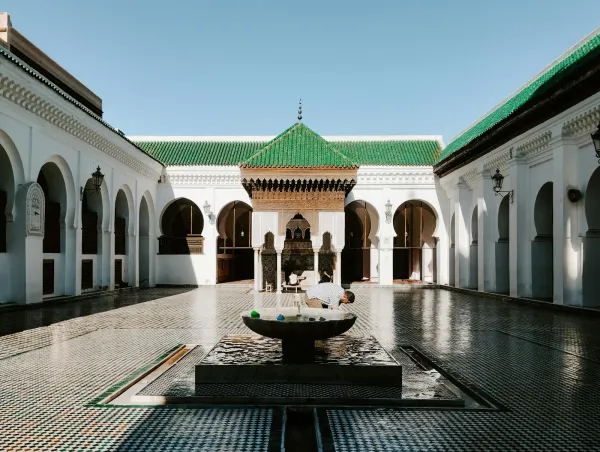
859 AD. Fatima al-Fihri — daughter of a wealthy merchant from Tunisia who had settled in Fes — donates her entire inheritance to build a mosque. The mosque becomes a school. The school becomes a university. The university has been running ever since — 1,167 years without interruption.
Al-Qarawiyyin. The oldest continuously operating university in the world — according to UNESCO and the Guinness Book of Records. Older than Oxford (founded 1096). Older than the University of Bologna (1088). Older than the Sorbonne (1150).
And it was founded by a woman. In the 9th century. In Muslim Morocco.
Fatima al-Fihri was not a scholar — that role simply did not exist for women of the 9th century. She was an heiress: her father, Muhammad al-Fihri, a prosperous merchant from Kairouan (Tunisia), had moved to Fes and left his daughters a fortune. Fatima could have lived a quiet, comfortable life. Married. Raised children. Forgotten about education — like every other woman of her era.
She chose differently. She invested the entire inheritance — down to the last dinar — in building a mosque, alongside which she opened a school. Legend has it that she fasted throughout the entire construction period — from the first day to the last. When the mosque was complete, Fatima herself performed the first prayer inside it.
The school attached to the mosque began drawing scholars from across the Islamic world. Theologians, jurists, mathematicians, astronomers — they came to teach and to learn. The academic process was formalised: curricula, examinations, and degrees emerged. By the 12th century, Al-Qarawiyyin was one of the foremost intellectual centres in the world — on a par with Baghdad and Córdoba. Maimonides studied here — the greatest Jewish philosopher of the Middle Ages. Al-Idrisi taught here — the geographer whose world map remained the finest on the planet for three centuries.
Fes is a city built around this university. Or more precisely — a city the university built around itself. The medina of Fes is the largest car-free urban zone in the world. The numbers: 9,400 buildings, 300+ mosques, 11,000+ alleyways, 3,000+ workshops. Cars cannot pass — the lanes are shoulder-width, some barely a hand-span wide. Goods are moved by donkey — as they have been for a thousand years. GPS is useless: the satellite sees the rooftops but not the labyrinth beneath them.
Smell is the first thing that greets you. And it never lets go. Spices: cumin, saffron, cinnamon, cloves — from stalls where cones of spice rise like coloured mountains. Leather — raw, curing, pungent enough to make your eyes water. Mint — from tea houses where the tea is poured in a thin stream from half a metre above the glass (not showmanship — it’s the way to cool boiling water and raise a foam). Cedar — from the woodworkers’ workshops, where craftsmen carve doors and ceilings with the same tools their great-grandfathers used. Incense — from the mosques that stand on every corner. All of it at once. All of it together. The smell of Fes is not one smell. It is an orchestra.
The Chouara tanneries are one of the most remarkable sights in Fes, and perhaps in all of Morocco. The 11th century. A thousand years — and the technology has not changed by a single step. Not one innovation. Not one electric motor. Not one chemical reagent. Just hands, water, and natural dyes.
The vats are round, stone, sunk into the ground like a giant painter’s palette spread across a rooftop. Dozens of vats, each a different colour. The white is not paint: it is pigeon dung mixed with lime and water. Hides are soaked in it for weeks — the dung softens the leather, kills bacteria, and removes the hair. The smell is such that visitors at the entrance are handed bunches of fresh mint to hold against their noses. Some cannot bear it and leave. Those who stay witness a sight they will never forget.
The red vat — poppy powder. Yellow — saffron. Brown — cedar bark. Blue — indigo (the same used in Chefchaouen). Green — mint. Workers stand knee-deep in the vats, soaking the hides with bare hands — turning, kneading, flipping. Their hands are permanently stained — red, yellow, brown, depending on which vat they work. It is hard, poorly paid labour. But the tanner families pass the craft from generation to generation, just as Fatima passed on her university — across the centuries.
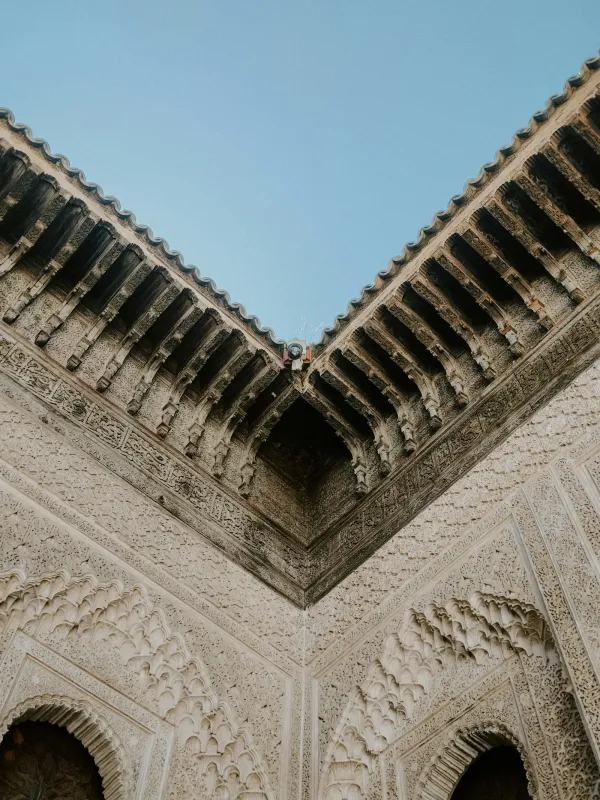
The Bou Inania madrasa — 14th century: zellige mosaic (geometric patterns made from small hand-cut ceramic pieces), carved cedar wood, plaster stucco. Every square centimetre is handmade. Not a single repeated element — Islamic art forbids the depiction of living creatures, but permits the infinite elaboration of geometry.
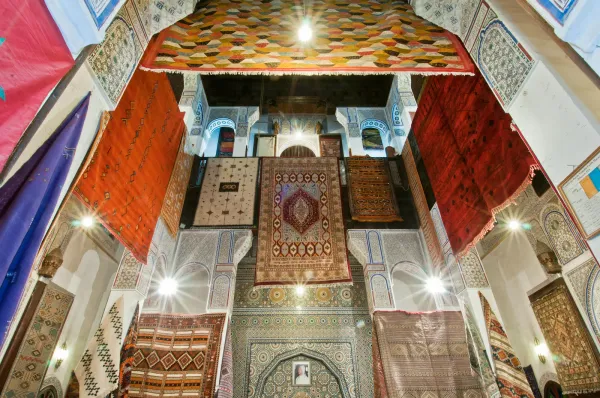
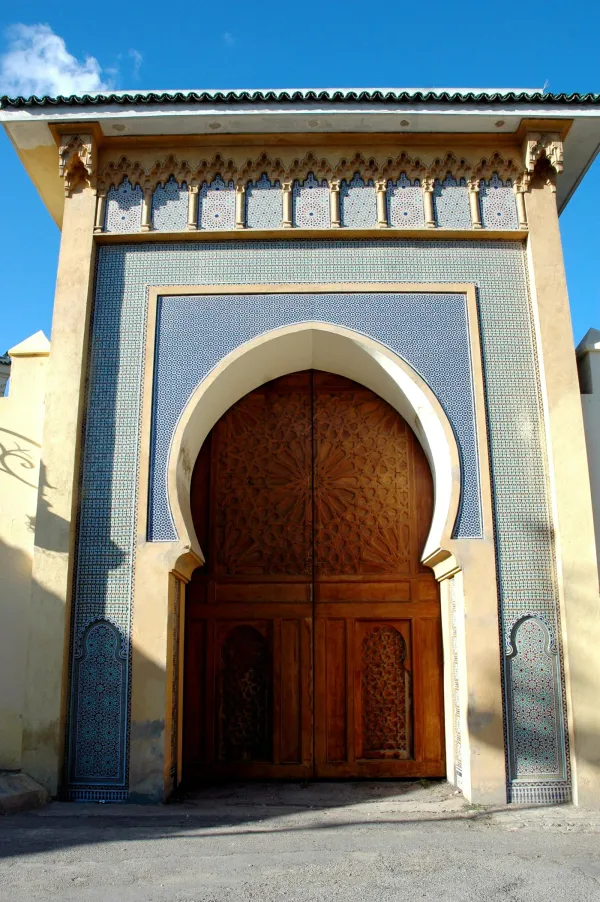
The Golden Gates of the Royal Palace — vast, double-leafed, covered in chased brass ornament so intricate you could stand before them for half an hour and still not take it all in. The panorama from the Merenid Hills — all of Fes laid out below: minarets, flat rooftops, TV aerials, smoke from the tanneries, the shouts of vendors, the distant call of the muezzin. A city that looks exactly as it did 700 years ago — if you discount the satellite dishes and the electric cables.
Fes is a labyrinth. Literally: without a guide, you will be lost within ten minutes. GPS does not help — the lanes are too narrow, the buildings too tall, the signal bounces off the walls and tells you that you are in the next neighbourhood. The only landmark that works is the Qarawiyyin mosque: you can find your direction by the sound of the adhan. When Fatima al-Fihri built that mosque in 859, she gave Fes not only an education — she gave it a compass. One thousand one hundred and sixty-seven years later, it still works.
With a guide, three hours later you will emerge from the medina feeling as though you have been to the Middle Ages. Not a reconstruction. Not a museum. Not a theme park — the real, living, working Middle Ages that never ended. That has been curing leather in pigeon dung for a thousand years, carving cedar into ceilings, laying zellige mosaic from tiny fragments — and has no intention of stopping.
But from Fes, the road leads south. Through the Atlas. Through mountains and passes and climate zones — from green valleys to scorched plain. Towards yellow. Towards the Sahara.