In the 1930s, Jewish families fleeing Hitler reached a small town in the Rif Mountains of Morocco. They had no money, no papers, no future. But they had a tradition: painting walls blue. The color of the sky. The color that reminds you of God.
Chefchaouen. “The Blue Pearl of Morocco.” One of the most photogenic cities on the planet — and one of the most inexplicable.
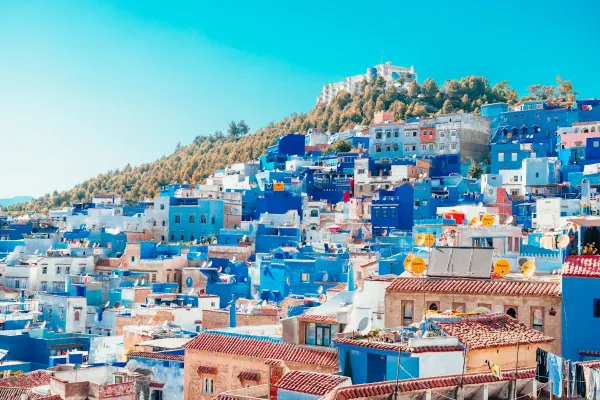
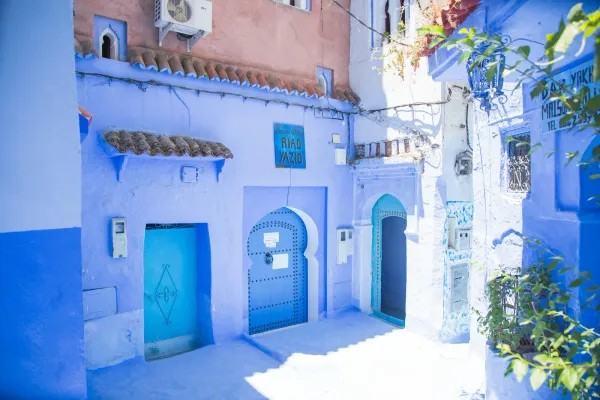
The town sits on the slope of Mount Kalaa, at an elevation of 600 meters, deep in the Rif Mountains — the wildest and least-visited mountain range in Morocco. Getting there takes two hours along a winding road from Tangier, past villages of mud-brick houses and goats on the roadside. Narrow streets, staircases, arches, courtyards — a typical Moroccan medina. But blue. All of it. Walls, doors, steps, fences, flower pots, drainpipes, even the rubbish bins. Dozens of shades: from pale azure to deep indigo, from sky blue to ultramarine. As if someone had tipped the sky over the city — and it ran down the walls, seeped into every crack, painted every stone.
Why blue? That’s the question everyone asks when they arrive. And no single answer is definitive — which is perhaps a good thing: the mystery keeps Chefchaouen alive rather than museum-like.
There are several theories. The most beautiful — and most plausible — is connected to the Jewish diaspora. In Judaism, the color blue — tekheleth — is sacred. God commanded the children of Israel to weave a thread of tekheleth into the fringes of their prayer shawls (tallitot) — as a reminder of the sky, the sea, and God. Blue is the color that binds earth and heaven. The color that reminds you: there is something higher.
Jews had lived in Chefchaouen for centuries — Sephardim expelled from Spain in 1492 found refuge here. But it was in the 1930s, when a new wave swept out of Europe — refugees fleeing Hitler — that the blue color began to spread. They painted the walls of their quarter (the mellah) blue, as they had done at home, as they had done for centuries, as tradition taught them. Not for beauty — for memory. So that even here, in the mountains of Morocco, far from Europe, far from home, the walls would remind them: the sky exists. God exists. Hope exists.
Over time, the blue spread from the Jewish quarter to the whole city. No one remembers the exact moment — it happened gradually, house by house, street by street. One family painted — a neighbor liked it — and painted too. Perhaps the residents simply fell in love with the color. Perhaps — and this version is popular with guides — blue repels mosquitoes (there is no scientific evidence, but Moroccans believe it firmly). Perhaps blue walls genuinely cool things down in the heat — lime reflects sunlight better than bare stone (this one is closer to the truth).
Or perhaps — and this is the most important thing — blue became an identity. The thing that sets Chefchaouen apart from thousands of other Moroccan towns. Without the blue, it would be just a village in the mountains: beautiful, but nameless. In blue, it is unique in the world. A color that began as a religious tradition of refugees became a brand. Not a marketing one — an organic one. Nobody planned the “blue city” as a destination product. It simply became one.
And now, every year, thousands of photographers come here for a single shot: a blue wall, a pot of geraniums, a cat on the steps. That shot appears on every postcard, every website about Morocco, every cover. And it never grows old — because every wall, every door, every step has its own shade. Chefchaouen is not monochrome. It is a symphony of blue.
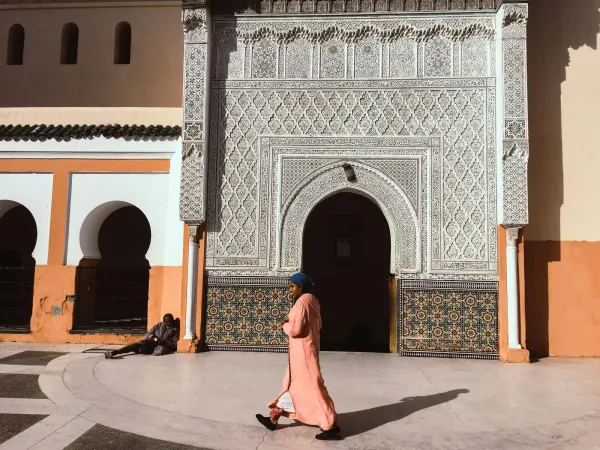
Chefchaouen has a history that runs deeper than paint. The city was founded in 1471 by Moulay Ali ibn Rachid — as a mountain fortress to repel Portuguese raids on the coast. For centuries it lived in isolation: entry for foreigners was forbidden until 1920, when Spain established its protectorate. The first European to penetrate Chefchaouen — the French explorer and priest Charles de Foucauld — visited in 1883, disguised as a rabbi (the Jewish community enjoyed relatively free movement; Muslims did not). De Foucauld described “a city that hides from the world in the folds of the mountains.”
The Jewish community of Chefchaouen had existed for centuries — long before the refugees of the 1930s. Sephardic Jews expelled from Spain in 1492 settled here and brought with them their crafts, trade, and traditions. The mellah — the Jewish quarter — was a city within a city: its own streets, synagogues, schools. It was here, in the mellah, that the walls had always been blue. But in the 1930s, when the new wave arrived — refugees from Europe, fleeing Hitler — the blue began to creep beyond the quarter’s boundaries.
Today residents repaint the walls each season. The paint is lime-based with blue pigment added (indigo or synthetic ultramarine, depending on the budget). Each person paints their own wall, which is why the shades vary: cobalt, azure, violet, turquoise. It is not uniformity — it is a choir, where every voice differs slightly from its neighbor. And that makes it more beautiful.
Chefchaouen is one day in the itinerary. But what a day. Morning in the mountains: light filters through archways and falls as blue shadows onto blue walls, creating a depth that no photograph can capture. Photography makes Chefchaouen flat — in person it is three-dimensional; you have to walk around it, peer around corners, climb the steps, duck through passageways. The scent of mint from the tea houses — sweet, thick, mingled with the smell of fresh lime. Cats — hundreds, perhaps thousands — sleeping on blue steps, perched on blue windowsills, like patches of a different color on a monochrome canvas. The market: handwoven blankets, wool from the Rif Mountains, spices, ceramics — all in blue tones, because here everything is in blue tones. Even the tagine is blue. Even the leather slippers are blue.
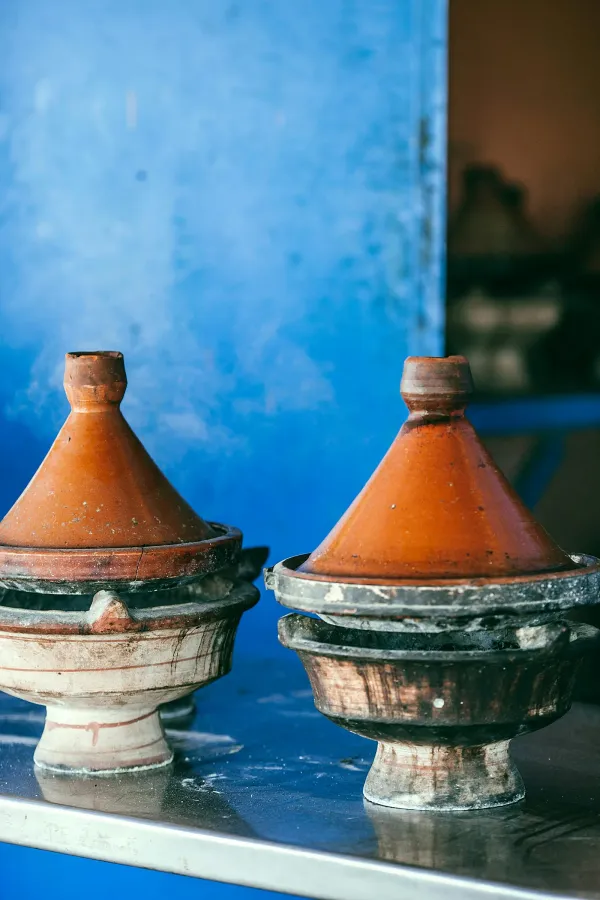
But Morocco is not only blue. Two hundred kilometers to the south lies a city where everything is gold. A city with the largest pedestrian zone in the world. With a university founded by a woman. In the ninth century.