19 people rated this journey 4.9 out of 5. But numbers don’t capture what matters most. What matters most is the moment you realize the sperm whale can see you. And decides to stay.
Some journeys fill up a memory card. Some fill up Instagram. And then there’s Mauritius — a journey that fills you. Not your memory — you. Something inside that can’t be measured in gigabytes and won’t fit in a Story. Dates, prices and the programme are on our Mauritius trips page.
10 days. An itinerary that begins in an airplane seat (12 hours to Mauritius — enough to sleep, read a book, and start anticipating) and ends with the feeling that you’ve been inside a documentary — only without a screen. Without glass. Without distance. The giraffe is right there, taking lettuce from your hand. The sperm whale is right there, breathing ten meters away. The tortoise is right there, closing its eyes as you stroke its neck.
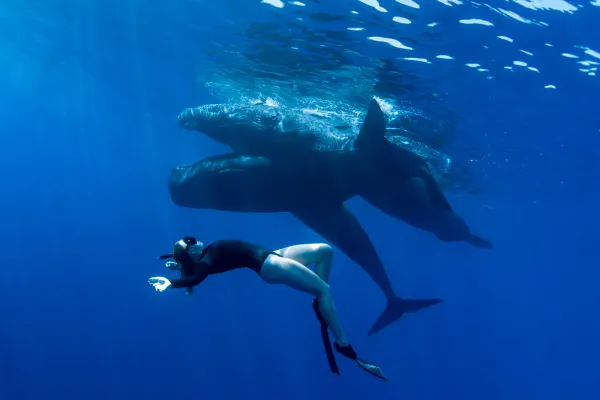
Three excursions to the sperm whales. Three mornings on the ocean, with a hydrophone picking up clicks from the deep. Three encounters with creatures whose brains are six times heavier than yours. That dive three kilometers down. That sleep vertically. That live in matriarchal families where every “nanny” knows every calf.
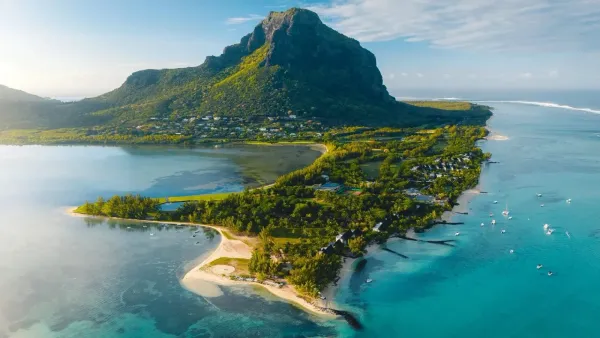
The Land of Seven Colors — dunes that shimmer like a palette, sorting themselves out against the wind and rain. A hundred-meter waterfall. The crater of a dormant volcano — perfectly round, like the moon.
Casela Safari Park — breakfast with a giraffe that takes lettuce with a black tongue 45 centimeters long. Its nostrils sniff your hand — moist, warm. Its eyes — brown, with long lashes — level with yours. A jeep safari among zebras and antelope — open jeep, dust from the wheels, ostriches racing you for speed. Walking alongside a cheetah — the fastest land animal on earth, capable of reaching 120 km/h in three seconds, yet now strolling beside you unhurried, glancing back with yellow eyes.
The Tea Road — Bois Cheri plantations on green hills, the colonial estate of St. Aubin where the air smells of vanilla — real vanilla, not synthetic, from orchid pods drying in the sun on wooden frames. A rum tasting — from young and fiery to dark, with caramel and smoke. La Vanille Park in the tropical jungle — crocodiles, flying foxes, lemurs. And Aldabra tortoises, 150 years old, weighing 300 kilograms, that close their eyes in pleasure when you stroke their wrinkled necks.
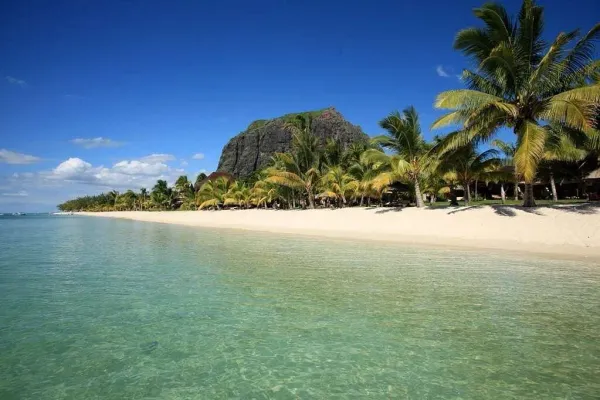
Beaches — real, tropical, straight out of the commercials. Golden sand, soft as flour. Turquoise water — warm, 27 degrees, clear to the bottom. Palms leaning toward the water, just like on postcards you never quite believed. A coral reef a hundred meters from shore — a barrier beyond which the open ocean begins. Between the shore and the reef — a lagoon: shallow, calm, waveless. A mask, a snorkel, five steps from the beach — and you’re among tropical fish. Butterflyfish, parrotfish, angelfish — names from a children’s book, but they’re real, and they’re here, a meter away.
Two free days for the beach. Just lying there. Just swimming. Just gazing at the horizon and thinking that somewhere out there, in the dark beneath the turquoise surface, 50 sperm whales are clicking at 236 decibels and hunting squid no one has ever seen.
And — the dodo. Not the bird — it went extinct three centuries ago. But its shadow falls over everything. Over every sign that says “do not touch,” “do not feed,” “keep your distance.” Over every wildlife protection law. Over every permit and quota. Mauritius is an island that once failed. And ever since, it has been trying — with every action, every park, every nature reserve — to make amends.
The sperm whales living offshore are monitored. The tortoises that let you touch them are protected. The reefs are recovering. The forests are being replanted. The dodo cannot be brought back. But everything else — can still be saved.
14 people in the group plus a trip leader. This is not a coach trip for fifty. This is a small group where everyone knows each other by name by day three. Where at dinner the talk is about who spotted the most sperm whales that morning, and who was first to notice the Aldabra tortoise stretching out its neck.
14 people — a group where everyone feels like a friend, not a number on a list. Dinner at a shared table. Excursions on a shared bus, but without that conveyor-belt feeling. On the boat to the sperm whales — shared wonder when the first spout appears on the horizon.
Help with flights — we’ll find the routes, connections, and seats. Transfers — from the airport to the hotel, from the hotel to the boat, from the boat to the park. Hotels on the program — breakfasts included, rooms booked, luggage delivered. Three whale-watching excursions with a local captain who knows these particular whales by name (or rather, by tail). A guided program with an English-speaking guide. A trip leader with the group for the entire journey — someone who has been here before, who knows where the best view is, where the best rum is, where the best sunset is.
24⁄7 manager support — before, during, and after. A visa question at 11 pm? We’ll answer. Lost luggage? We’ll sort it. Want to extend by two days? We’ll arrange it.
You call. We put it together. You fly. We meet you.
Mauritius is small. 65 by 45 kilometers. Usually “small” is a drawback. Not here. Here “small” means: everything is close. From the beach to the volcano — one hour. From the volcano to the sperm whales — one hour. From the sperm whales to the giraffe — half an hour. The density of experiences per square kilometer is higher than almost anywhere in the world. In 10 days you’ll see more than in a month in a larger country. Because here you don’t need to travel for hours between points. Here everything is just around the corner.
One more detail: the temperature. May in Mauritius is the start of “winter” (southern hemisphere), but winter here means 24–27 degrees of air and 25–26 degrees of water. Perfect. Not too hot — no need to hide in air conditioning. Not cold — you can swim all day. No rain (May is the dry season). No crowds (high season is December to March; by May the tourists are fewer).
A week after you get home, you’ll be on the metro, or in the office, or in the car — and suddenly you’ll remember. Not a photograph. A feeling. The weight of a tortoise’s neck in your palm — warm, rough, alive. The clicks of a sperm whale in the hydrophone headphones — rhythmic, like Morse code from another world. The smell of vanilla at St. Aubin estate — thick, sweet, real. The black tongue of a giraffe — long, rough — carefully lifting a lettuce leaf from your hand.
And the eyes of the sperm whale. Small. Dark. Attentive. At a distance from which it could have touched you. But it didn’t. It simply looked. And went back down into the deep. To the squid. To the dark. To its 236 decibels.
4.9 out of 5. One tenth short of perfect. Perhaps perfect is when you don’t want to go home. You want to go back — to the sperm whales.
7–16 May 2026. Mauritius. Whales and Casela Park. From €3,080.