The Aldabra tortoise in front of you is roughly 150 years old. When it was born, people were still alive who remembered slavery in Mauritius. It weighs 300 kilograms. It lets you stroke its neck. It closes its eyes with pleasure.
Mauritius is an island where time flows differently for different creatures. For a traveller — 10 days. For a sperm whale — a hunting season. For an Aldabra tortoise — a moment in a life that outlasts any human one. Those 10 days are our Mauritius trip: sperm whales, Casela, the Tea Route and the tortoise park described below.
La Vanille Park is a patch of tropical jungle on the southern shore of the island. The name is misleading — this is no city park with paved paths and benches. It is real jungle, threaded with wooden walkways and narrow trails. The trees close overhead, forming a green tunnel. Light filters through in patches — golden shafts against a deep-green backdrop. The air is warm and humid, like a greenhouse, smelling of wet earth and rotting leaves — the scent of a living forest that grows, breathes and decomposes all at once.
And in the middle of these jungles — tortoises. Not small ones. Giant Aldabra tortoises — Aldabrachelys gigantea — among the largest land reptiles on the planet. Second in size only to the Galapagos species.
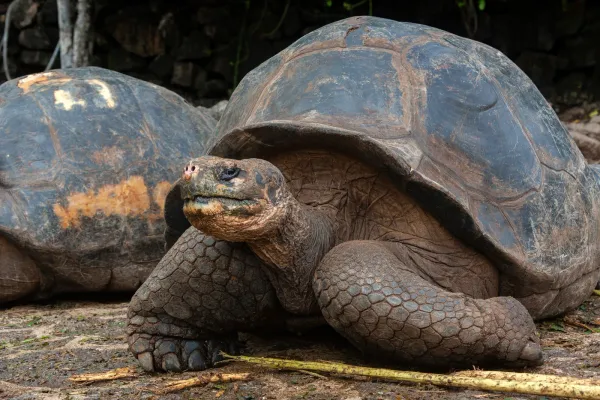
They are enormous — up to 120 centimetres long, up to 300 kilograms in weight. The shell is a dome of bony plates, grey-brown and covered in moss and lichen. The neck is long, wrinkled, with skin like an elephant’s. The eyes are small and dark, with an expression you want to call wise — though perhaps it is simply the calm of a creature that is in no hurry to go anywhere.
Aldabra tortoises live up to 200 years. Some individuals at La Vanille Park are older than any building on the island. Older than the Eiffel Tower. Older than many nations. They remember — if tortoises remember — the days when Mauritius was a French colony. When enslaved people worked the plantations. When the dodo was already gone, but memory of it still lived on in stories.
You can walk right up to them. You can crouch down beside them. You can reach out and stroke a neck — and the tortoise will not flinch or retreat into its shell. It will tilt its head, offering its neck the way a dog offers its ear to be scratched. And it will close its eyes.
This is trust. Trust again. Like the dodo — only with a different ending. Because this time the people nearby are not hungry sailors. They have come to watch. And to protect.
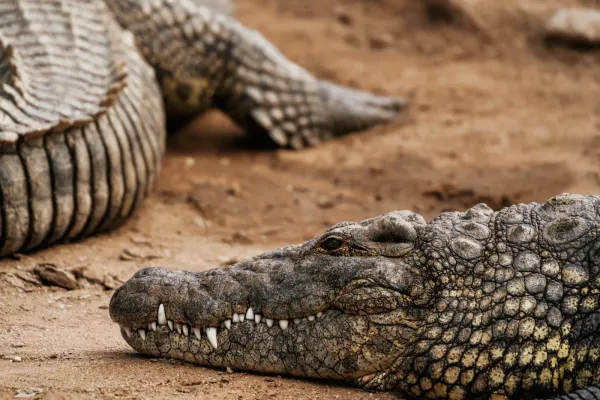
La Vanille Park holds more than tortoises. Nile crocodiles — in pools behind fencing — lie motionless, like logs. A minute. Five. Ten. You begin to wonder whether they are models. Then someone throws a piece of meat, and the water explodes. Two metres of scales, teeth and muscle launch out of the water in a fraction of a second. The jaws snap shut with a crack you can hear thirty metres away. The crocodile is motionless again. As if nothing happened.
Flying foxes — large fruit bats with a wingspan of up to a metre — hang from the trees upside down, wrapped in their own wings like leather cloaks. They sleep by day. At dusk they unfurl their wings and fly off to feed — in dozens, in hundreds, black silhouettes against the sunset. Ring-tailed lemurs — not from Madagascar, but kept in semi-wild conditions — leap through the branches overhead. Iguanas bask on rocks. And an insectarium holds a collection of insects from around the world: giant stick insects thirty centimetres long, Goliath beetles, butterflies with wings the size of a hand.
After the park — the Tea Road. A route that links tea plantations, colonial estates and rum distilleries into a single story — the story of the island, told through what it grows.
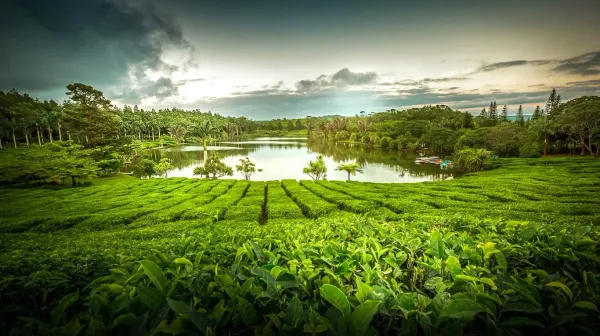
Bois Cheri factory — founded in 1892, the oldest tea factory in Mauritius. Mauritian tea is neither Sri Lankan nor Indian; it has its own character: softer, with notes of the tropical fruits growing around the plantations. The tea bushes cover the hills in waves of deep green — neat rows stretching to the horizon, interspersed with tropical trees. Picking is done by hand, as it was a century ago: women in wide-brimmed hats pluck the top two leaves and a bud — “two leaves and a bud,” the golden standard of quality.
At the factory you see the whole process: withering, rolling, fermentation, drying. The smell is rich, astringent, alive. Not the pale aroma of a teabag — but the real scent of fresh tea, the kind that tickles your nose.
The tasting takes place in a pavilion overlooking the lake and the mountains. Vanilla black, jasmine green, mint, coconut, passion fruit. Each one made from leaves picked on these hills and processed in this factory. You drink tea while looking at the plantation it came from. The distance from bush to cup: one hundred metres.
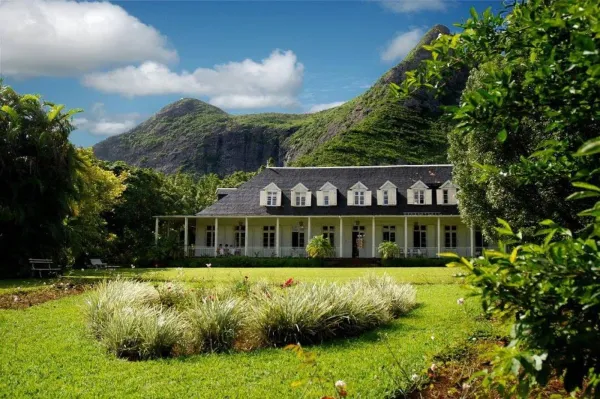
The colonial estate St. Aubin is a white house with columns, a veranda and a view of a garden where anthuriums bloom — red, white, pink, with waxy petals that look plastic (but are real). Vanilla grows here — real vanilla, not synthetic. Ninety-five percent of the world’s “vanilla” is synthetic vanillin, manufactured from wood pulp or petroleum products. Real vanilla is an orchid pod that takes nine months to grow, is pollinated by hand (Mauritius has no insects that pollinate this species of orchid), dried in the sun for weeks and fermented for months. One kilogram of natural vanilla costs up to 600 dollars — more expensive than silver.
The pods lie on wooden frames in the sun, and the air around them smells so good you want to eat it. A rich, sweet, warm fragrance — not the pale “vanilla” scent of shop-bought ice cream, but the real thing: deep, layered, complex.
The sugarcane rum tasting moves from clear, young, sharp spirit that burns the throat, all the way to dark, oak-barrel-aged rum, smooth, with notes of caramel, smoke and spice. Rum has been made in Mauritius since the eighteenth century, when French colonists planted the island with sugarcane from coast to mountain.
Cape Gris Gris — the southernmost point of Mauritius. And the most unexpected. There is no coral reef here: a break in the reef barrier exposes the shore to the full force of the ocean. The waves — enormous, white, furious — pound the black basalt rocks, throwing fountains of spray ten metres into the air. The wind carries salty mist into your face.
This is a different Mauritius. Not the postcard version, not the turquoise, not the languid. Austere. Real. Wild. A reminder that the island is not a resort but a volcano in the middle of an ocean. And the ocean has not forgotten that.
Standing on the edge of Gris Gris, looking out at the endless blue to the south, you understand: Antarctica is 5,000 kilometres from here. And between you — nothing. Only water. Only wind. And somewhere out there, far away — ice.
After the tea, the vanilla and the rum — Cape Gris Gris. The southernmost point of Mauritius. And the most honest. There is no coral reef here — a break in the barrier exposes the shore to the full force of the ocean. Waves strike the black basalt rocks, throwing fountains of white foam ten metres high. The wind is salty, fierce. This is not the Mauritius of the postcards — turquoise, languid, beachy. This is the real one. Volcanic. Wild.
Standing on the edge of the cliff, you look south. Antarctica lies 5,000 kilometres of open water away. Between you and the ice — nothing. Only ocean. Only wind. And somewhere down there, in the darkness — sperm whales. Hunting. Sleeping vertically. Clicking away at their 236 decibels. Living.
By evening — back to the hotel. Sunset. Tomorrow — one last trip out to the sperm whales. And a free day on the beach, which you will spend gazing at the horizon and knowing — knowing for certain — that beneath that turquoise surface, right now, 50 sperm whales with the largest brains on the planet are talking to each other in a language made of clicks.