Take a handful of multicolored sand. Mix it. Pour it back. Wait. The colors will separate again. Red to red, blue to blue, violet to violet. This is not a trick. This is Chamarel.
Mauritius is a volcanic island. It rose from the ocean roughly 8 million years ago — young by geological standards, a contemporary of the human race. Molten magma broke through the ocean floor, built a cone of basalt, and pushed it above the surface. Then the volcano fell silent — the last eruption was about 25,000 years ago. Since then, rain, wind, and time have done their work: basalt turns into clay, clay into soil, soil into tropical forest.
Mauritius is green. Almost entirely. Mountains cloaked in dense tropical forest. Fields of sugarcane. Mangrove thickets along the coast. Flowers blooming year-round — hibiscus, frangipani, bougainvillea. Green everywhere.
Except in one place. In the village of Chamarel, in the southwest of the island, up in the hills, something went differently. Chamarel is one of the excursion days of our Mauritius trip — together with the sperm whales, Casela and the Tea Route.
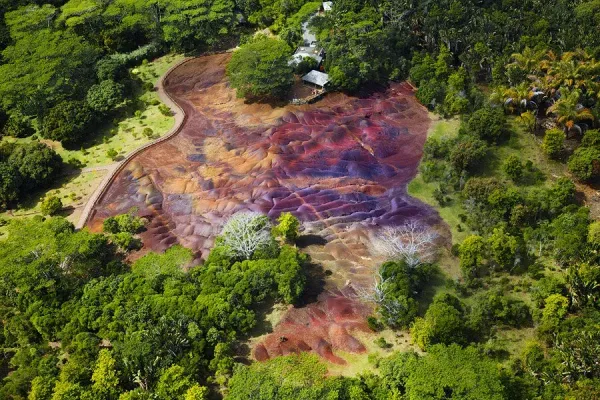
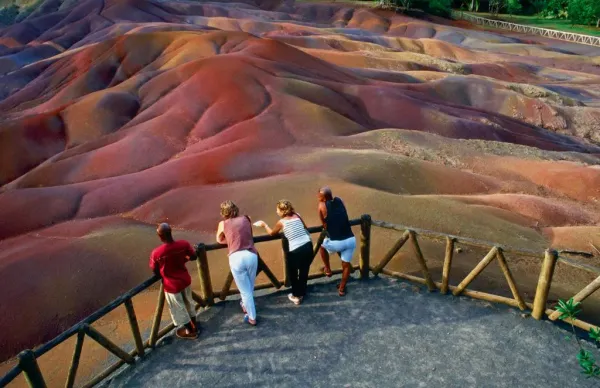
Here the soil is bare. Completely. No grass, no trees, no moss — nothing. Naked earth, rolling dunes shimmering in seven colors. Red, brown, violet, green, blue, purple, yellow. Not paint — no one painted this earth. Not minerals on the surface — not sawdust, not sand. The earth itself is colored. All the way through. Dig down a meter — the same color. This is no stage set. This is geology that decided to become art.
Geologists explain it this way: the basalt here underwent complete hydrolysis — tropical rains, temperature, millions of years. Water worked its way into every molecule of the rock and broke it down into its components. Iron — in abundance — produced the red and anthracite hues. Aluminum — the blue and purple. Manganese — the yellow and brown. Other elements — the green. Seven colors — seven chemical elements locked in the earth like pigments on a palette abandoned by a painter.
But the most inexplicable thing is not the colors. It is the fact that they do not mix. Take a handful of multicolored sand from Chamarel. Swirl it in your palm. Pour it onto the ground. Wait — a day, a week. The colors will separate again. Red will settle toward red. Blue toward blue. Each hue will return to its own layer.
Rain erodes the dunes — the colors stratify back. Wind mixes them — they stratify. Before the fences went up, tourists walked across them, mixing everything — they stratified. As though an invisible sorter works inside the earth, one that never sleeps, never tires, and never makes a mistake.
Scientists believe it comes down to differences in particle density and size: iron-rich particles are heavier and finer, aluminum-rich ones are lighter and coarser. Under the action of rain the heavier particles sink, the lighter ones stay near the surface — and the colors separate. Simple physics. But when you stand before these dunes shimmering like a surrealist painter’s palette, no physics can explain the feeling. The feeling that the earth is alive. That it breathes, moves, plays with color for its own pleasure.
Next to the seven-colored earth is the Chamarel Waterfall. One hundred meters of free fall. Two streams of water plunge down a sheer basalt cliff into a crater surrounded by dense tropical forest. Not the tallest in the world, not the most powerful — but one of the most beautiful, because everything comes together: a narrow canyon, walls of black rock, greenery on every ledge, a mist of spray rising upward and hanging in the air like a cloud. When the sun hits at the right angle — a rainbow. A real one, vivid, suspended right in the water vapor as if painted there.
And at the foot of the waterfall — a rum distillery. Because Mauritius is an island where seven-colored volcanic earth, a hundred-meter waterfall, and a sugarcane rum tasting are all within walking distance of one another. Absurd? No. Mauritius is simply small. 65 by 45 kilometers. Everything is close. From the beach to the volcano — an hour by car. From the volcano to the rum distillery — twenty minutes.
Rhumerie de Chamarel is a small producer where the entire cycle happens on site: cane is pressed, juice is fermented, distilled in copper pot stills, and aged in oak barrels. The tasting covers five varieties: a young white, sharp, smelling of cane; a three-year aged spirit, smoother, with notes of vanilla; a five-year dark rum with caramel; and two specials — infused with local spices. After the third glass the world looks even more colorful. And it was already seven-colored to begin with.
The town of Curepipe — on the road to Chamarel — is the old colonial capital, built at an elevation of 500 meters, where French colonists retreated to escape the malarial mosquitoes of the coast. Narrow streets, colonial houses with wooden verandas, a market selling handmade model sailing ships — Mauritius is famous for this craft: miniature replicas of the Bounty, the Cutty Sark, and the Victory, made by hand down to the last rope.
The whole day is spent on the road, but it never feels tiring. Mauritius is compact. Between each stop — 20 to 30 minutes, and every road passes through tropical forest, along mountain ridges, past waterfalls and plantations. The bus window is like the screen of a documentary film that needs no switching on.
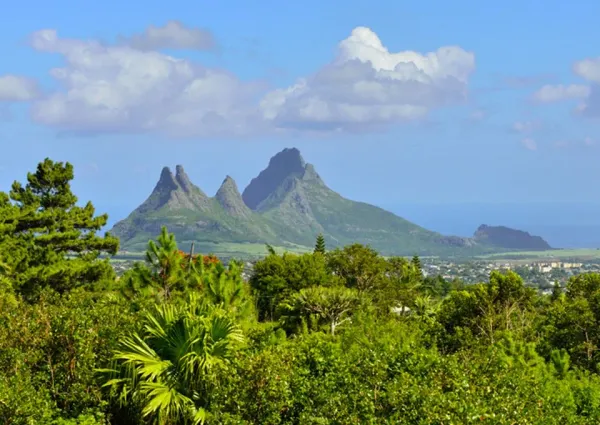
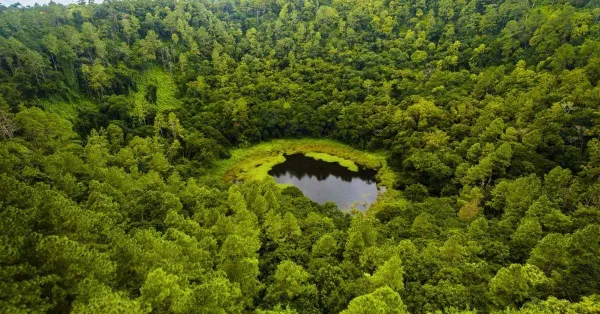
On the road to Chamarel lies the crater of the dormant volcano Trou aux Cerfs. Perfectly round, 300 meters across, 80 meters deep, overgrown with tropical forest right down to the bottom. From the viewing platform — a panorama of the whole island: mountain ranges wrapped in green, the coastline in the distance, clouds snagging on the peaks. Mauritius is not a flat atoll. It is a mountainous island, a former volcano, with an elevation range from sea level to 828 meters (Piton de la Rivière Noire).
The sacred lake Ganga Talao is another stop, and perhaps the most unexpected. A lake in a volcanic crater at 550 meters elevation, surrounded by tropical forest — and Hindu temples. Statues of Shiva and Hanuman stand among ferns and palms. On the shore — a temple complex with multicolored towers adorned with sculptures of deities. Monkeys (the same macaques, descendants of introduced animals — the irony holds) sit on the steps and steal offerings.
Mauritius is a remarkable blend of cultures. 48% of the population are Hindu, descendants of laborers brought from India to work the sugar plantations. 27% are Creole, descendants of African slaves and European colonists. 17% are Muslim. 3% are Chinese. The rest are European, mostly Franco-Mauritians. Hinduism, Islam, Christianity, Buddhism, Confucianism — all on an island measuring 65 by 45 kilometers.
Temples stand next to mosques, mosques next to churches, churches next to pagodas. And no one argues. Mauritius is one of the few countries in the world where national holidays include Diwali, Eid al-Fitr, Christmas, and Chinese New Year. An island that passed through slavery, colonialism, and the extinction of the dodo — and learned to live together. Or perhaps had no other choice: when everyone shares a small island, there is nowhere to take your grievances.
In the evening — back to the hotel. Sunset over the Indian Ocean is different every evening: orange, pink, violet, sometimes all three at once. Mauritius faces the setting sun on its western coast, and this becomes a nightly ritual: a glass on the terrace, bare feet in the sand, and a sky that burns.
But of everything Mauritius offers on land, there is one place that stays with you longest. A place where you have breakfast with a giraffe, then go for a walk with a cheetah.