236 decibels. Louder than a jet engine. Louder than a gunshot. Louder than anything ever created by human hands. And this sound comes from a creature you can see — ten meters from the boat, in the turquoise waters of the Indian Ocean, off the shore of a small island you may have never heard of.
Mauritius. A tiny dot in the middle of the Indian Ocean, 900 kilometers east of Madagascar. An island most people know for two things: postcards of turquoise water and the dodo bird, which went extinct here three centuries ago. But there is a third thing, far fewer people know about.
Sperm whales live off the coast of Mauritius. Not visiting for a season, not migrating through — living. Permanently. Around 50 individuals: females, calves, juveniles. A resident group that chose these waters and never leaves. You can go out to them by boat and swim alongside — how it works, when to go and what it costs is on our Mauritius trips page.
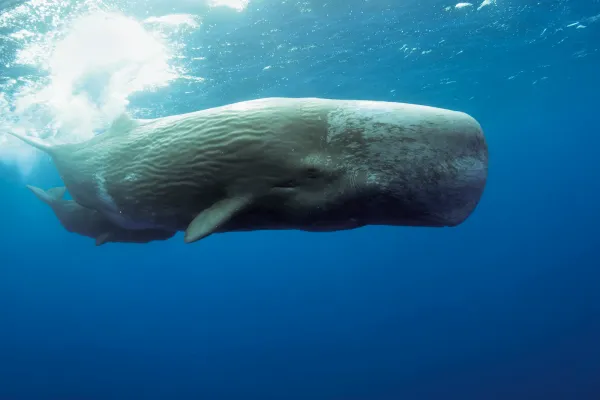
This is rare. Sperm whales are among the most widely distributed mammals on the planet, yet seeing one is like winning the lottery. They spend most of their lives at depths no human will ever reach: diving to 2,000–3,000 meters and staying submerged for up to an hour and a half. They surface for 10–15 minutes — to breathe, to socialize, to rest — then disappear back into the abyss.
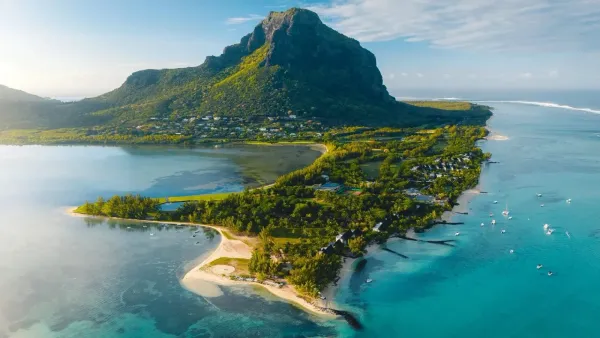
Off Mauritius, an underwater canyon begins just a few kilometers from shore. Picture this: you are standing on the beach, a turquoise lagoon in front of you, shallow water, a coral reef. And beyond the reef — a cliff. The seafloor drops 1,000, 2,000, 3,000 meters. An hour’s boat ride from the beach takes you over depths that would crush a submarine.
That is why the sperm whales are here. Their food — giant squid and deep-sea fish — lives in this canyon. No need to swim hundreds of miles into open ocean as they would elsewhere. Their hunting grounds are right at hand. And at the surface: warm tropical water, no storms (Mauritius is sheltered from the main ocean currents), and calm. A perfect place to live, raise calves, and hunt — without ever migrating.
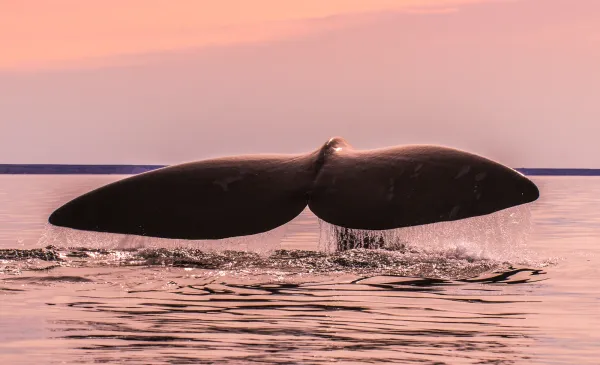
Very few places in the world have resident sperm whale groups. The Azores, Dominica, Mauritius — that is essentially the complete list of places where sperm whales do not simply pass through but stay. Living for years, decades. Giving birth. Growing old. Dying — right here, in these same waters. Scientists know some of the Mauritian sperm whales individually — by the shape of their flukes, by scars, by distinctive markings on their skin.
The sperm whale is the largest toothed animal on Earth. Males reach 20 meters in length and 50 tons in weight — that is the length of two buses end to end. The head takes up a third of the body — disproportionately enormous, as if someone made an error in the design. But there was no error.
Inside that head are two organs that make the sperm whale unique.
The first is the brain. The largest brain on Earth: up to 9 kilograms. The human brain weighs 1.4 kg. An elephant’s — 5 kg. A sperm whale’s — 9. What does it do with a brain like that? Why does a creature that hunts squid in the dark need a brain six times heavier than ours? Scientists have yet to find a definitive answer. But one hypothesis points to social life. Sperm whales live in complex matriarchal groups, where females and calves stay together for decades. They communicate through clicks — sequences unique to each family. Every group has its own “dialect.” Perhaps the brain is needed to remember — who is kin, who is a stranger, who is a friend, who is a rival. Social memory spanning a 70-year life.
The second organ is spermaceti. A waxy substance filling an enormous cavity in the head — up to three tons in a single whale. It was precisely because of this substance that sperm whales were hunted for centuries. Spermaceti candles burned brighter and cleaner than any other — with a steady white flame, no soot. Spermaceti oil was used in clockwork mechanisms, in the space industry (NASA purchased it through the 1970s), and in cosmetics manufacturing. One sperm whale — thousands of dollars. By the mid-20th century the population had declined by 70%.
The ban on commercial whaling in 1986 saved the species. Sperm whales are recovering — slowly, because a female gives birth to one calf every 4–6 years and each calf nurses for up to two years. But they are recovering.
Why does a sperm whale need spermaceti? Scientists still debate this. One hypothesis: an acoustic lens. Spermaceti focuses sound, turning a click into a directed beam. 236 decibels — louder than a rifle shot, louder than a rock concert, louder than a fighter jet taking off. The most powerful sound in the animal kingdom. With this beam the sperm whale “scans” the space around it — for distances of several kilometers, in absolute darkness, at depths where not a single photon of light penetrates. Another hypothesis: spermaceti regulates buoyancy — it hardens and becomes denser as it cools, helping the whale dive.
And one more detail that sends a chill down your spine: sperm whales sleep vertically. They drift in the water in groups of 5–8 individuals — heads up, tails down, motionless, like living pillars. Eyes closed. Breathing slowed. Ten to fifteen minutes of absolute stillness. Researchers first documented this in 2008 — and could not believe what their cameras had captured. A group of sperm whales suspended in the water column, like sculptures in weightlessness.
You leave Mauritius harbor by boat at dawn. One hour and you are over the canyon. The boat is equipped with a hydrophone — an underwater microphone. The captain lowers it into the water, and in the headphones — clicks. Tuk-tuk-tuk-tuk. Fast, rhythmic, like Morse code. That is a sperm whale, somewhere below, in the dark, a kilometer down, hunting. Scanning the space around it with a sound beam more powerful than any instrument ever built by human hands.
Then the clicks stop. Silence. The captain raises his hand — we wait. One minute. Two. Everyone on the boat stares at the water, scanning the horizon.
And then — far off, two hundred meters away — the surface of the water bulges. First — a cloud of vapor, expelled at a 45-degree angle to the left (the sperm whale’s blowhole is offset — its spout is always asymmetrical, which distinguishes it from every other whale). Then — the back. A vast gray back with wrinkled skin covered in scars from the suckers of giant squid — round marks 3–5 centimeters in diameter, traces of battles in pitch darkness two kilometers down.
The sperm whale surfaces slowly, lazily, like a submarine. It breathes. One series of breaths — 40–50 times over 10 minutes — and its lungs are full of oxygen again. For 10–15 minutes it will be at the surface. Ten to fifteen minutes to observe a creature with the largest brain on the planet, with skin covered in the marks of deep-sea battles, with eyes — small, dark, attentive — looking at you from beneath the wave.
Sometimes a sperm whale approaches the boat. Not always — it depends on mood, on weather, on dozens of factors we do not understand. But when it does — everyone goes still. A twenty-meter creature ten meters away. Its head the size of a minibus. You can see its skin, its eye, its blowhole. You hear the exhale — powerful, like a steam whistle. And you catch the smell — fishy, salty, ancient.
And one more thing. Sperm whales are social animals. Females and calves live in groups of 10–15 individuals — clans. Within the clan there is mutual support: when a mother dives for squid for an hour or more, other females watch over her calf. “Aunts,” “grandmothers” — a real family. Males leave the clan in adolescence and roam the ocean alone, returning to females only to breed. Then — back to solitude.
Among the Mauritian sperm whales, scientists have identified several clans. Each with its own set of clicks, its own “voice.” When you hear in the hydrophone the sequence tuk-tuk-tuk-pause-tuk — that is not random noise. That is someone in the clan saying: “I am here. I am hunting. All is well.”
Three trips out to the sperm whales during the journey. Three mornings on the ocean. Encounters are practically guaranteed — because these 50 whales go nowhere. They are here. Always. With their clans, their calves, their songs made of clicks.
But Mauritius is not only sperm whales. It is an island with a wound. An island that once killed the most trusting creature on Earth. A bird that could not fly and felt no fear of people. A bird whose name became synonymous with extinction.