180 kilometres from the nearest shore. 300 metres of water beneath the keel. At 30 metres — a sheer wall of Daedalus reef, encrusted with gorgonians and soft corals. Beach divers will never reach this place.
In 1954, underwater photographer Stan Waterman bought a decommissioned lobster boat in the Bahamas. He paid $45,000 — the price of a decent house at the time. He installed a compressor, packed the hold with tanks, and hung up bunks. This was the world’s first liveaboard — a floating dive centre where you could live for weeks.
The idea was embarrassingly simple: the best reefs are far from shore. A day boat can’t reach them. So you need to live at sea. Schedules and prices for more than 120 liveaboards are in our dive safari catalog.
The lobster boat that changed diving
Waterman wasn’t a businessman. He was obsessed — shooting underwater film when underwater film didn’t yet exist as a genre. His boat looked absurd: a former fishing vessel converted into a floating hostel for divers. But it offered something no shore-based dive centre could: time. A week on the water. Dive after dive. Reefs that no diver had seen before him.
Eighteen years later, naturalist Paul Humann launched M/V Cayman Diver — the first commercial dive yacht running a regular schedule. Then, in 1984, Aggressor Fleet appeared — the first network of safari vessels. Today they operate in over thirty countries.
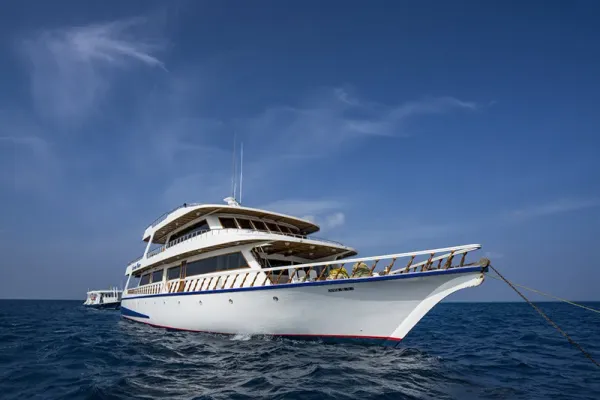
In seventy years the industry went from a lobster boat to steel yachts with air-conditioned cabins, nitrox in the tanks, and a sundeck on the upper deck. But Waterman’s formula hasn’t changed one bit: live at sea — dive on reefs that others can’t reach.
Why the shore loses
Shore diving means two dives a day. In the morning you assemble your gear, wait for the boat, head to the nearest reef. An hour underwater, an hour back. In the afternoon — once more. In the evening — disassemble, rinse, dry. Next day — start over.
Liveaboard diving works differently.
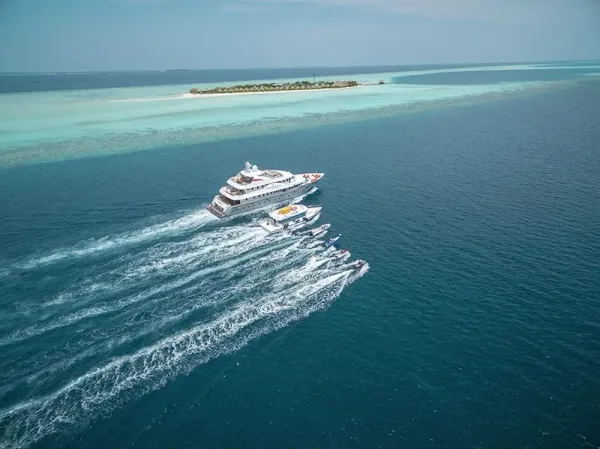
You assemble your gear once — on the dive deck — and it stays there until the last day. The yacht moves to the next spot overnight. When you wake up — there’s a new reef beneath you. No transfers, no commuting between hotel and pier and boat and pier and hotel. Three to five dives a day instead of two. In a week that adds up to twenty to twenty-seven dives. From the shore in the same week — eight to ten.
But it’s not about the numbers. It’s about where.
Daedalus reef sits in the open sea, 180 kilometres from the Egyptian coast. Rocky Island and Zabargad are even further south. Darwin’s Arch in the Galápagos is a 36-hour sail from the nearest port. Cocos Island lies 500 kilometres off Costa Rica, and the dive permit costs $500.
Day boats don’t go there. A safari is the only way to dive these reefs.
Six a.m., dive deck
The generator hums. Down the corridor drifts the smell of coffee — strong, dark, the kind they only brew on ships in the tropics. On the dive deck, towels are already laid out, tanks stand in their racks — silver twelve-litre cylinders, some with a green nitrox stripe.
Seven a.m. Briefing. The dive guide draws the reef profile on the whiteboard with a marker: here’s the wall, here’s a plateau at thirty metres, here’s the entry point. Current from the south. Hammerhead sharks patrol the wall at the edge of the blue. Don’t chase them — they’ll approach on their own if the group hangs motionless.
Seven thirty. Giant stride from the stern. A second of free fall, the slap of water, a column of bubbles — then silence. BCD deflated, weights pulling you down, ears equalising every two metres. A wall emerges from the blue — first the outline, then the colour: russet gorgonians, purple soft corals, yellow sponges. And a school of barracuda, standing in the current like a silver wall.
By ten — back on board. A warm shower on deck, breakfast: omelette, fruit, toast, more coffee. An hour and a half of surface interval. Some review photos on the camera monitor, some sleep in a deckchair on the upper deck, some write in their logbook — depth, time, temperature, what they saw.
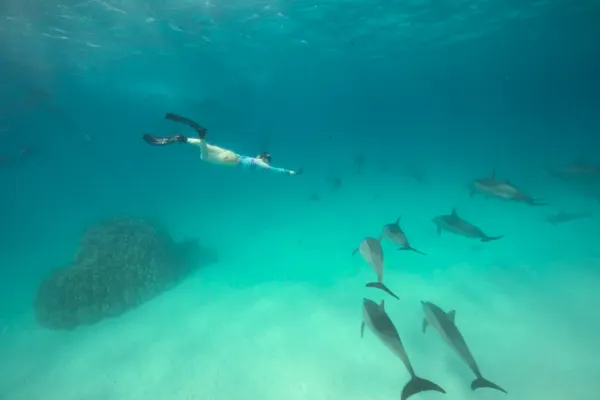
Second dive. Third. And in the evening — a night dive. A different story entirely. The torch cuts a cone of light from the darkness, and inside that cone is a completely different world. Reef octopuses hunting, changing colour every second. Moray eels out of their holes. Spanish dancers — nudibranchs the size of a palm, crimson with a white fringe — dancing in the beam, living up to their name.
Between dives — a dry law. Alcohol only in the evening, after the last dive. Nitrogen in the blood and a glass of wine — a combination that physics doesn’t forgive.
Where yachts go
A dive safari makes no sense where the reef is a hundred metres from the beach. Safaris are for places that day boats can’t reach.
Red Sea, Egypt. The genre classic. The yacht departs from Port Ghalib and in a week covers the legendary route: Daedalus with its sheer walls and hammerhead sharks, the mountainous island of Zabargad with its lagoon and shipwrecks, the jagged Rocky Island. On the way back — Sha’ab Sataya, a lagoon where pods of hundreds of dolphins live year-round. Eight days, three to four dives a day, nitrox included. From €1,760.
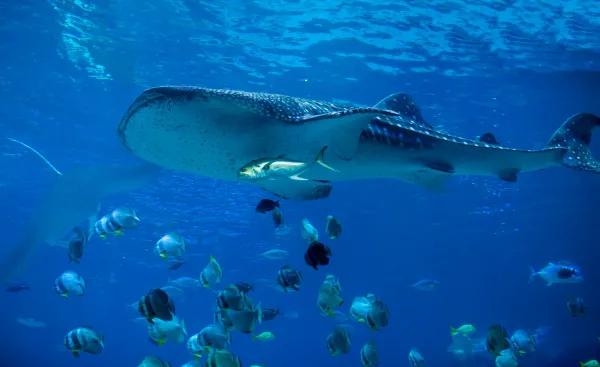
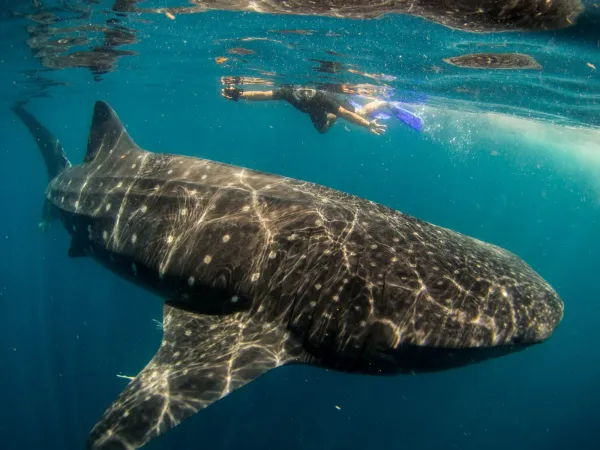
Maldives. Eleven nights on a yacht, 27 dives across the Ari, Felidhu, and Malé atolls. The channels between atolls are underwater highways where reef sharks, mantas with a four-metre wingspan, and whale sharks — the largest fish on the planet cruise past. One evening — a barbecue on the beach of an uninhabited island: white sand, palm trees, a 360-degree horizon. From $3,850.
Galápagos. Wolf Island and Darwin’s Arch — two dive sites at the edge of the world. Getting there means flying via Quito, then via Baltra, then 36 hours on a yacht. But at depth — schools of hammerhead sharks so dense you won’t see anything like it anywhere else on the planet. People pay $7,395 and ten days of their life for this, counting the flights. And they come back.
Cocos Island, Costa Rica. 500 kilometres from the mainland. Permit — $500 per person. Twelve days in the ocean. Hammerheads, mantas, whale sharks — and nobody but your group in the entire area. Cocos isn’t a trip. It’s a pilgrimage.
Who it’s for
A dive safari isn’t an option for your first dive. The minimum is an Open Water Diver certificate and twenty to thirty dives in your logbook. On advanced routes like Daedalus or Darwin’s Arch — strong currents, depths to forty metres, drift dives in blue water with no visual reference. Here you need Advanced Open Water and confident buoyancy control.
Groups on yachts are twelve to twenty people. These aren’t random hotel neighbours. A week together on a ship. Three times a day underwater. By the third day — a team.
How much it costs
A dive safari isn’t a beach holiday. But the price includes almost everything: a cabin on the yacht, three meals a day, soft drinks, all dives (including night dives), tanks, weights, nitrox, dive guide services.
| Destination | Days | Price |
|---|---|---|
| Egypt, Red Sea | 8 | from €1,760 |
| Maldives | 13 | from $3,850 |
| Galápagos | 8 | from $7,100 |
| Cocos, Costa Rica | 12 | from $7,860 |
Additional: flights, visa, personal gear rental, crew tips.
Twenty-seven dives in the Maldives over thirteen days — $142 per dive, including your cabin and meals. A single boat dive at a tropical resort — $80–100. Without accommodation. Without food. The arithmetic favours the yacht.
If it’s your first time
Start with the Red Sea. A short flight from Moscow, straightforward logistics, comfortable conditions at most sites. Eight days is enough to know whether this format is for you.
And then — the Maldives. Or the Galápagos. Or Cocos — five hundred kilometres from the mainland, twelve days in the ocean, and not a single other ship on the horizon.
The very reef that Stan Waterman converted a lobster boat for, seventy years ago.