A grapevine. A black lava wall. An Atlantic wind that tears apart anything left unshielded. And — wine. Wine that was once served at the court of the Russian tsar.
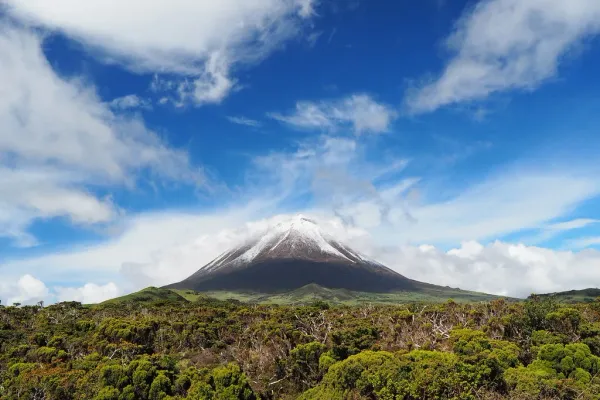
Pico Island is a volcanic cone jutting out of the ocean. Mount Pico — 2,351 metres, the highest point in Portugal. It is visible from neighbouring islands dozens of miles away — a black cone, often wrapped in clouds like a deity in a turban.
But the greatest wonder of Pico is not at the top. It is below. On the coast. On narrow strips of lava land between the mountain and the ocean.
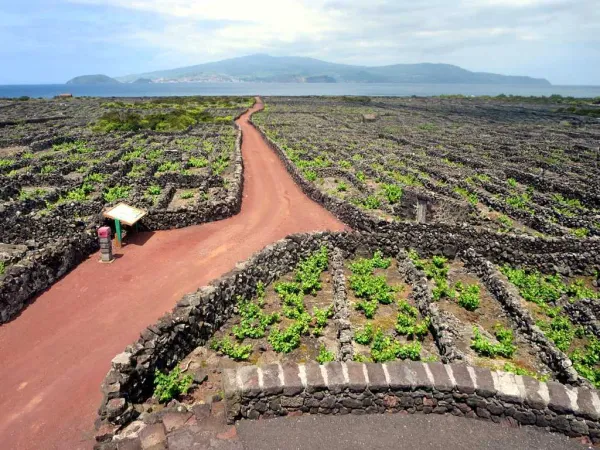
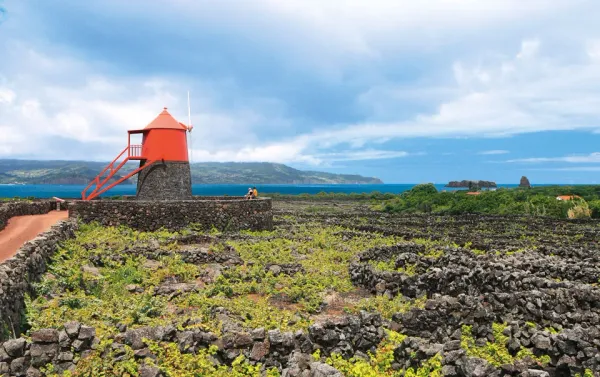
The vineyards of Pico are a UNESCO World Heritage Site. Not because the grapes are extraordinary — though they are. But because the way they are grown has no parallel on the planet. Lava walls — currais — small stone enclosures of black basalt, half a metre to a metre high, laid without mortar, stone upon stone. They protect the vines from the Atlantic wind, which would otherwise kill every shoot within a day. Thousands, tens of thousands of these enclosures cover the coastline — a black geometric grid against the backdrop of the blue ocean.
Pico wine has its own history. In the 18th and 19th centuries it was exported across Europe — and, so the story goes, supplied to the court of the Russian tsar. The volcanic soil — mineral-rich, lean, well-drained — gives the wine its character: mineral, with hints of salt and stone. The vineyards look like a work of land art: black walls, green vines, blue ocean. Beautiful enough that UNESCO added them to the list without a second thought.
A mountain road runs along the coast to the village of Lajes — the former capital of the whaling industry on Pico. The village is small and quiet, with stone houses and a church. And with a museum that tells a story that tightens the throat.
The Whaling Museum. Harpoons — rusty, heavy, with wooden handles polished by thousands of hands. Boats — open, wooden, for six oarsmen and a harpooner at the bow. In these boats — without engines, on oars — men went out into the Atlantic and hunted sperm whales. By hand. With a harpoon. In the open ocean. This was not adventure — it was work. Hard, mortally dangerous, poorly paid.
And — scrimshaw. Engravings on the teeth and bones of sperm whales, made by whalers during the long months at sea. Extraordinarily fine work: portraits of wives, ships in storms, nautical charts, biblical scenes — carved into bone with a fine needle, filled with ink or soot. The art of men who killed whales for a living — and in the pauses between killings created beauty from remains.
The last sperm whale in the Azores was killed in 1987. The name of the last whaler is known, but it is not spoken. Not out of respect — out of shame. Or out of something more complex: the understanding that he was not a bad man. He was a man doing his job — as his father had, as his grandfather had, as his great-grandfather had. And one day the job — ended. Not because the whales ran out. But because the world changed.
Since then — only watching. Only cameras. Only respect. The lookout towers from which men cried “Baleia!” and ran for the harpoon now serve whale watching. The same towers. The same cliffs. The same eyes — often literally: vigías — former whalers or their sons. The man who in 1985 pointed out the direction for a boat carrying a harpooner — in 2026 points out the direction for a boat carrying tourists. The same gesture. The same cry. A different meaning.
The harpoons — in the museum. The boats — on dry land. The scrimshaw — behind glass. The sperm whales — safe. And the descendants of whalers earn their living by showing tourists the very whales their grandfathers used to kill. This is not irony. This is transformation. The most beautiful transformation a person can make: turning killing into protection. A harpoon into binoculars. The hunter’s shout into the observer’s whisper.
The Gruta das Torres lava tube is another wonder of Pico. Over five kilometres of tunnel carved by a lava flow thousands of years ago. The lava flowed inside — like a river in its bed. When the eruption stopped, the lava drained away, and the tunnel remained. Four hundred and fifty metres are open to visitors: darkness, dripping water, stalactites of solidified lava, bats.
Aldeia da Fonte hotel — six cottages of black basalt on cliffs above the ocean. Traditional Azorean style, but with modern comfort. From the window — the Atlantic. In the morning — dolphins pass by. In the evening — a sunset that is different every day, because the clouds over the Azores never repeat themselves.
At dawn — if you get up early and step onto the terrace with a coffee — you can see the summit of Pico. 2,351 metres. The highest point in Portugal. It is almost always in the clouds — like a shy giant hiding its face. But on rare clear mornings it opens up entirely: a black cone, sharp as a pencil, against a pink sky. They say that seeing the summit of Pico without clouds brings good luck. Like seeing a mako shark off Faial.
Pico is an island where land and water, fire and ice, life and death are woven together so tightly you cannot tell them apart. Wine grows among lava. Whalers became guides. The volcano that destroyed — became a home. The teeth of the sperm whales that were killed — became works of art.
And across the strait — the third island. São Miguel. The largest. The greenest. With craters that became lakes. With ground that cooks your lunch. With the only tea plantation in Europe. And with pineapples in greenhouses.