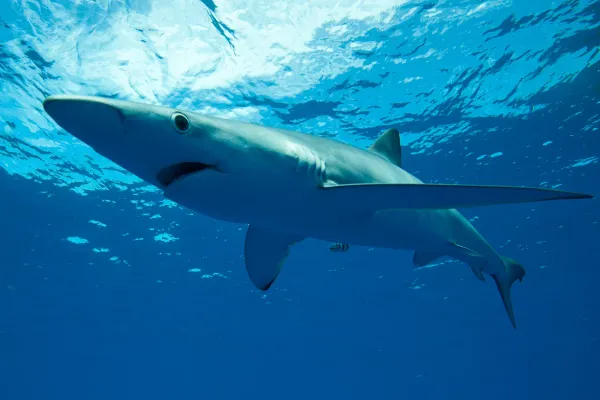
It emerges from the blue. Long, slender, with pectoral fins like glider wings. Its back is a vivid electric blue, bright as neon. Its belly is snow-white. Its eye is huge, black, and watchful. A blue shark. And it is heading straight for you.
Diving with sharks in the Azores is not a cage, not watching from a boat, not a video on a screen. You are in the water. The shark is in the water. Between you — nothing.
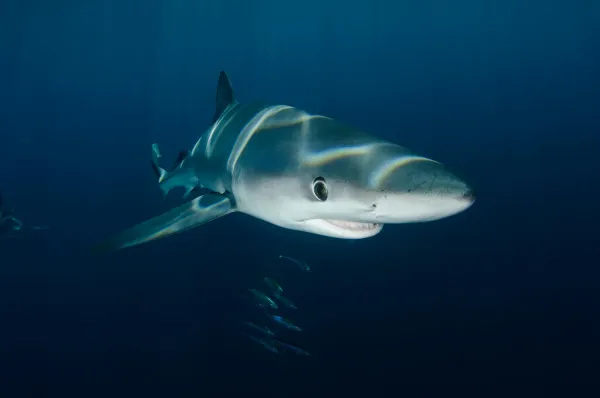
The blue shark — Prionace glauca — is one of the most beautiful fish in the ocean. Length: 2–3 metres (large females up to 4). The body is elongated and streamlined, like the hull of a submarine. The back is indigo, brighter than any sapphire. The pectoral fins are disproportionately long, like the wings of an albatross. It moves slowly, gracefully, swaying from side to side — and yet it is one of the fastest sharks in the ocean: up to 40 km/h in an attack.
Azores dive centres use chum — a fish “cocktail” (a mixture of sardines and mackerel) in a perforated container that slowly releases scent into the water. The scent trail drifts with the current for kilometres, and the sharks follow it like a thread — straight to the source.
You hang on a line tied to the boat, at a depth of 5–10 metres. In the open ocean. No bottom — a kilometre of water beneath you, perhaps two. The blue fades downward and disappears into darkness. The boat is above, its hull rocking on the waves. Beside you is a guide who has done this hundreds of times and knows exactly how to behave. His rule number one: don’t rush. Sharks react to sudden movements. Hang still. Breathe evenly. Wait.
And then — there it is. Out of the blue, slow as a shadow. A blue shark. It comes closer than you expected — within arm’s reach. Its eye — large, round, with a third eyelid (the nictitating membrane that protects it during an attack) — looks at you. Not with hostility. Not with hunger. With curiosity. It passes by. Turns. Passes again. Closer.
You freeze. Not because you’re frightened (though — a little). But because it is beautiful. A blue shark in the water is not a photograph in a magazine. It is movement. Fluidity. Grace. Every turn is like slow motion. Every sweep of the tail is economical, precise. Not a single wasted motion. Four hundred million years of evolution — and the result is perfect.
Nearby are pilot fish: small striped fish that accompany the shark like an honour guard. They feed on scraps from its meals and parasites on its skin. In return — protection: nothing in the ocean will touch a fish swimming alongside a shark. A symbiosis tested by millions of years. Pilot fish never leave their shark — they are born, live, and die beside it.
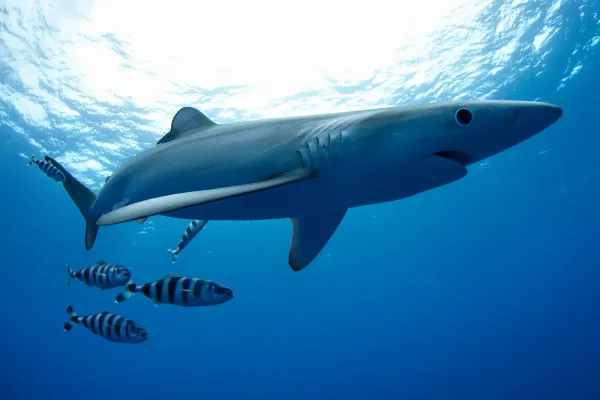
Sometimes a mako shark appears — Isurus oxyrinchus. The fastest shark in the ocean: up to 70 km/h, faster than any boat in the marina. The mako is larger, more powerful, with teeth that protrude like a dragon’s. It doesn’t linger — it appears from nowhere, circles once, assesses, and leaves. Seeing a mako is lucky. Photographing one is doubly so. It’s too fast.
Blue sharks are pelagic: they live in the open ocean, not at reefs, not near shores. They migrate across the entire Atlantic — from Europe to the Americas and back, up to 9,000 kilometres a year. The Azores are their waypoint, just as they are for sailors, for whales, for Prince Albert. A crossroads in the middle of the ocean — for everyone who travels through.
But — a sobering detail: up to 20 million blue sharks die each year in fishing nets as bycatch. No one hunts them — they are caught by accident. To see a blue shark alive, in the water, a metre away from you, is a privilege. And a reminder: the Azorean whalers nearly wiped out the sperm whales — but they were saved in time. Will we manage the same with sharks?
Blue sharks pose no danger to humans. Throughout recorded history there have been isolated cases of bites, and those were provoked (fishermen who entangled a shark in a net). In the water, at a chum site, with an experienced guide — the risk approaches zero. But the adrenaline — reaches its maximum. Because it is one thing to know that a shark is not dangerous. It is another to believe it when two metres of blue muscle with teeth passes half a metre from your mask.
After the dive — three hours back on the boat. Salt spray, wind in your face, sun drying out your wet wetsuit. And a feeling that words cannot describe: just now — in the water — face to face with a shark. No cage. No glass. No barrier. And it did not attack. Didn’t even try. It looked. Turned. Disappeared into the blue. As if to say: “You don’t interest me. But you may stay.”
In the evening — dinner in Horta. Fresh fish, Azorean cheese, local wine. Conversation around the table: who saw the mako, who didn’t, who managed to get a photo, whose camera fogged up with excitement. The diver’s brotherhood — instant, strong, built on a shared experience that cannot be explained to anyone who wasn’t there alongside you.
And then — the ferry. 30 minutes across the strait, with a view of the volcanic cone of Pico, which is often hidden by clouds, but sometimes opens up entirely — from base to summit, black and majestic, like a deity.