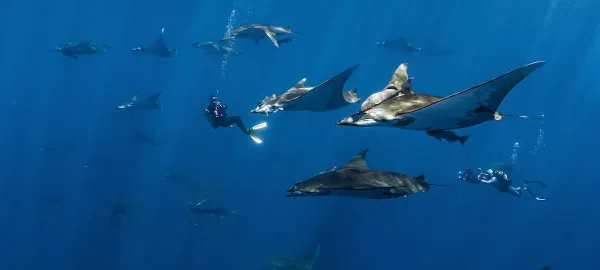
45 miles from shore. Three hours by boat in the open ocean. A kilometer of water beneath you. Then the bottom suddenly rises — and you hang suspended at 35 meters, on the summit of a seamount, surrounded by a carousel of hundreds of rays.
Princess Alice Bank. One of the finest dive sites in the North Atlantic — and one of the most difficult to reach. A seamount whose peak rises from depths of 1,000+ meters to just 35 meters below the surface. In the middle of the ocean. Without a single landmark on the horizon.
The bank is named after the yacht Princess Alice, which belonged to Prince Albert I of Monaco. Not the Albert who rules today (his great-grandson). The one who, in the late 19th century, abandoned the palace ballrooms and went to sea. While Azorean whalers hunted sperm whales with harpoons, Albert studied them with a notebook. He founded the Oceanographic Museum of Monaco (later directed by Cousteau), mapped the floor of the Atlantic, and described dozens of marine species. His yacht discovered this seamount in 1896 — a sounding line revealed a sudden rise from a thousand meters to thirty-five. Albert dropped anchor and began his research. The whalers sailed past — they had no use for the bank: sperm whales hunt deeper. Albert stayed. A legend ever since.
Three hours by boat in the open Atlantic Ocean. Three hours without land on the horizon. Only water — endless, blue, with long ocean swells that lift the boat and drop it, lift and drop. The GPS shows coordinates — 37°N, 29°W — a point in the middle of nowhere. Then the captain says “here,” cuts the engine, and you descend down the line into the water.
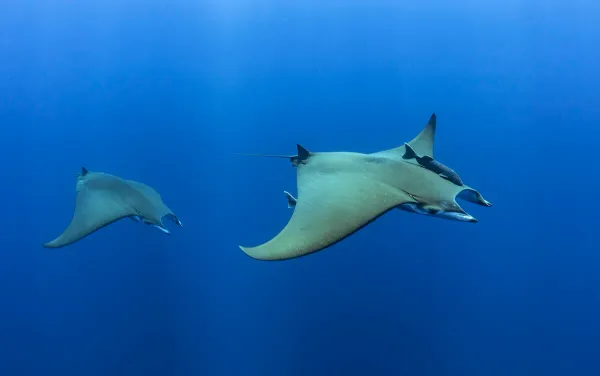
Mobulas — giant rays of the species Mobula tarapacana. Wingspan up to 3–4 meters. Dark back and bright yellow belly — a unique coloration found in no other ray in the world. They come here in summer — in dozens, sometimes hundreds — and circle above the summit of the bank like a carousel. Slowly, rhythmically, endlessly. Why do they circle? One theory: they use the current rising along the slopes of the seamount to conserve energy. Another: this is a cleaning station — cleaner fish at the summit pick parasites from the rays’ skin.
You descend along the anchor line — 35 meters. The water is blue, clear, bottomless (the bottom is a kilometer below). At the summit of the bank — rocks covered in algae and mollusks. And rays. They pass above you, beside you, below you. Silently, gracefully, wings spread wide. Shadows glide across the rocks. Sunbeams pierce the water and light up the yellow bellies like lanterns.
Beyond the mobulas — barracuda. Schools of hundreds, spiraling into familiar tornados (like Sipadan, but in the Atlantic). Tuna — heavy, muscular, shooting past like torpedoes. Jacks. And — in the depths, at the edge of visibility — occasionally the silhouettes of large sharks.
Diving at Princess Alice is for advanced divers. The depth, the current, three hours by boat in the open ocean, no shore nearby. But for the carousel of hundreds of mobulas — everyone who has dived here says the same thing: it was worth it.
Diving in the Azores, though, is not just Princess Alice. The coastlines of Faial and Pico offer volcanic underwater landscapes found nowhere in the tropics. Black basalt arches, fissures, shafts, caves — a grand architecture built by eruptions. Gardens of black coral — soft, branching, growing in the dark. Octopuses — large, curious, changing color before your eyes. Grouper the size of a suitcase, swimming up to the camera and posing.
Water temperatures reach 20–22°C in summer. Not tropical — but after the Red Sea and Sipadan, it’s refreshing. A 5mm wetsuit, gloves, hood — and you’re comfortable. Visibility 20–30 meters, sometimes more. The light is different: not blindingly tropical, but soft, blue, diffused, like a photography studio with softboxes. Atlantic light is theatrical. It doesn’t reveal everything at once the way the tropics do. It opens gradually, layer by layer, like a curtain lifting.
The coastlines of Faial and Pico offer a different kind of diving. Not open ocean, but volcanic reefs. Black basalt, frozen in the forms lava invented: arches as tall as a two-story building, fissures that resemble canyons, shafts and caves with openings at the top through which light pours. Beneath every rock — an octopus. On every ledge — a grouper. Gardens of black coral — not actually black in appearance (it looks greenish), but with a black skeleton — hang from the walls like the needles of underwater firs.
Grey triggerfish — large, with powerful teeth — swim up and study you with an expression that says “so what?” Moray eels peer from crevices. Schools of silver fish race overhead. And — if you’re lucky — a manta. A giant ray with a 4–5 meter wingspan, gliding through the current like the shadow of a plane.
And the next day — another encounter. In the open ocean. No reef. No bottom. Just you — and the most beautiful shark in the Atlantic.