The lookout stands on a cliff. Binoculars pressed to his eyes. He watches the ocean — one hour, two, three. Once he would cry out “Baleia!” — “Whale!” — and men would run to the boats with harpoons. Now he calls the captain, and a boat carrying cameras heads out toward the sperm whale.
23 species of cetaceans in the waters of the Azores. Twenty-three. Sperm whales — a resident population, living here year-round. Blue whales — the largest creatures ever to have lived on Earth, up to 30 meters and 170 tons — pass through in spring on their way to Arctic feeding grounds. Humpbacks — with their songs audible dozens of kilometers away. Striped dolphins — in pods of hundreds, leaping from the water in unison like acrobats. Cuvier’s beaked whales — deep divers, descending to 3,000 meters. Orcas — rare, but they do appear.
Why here? The Azores sit atop the Mid-Atlantic Ridge — an underwater mountain range stretching across the entire Atlantic Ocean from north to south, like the seam on a baseball. This is the boundary between tectonic plates — a place where the earth’s crust pulls apart and magma rises from the depths. Underwater mountains, banks, canyons — a topography that creates currents drawing nutrients up from the deep to the surface. Plankton blooms. Fish arrive. Whales follow the fish. The entire food chain — from microscopic algae to the blue whale — operates here at full capacity.
Whale watching in the Azores is not a harbor cruise on a catamaran with a buffet. It is an expedition. A fast Zodiac inflatable, 10–12 people, a captain, a biologist-guide. Heading out into the open ocean. Waves. Wind. Salt spray in your face.
And — a system that exists nowhere else in the world. The vigía — the lookout. He sits in a stone watchtower on top of a cliff, with a powerful fixed-mount telescope, scanning the horizon. For hours. Patiently. Searching for spouts — columns of vapor blasted out by whales when they exhale, visible for kilometers. When he finds one, he radios the coordinates to the boat captain. The vigía system is a legacy of the whaling era — only back then, the spout drew longboats with harpoons; now it draws boats with cameras.
The boat races toward the coordinates. Ten minutes, fifteen. The ocean — blue, boundless, without landmarks. The waves — Atlantic, long, powerful, nothing like the Mediterranean. The boat crests a wave and drops into the trough. Spray in your face. Wind in your ears. Adrenaline — before you’ve even spotted the whale.
The biologist-guide explains: “Watch the horizon. Look for vapor. A sperm whale’s spout is low and angled to the left. A humpback’s is vertical, powerful. You’ll see dolphins by their leaps.” All ten people on the boat — binoculars pressed to eyes, the horizon swept like a radar sweep.
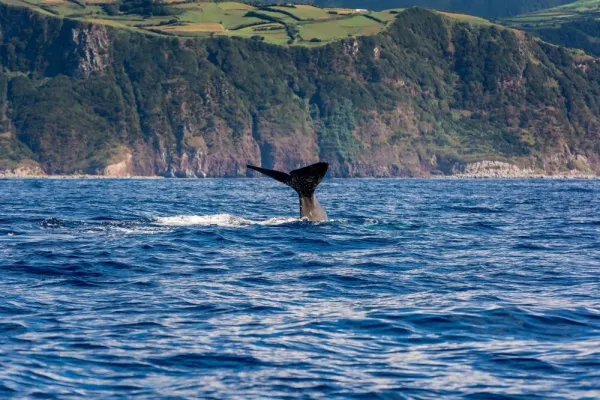
And then — a spout. Asymmetrical, angled 45 degrees to the left. A sperm whale. The gray back surfaces slowly, like a submarine. Wrinkled skin, covered in scars. The animal breathes — a series of powerful exhalations visible for kilometers. Then — the tail. The sperm whale raises its tail straight up, showing it whole — and descends into the deep. For 40 minutes, an hour. To hunt.
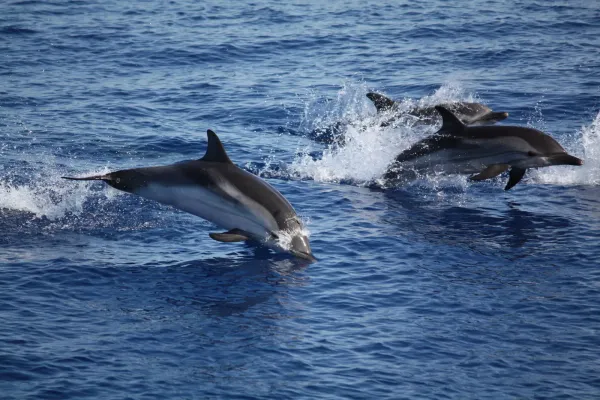
Dolphins are a different world. A different character. A different energy. If the sperm whale is an organ mass, the dolphins are jazz. Chaos and joy. Improvisation.
A pod of fifty, a hundred, sometimes two hundred striped dolphins charges toward the boat — and a show begins that no director could stage. They leap one meter, two meters out of the water. They spin in the air — a full rotation around their axis, like circus acrobats, only without a safety net and without rehearsals. They dive under the boat and surface on the other side — so fast you cannot cross from one rail to the other in time. They ride the bow wave — a free ride, using the pressure from the boat’s movement — and look up at you with an expression of pure, unclouded delight. Calves leap alongside their mothers, mimicking them but with twice the enthusiasm.
And sometimes — if you are very lucky — something enormous appears on the horizon. A back longer than the boat. A spout nine meters tall — vertical, powerful, like a column of steam from a pipe. A blue whale. The largest animal ever to have lived on this planet — larger than any dinosaur, larger than any other whale. 30 meters. 170 tons. A heart the size of a car.
Seeing a blue whale is not a guarantee. It is a gift from the ocean. They pass by the Azores in spring — on their way to Arctic pastures. August is late, but it does happen. And when the vigía — a former whaler, whose voice trembles over the radio not from a hunter’s excitement but from sheer wonder — spots a vertical nine-meter spout on the horizon, the boat turns and runs at full speed.
Sperm whales are more reliable. A resident population, families living here year-round. Seeing a sperm whale is nearly guaranteed. Watching it raise its tail — wide, with distinctive notches along the edge, like a signature — and descend a kilometer straight down is a sight that does not fade.
Between the whale excursions — a drive around Faial. The Ponta Espalamaca headland — panoramic views over Horta and the ocean. The caldera — a volcanic crater two kilometers wide and 400 meters deep, blanketed in moss and ferns, like a Grail chalice filled with green. When the clouds descend into the crater — and they do so often — the caldera looks like a portal to another dimension: white mist in a green bowl, and nothing visible an arm’s length away.
And underwater — another world. Volcanic. Black. With arches, fissures, and a seamount where thousands of rays circle.